
Monica Piccinini
4 October 2025
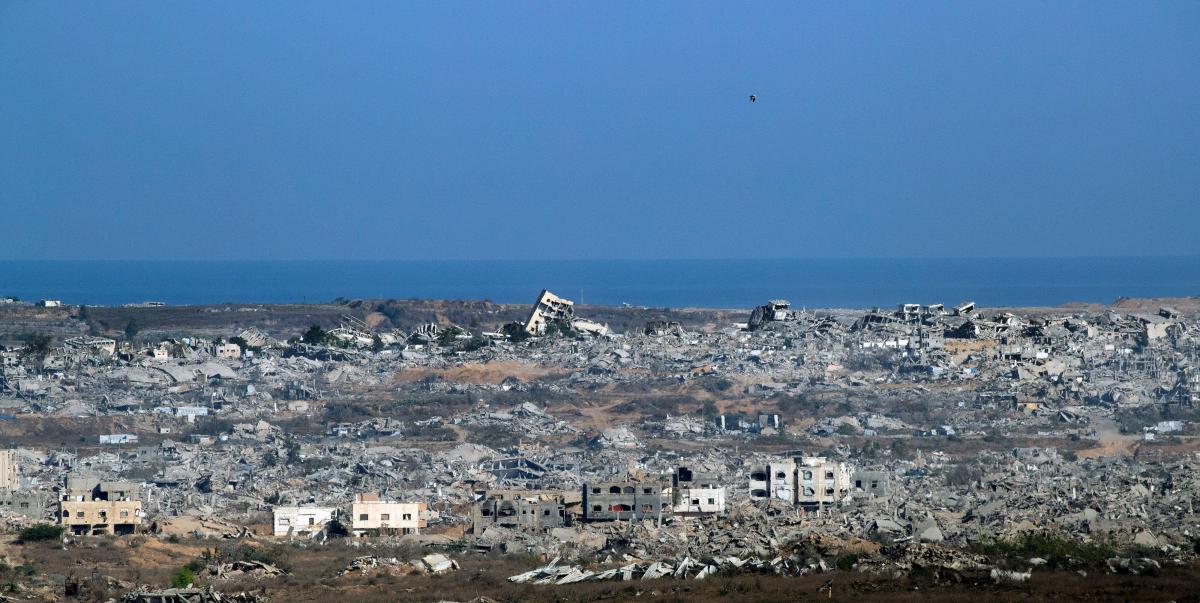
Beyond the unbearable loss of lives and the endless destruction of homes, another war is being waged in Gaza, one that’s quieter, but just as deadly. It’s a war against the land itself.
Fields once used to grow food have been burnt, wells and water pipes are poisoned, and the air is filled with smoke, dust, and toxins that lingers long after the bombs fall. What remains is not just rubble, but a landscape stripped of its ability to sustain life.
This destruction has a name: ecocide. It’s the deliberate killing of the environment, the tearing apart of the soil, the water, and the air that people depend on to survive.
In Gaza, ecocide means that even if the bombs were to stop tomorrow, families would still face hunger, thirst, and sickness because the very earth beneath them has been attacked.
Ecocide isn’t just a side effect of war, it’s used as a weapon, and its damage lasts long after the fighting ends, leaving the land and its people scarred for generations.
Water weaponised
UN experts expressed their concern about Israel’s water weaponisation:
Israel is using thirst as a weapon to kill Palestinians. Cutting off water and food is a silent but lethal bomb that kills mostly children and babies. The sight of infants dying in their mothers’ arms is unbearable. How can world leaders sleep while this suffering continues?
Water is at the heart of Gaza’s ecocide. Even before October 2023, access to clean water in Gaza has been systematically destroyed. Less than 3% of available water met safe standards before the war.
By mid-2024, 88% of Gaza’s water wells and all desalination plants had been destroyed or disabled. Reservoirs, pipelines, and pumping stations were deliberately stuck.
At least 1 million people in Gaza reported having less than six litres per person per day of water suitable for cooking and drinking. Before October 2023, the population in Gaza had access to the minimum recommended of 80-85 litres of water per person each day.
Children are queueing up for hours to fill a small jug, while hospitals report a surge in dehydration, diarrhoea, jaundice and water-borne diseases.
Between February and August 2024, a joint study by Newcastle University and the Palestinian Environmental NGOs Network uncovered alarming levels of contamination in Gaza’s soil and water. Their tests on landfill sites revealed both total and faecal coliform bacteria, clear evidence that untreated sewage and toxic runoff have seeped into the groundwater that people rely on.
A separate Water, Sanitation and Hygiene (WASH) survey painted an even grimmer picture: at least 87% of the population live within just ten metres of raw sewage or faecal waste. This daily exposure leaves communities facing not only grave health risks but also long-term damage to their already fragile environment.
The United Nations Environmental Programme (UNEP) has warned that Gaza’s coastal aquifer, the main source of groundwater, is on the brink of irreversible collapse. Salinisation and sewage infiltration have rendered much of the aquifer undrinkable, endangering not only human survival, but also agriculture. Water has been turned into a weapon of war.
For those who have endured relentless bombings, the suffering is made worse by a water crisis – many are forced to drink unsafe water, while others don’t have enough, said Paula Navarro, Medecins Sans Frontieres (MSF) water and sanitation coordinator.
Soil without life
More than 86% of Gaza’s agricultural land have been destroyed with only 1.5% accessible and not damaged.
Orchards of olive and citrus trees, tended by families for generations, have been bulldozed or burned. Irrigation wells have been bombed, leaving the soil either dry or poisoned.
For farmers, the devastation is not only material, but spiritual. For Palestinians, olive trees are passed down through generations, are a symbol of heritage, a connection to the land.
Scientists warn that contamination from white phosphorus, heavy metals, asbestos, and other hazardous materials have seeped into the soil, threatening future harvests and impacting food security.
UNEP reported that soil was significantly contaminated with total petroleum hydrocarbons (TPH) and aliphatic hydrocarbons, levels which surpassed the threshold requiring intervention.
A report in the American Journal of Public Health warns that crops grown in Gaza may carry harmful levels of toxicity for years, and possibly decades to come, raising deep concerns about the long-term safety of food supply and its impact on human health.
Air that kills
The air over Gaza is filled with toxins. Clouds of dust hang over neighbourhoods filled with asbestos, pulverised gas, and chemicals from explosives.
UNEP estimates that more than 39m tonnes of hazardous rubble fill the Strip. Breathing this dust carries risks of cancer, chronic illness that will impact survivors for decades to come.
Researchers have also measured the war’s invisible toll on the climate. In the first three months of the bombardment, greenhouse gas emissions exceeded the annual output of 26 countries, producing between 400,000 and 600,000 of CO2.
The study, led by Frederik Out-Larbi and colleagues, found that the first 60 days alone, 281,000 tonnes of CO2 were emitted, more than the yearly footprint of 20 nations.
Rebuilding Gaza, if it’s ever allowed, could itself generate more emissions than 135 entire countries produce in a year. This war has caused an environmental catastrophe with irreversible consequences to the region and beyond.
Debris, waste, sewage and disease
Waste has become another weapon. Bombing has destroyed 70% of sewage pumps and wastewater treatment plants. Untreated sewage now seeps into streets, farmland, and the sea.
Piles and piles of uncollected garbage attract disease-carrying insects. Medical waste, hazardous chemicals, and munition debris further poison the land, water, and the population of Gaza.
The result is an environmental and public health disaster. Outbreaks of diarrhoea 25 higher than before the war, a resurgence of polio, surging cases of scabies, lice, and respiratory infections. Disease, like hunger, is part of this environmental war.
Epidemics don’t respect borders and disease spreading from Gaza threatens the wider region and beyond.
The environmental catastrophe taking place in Gaza won’t disappear with a ceasefire. Aquifers poisoned with sewage can’t be stored overnight. Children will inhale asbestos fibres today may not show symptoms for decades. Fields covered with phosphorus may take generations to heal.
Ecocide as elimination
Human rights groups, environmental scientists, and UN agencies argue that Gaza’s environmental destruction isn’t a tragic accident.
Al Mezan Centre for Human Rights has documented how Israel’s military systematically targets environmental infrastructure: water pipelines, reservoirs, sewage plants. Their 2024 report calls it by its name: ecocide.
The logic is as cruel as it’s clear: destroy the environment and you destroy the conditions for life. Turn water into poison, farmland into ash, air into a weapon, and survival becomes impossible. International law recognises this.
The Genocide Convention lists the creation of living conditions intended to destroy an entire population as an act of genocide. In Gaza, ecocide and genocide are intertwined.
This is Gaza’s catastrophe, and unless named for what it truly is, a crime against the environment and humanity, it risks being forgotten beneath the rubble.

 YourVoiz