
Monica Piccinini
1 December 2025
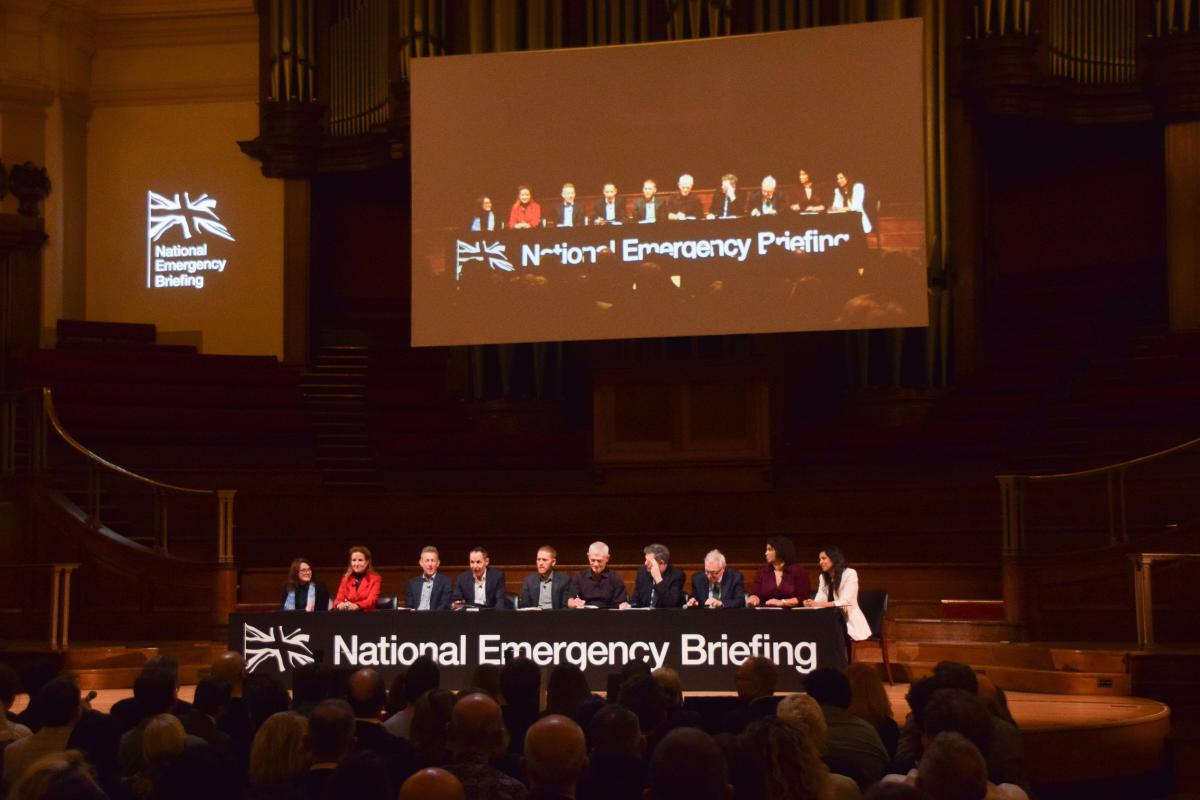
On 27 November, the National Emergency Briefing on Climate & Nature took place at Central Hall Westminster, bringing together leading experts from climate science, national security, energy, food systems, health, and the economy.
Their mission was to deliver a stark, science-led wake up call to politicians, business leaders, and the media of the accelerating threats facing the UK.
The message left the room in no doubt: Britain isn’t ready for what’s coming.
Naturalist and broadcaster Chris Packham opened the event with a stark warning:
This beautiful little blue planet is where we will either learn to live in harmony with the environment or we will destroy ourselves and much of other life, too.
He stressed that misinformation isn’t just corrupting public opinion – it’s corrupting policy:
A dangerous wave of misinformation and lies fills our lives. But worse, it fills the lives of our decision makers. And these are the people who shape policy.
His challenge to MPs was simple:
You must listen to the science because if you don’t, then things go wrong and lives are lost.
15,000 scientists have already warned that environmental breakdown is pushing societies toward “socio-economic collapse.”
Recent heatwaves, deadly floods and supply chain shocks, once treated rare events, are now early warnings of a destabilising global system.
Experts argue this demands a response on the scale of wartime mobilisation, coordinated across government, backed by clear public communication, and grounded in science, not politics.
The contradiction at the heart of UK energy policy
Several speakers highlighted a dangerous contradiction at the heart of UK policy: while climate risks intensify, Britain’s still building infrastructure as if the climate were stable and predictable.
Even as talk of a green transition grows louder, the country still relies heavily on fossil fuels at home and abroad.
Professor Mike Berners-Lee said the world has had more than three decades of warnings, yet emissions are still rising:
As we’ve just heard, it’s not surprising that the climate is coming to bite us after 30 COPs have failed to even reduce the rate at which we’re putting fossil fuel emissions into the atmosphere. It’s still going up year on year. It hasn’t even begun to come down.
Economist Angela Francis argued that markets currently reward polluting industries and punish those trying to change:
Net-zero and nature-positive solutions will not win in markets which take for granted a stable climate, clean air, fresh water, pollinators.
As Lt Gen Richard Nugee explained, decentralised clean energy delivers “more secure energy, more resilient infrastructure and a safer, more stable society.”
Despite the warning and proven alternatives, the UK still grants new fossil fuels licenses.
British energy decisions ripple far across the planet and eventually circle back to affect us here.
Take Brazil, now a hotspot for British oil ambitions. BP announced its biggest oil and gas find in the Santos Basin. Shell also continues to expand in Gato do Mato, a deep-water project in the pre-salt area, also in the Santos Basin. Thousands of miles away, these operations contribute to emissions the UK claims to be cutting.
Researchers at the Economic Statistics Centre of Excellence (ESCoE) show that much of the UK’s real carbon footprint is hidden in imported goods and financed industries abroad. We may cut emissions from our homes and power stations, but carbon generated on our behalf in other countries remains massive.
More than half of the emissions linked to daily UK consumption happen outside the UK. The clothes we wear, the food on our tables, and the fuel we pump from foreign soil all carry a hidden climate cost.
There’s no distinction between a tonne of carbon in Aberdeen or São Paulo. The warming it causes returns to us in the form of rising seas, harsher storms, droughts and climate extremes.
If Britain wants to lead, it must confront not only what its own emissions, but the consequences of its footprint overseas.
Food security
Food security featured heavily in the briefing. The Climate Change Committee warned that national planning on food resilience is “insufficient”, red-rated across key indicators.
Professor Paul Behrens warned:
I’m going to tell you about a threat that will affect everyone in this room, every family in this country, and every constituent – a threat for which we’re woefully unprepared. And I’m talking about the increasing pressure on global food supplies in the face of accelerating climate change and nature loss.
This is what happens when food systems fail. Empty supermarket shelves, people queuing for hours for food, protests, and civil unrests.
Britain depends on a food system that stretches across the globe, a system growing ever more fragile. It imports around 40-50% of its food. What we buy and eat here affects forests, farmers, and communities thousands of miles away. Shocks abroad return as higher prices, shortages, and climate-driven disruptions.
NGO Global Witness found that last year alone, UK demand for forest-risk commodities, including beef, soy, palm oil, cocoa, coffee and rubber, drove deforestation equivalent to the size of major British cities.
Laws like the Environment Act promised safeguards, but key measures have never been implemented. Supply chains linked to illegal deforestation continue largely unchecked, almost half arriving in the first six months of Labour’s new term.
The climate footprint of global agribusiness is staggering. Research by Foodrise shows the five largest meat and dairy companies (JBS, Marfrig, Tyson, Minerva and Cargill) emit more greenhouse gases than oil giants like Chevron, Shell or BP. Their methane alone exceeds the combined output of the UK and EU.
Rich countries like the UK consume the most meat and dairy, so the choices we make abroad end up driving the very climate disasters we face at home.
Food insecurity isn’t just about climate related. Global agribusiness is dominated by a handful of powerful corporations controlling seeds, fertilisers, livestock feed, and even crop genetics. This concentration weakens resilience, increases inequality, accelerates ecological destruction, and traps farmers into dependency.
Meanwhile, small-scale farmers, whether in Brazil or here at home, receive a fraction of the support (subsidies) industrial agriculture gets, despite producing most of the food consumed locally.
The UK can’t claim security while shifting risk onto others. Every import, every policy, every meal in Britain carries a global footprint. Food insecurity abroad returns as floods, fires, shortages, and soaring prices at home.
Behrens said:
We need a great food transformation built on four main pillars. Shifting to plant-rich diets, reducing food waste, improving production, and increasing climate resilience.
Health: how climate change is already hitting the UK
Climate change isn’t just a future threat; it’s already making people sick here. Rising heatwaves are taking lives now.
Professor Hugh Montgomery explained:
Without a functioning economy, without food supply available to us, we can’t run a health service. We can’t have health.
The climate emergency is a health emergency. And it’s about time we started treating these.
According to the UK Health Security Agency (UKHSA), 1,311 heat-related deaths occurred in England in 2024 alone. Without action, the NHS projects heat-related deaths could reach around 10,889 by 2050.
Warmer conditions are expanding the range of disease-carrying insects like ticks and mosquitoes. The UK’s HECC report warns that species such as Aedes albopictus, which can carry dengue, Zika, or chikungunya, could become more common here.
Climate-sensitive infections are rising. Changes in temperature and rainfall make food and water-borne illnesses more likely and alter how other pathogens spread.
At the same time, antimicrobial resistance (AMR), the “superbug” problem, is worsening. Heavy antibiotic use in global food systems, combined with climate impacts on sanitation, helps resistant bacteria thrive.
The impacts hit the most vulnerable hardest. Poorer communities are more exposed to heat, air pollution, and emerging infections, and less able to adapt.
The message is simple: cutting emissions, reforming food systems, and investing in resilient health services aren’t distant policies, they’re essential to protecting lives in the UK and globally.
The cost of delay
The economic reality is no softer. The latest Lancet Countdown report estimates that extreme heat wiped 639 billion working hours in 2024, more than a trillion dollars in lost income. Agriculture was hit hardest.
Behind those figures are real stories: farm workers forced out of the fields by midday heat, construction workers slowing down to avoid heat exhaustion, and entire shifts cut short because temperatures simply became too dangerous.
The report makes the case that it doesn’t have to be this way: investing in cleaner energy and building resilience into communities could protect both livelihoods and the people who depend on them.
Angela Francis highlights a striking economic truth: the faster we transition away from fossil fuels, the more money we save:
The Oxford Martin School and the Smith School have been looking at this in the context of the energy transition. They compared a fast, a slow, and no transition. And faster is cheaper.
The faster transition saves $12 trillion compared to staying on fossil fuels. That’s more than twice the saving of a slow transition.
National security: conflict & migration
Climate change is already driving global instability. Crop failures, food shortages and worsening weather are pushing some regions towards crisis.
As rising heat, drought and sea-level change make parts of the world unliveable, researchers now suggest that 20–25% of people in some areas may be forced to relocate, far more than earlier projections.
These pressures feed conflict, overwhelm border systems destabilise economies and, ultimately, pose direct security risks to Britain.
Senior UK military figures have warned repeatedly: climate change is no longer a distant or secondary issue. It’s a central threat shaping global security.
Lt Gen Richard Nugee highlighted the security risks of a warming planet:
Climate change can be thought of as a threat multiplier, making existing threats worse and more frequent and introducing new threats. Climate shocks fuel global instability.
People are forced to move within countries and across borders – that puts pressure on receiving regions, can stoke instability, and feeds into wider political tensions.
There’s risk of conflict over access, over resources, and of course, over shipping routes. So, the climate crisis is now shaping strategic and military competition.
But what concerns me most is not any single crisis. It’s crises cascading together. Multiple crises, food, health, infrastructure, migration, energy, extreme weather, etc., all hitting at the same time, eroding trust in government by slow or failed responses and reactionary politics claiming to be able to solve all these crises at once.
A briefing that demands action
Organisers stress that the event is non-partisan. Its purpose is to ensure MPs; business leaders and the media understand the scale of the emergency – and the pathways out of it.
Among the recommendations include establishing a permanent Climate COBRA, reviving public information campaigns and holding annual briefings to keep decision-makers accountable.
The experts insist that the solutions already exist. What’s missing is the courage to act quickly and decisively.
The warning from the briefing was unmistakable: delay isn’t neutral. Its costs are measured in lost harvests, rising instability, mounting deaths and a future made harsher with every year of inaction.
The briefing left one question hanging in the air, one now facing the country as a whole: if this isn’t the moment to mobilise, then what is?
Featured image: ZUMA Press, Inc./Alamy

 YourVoiz