
Monica Piccinini
19 January 2026
Polluted rivers, collapsing ecosystems and communities left to pick up the damage: Britain’s privatised water system has normalised environmental harm at home. Now the same model is being exported to Brazil, where its impacts could be even harder to undo.
In the UK, the sight of raw sewage pouring into rivers has become disturbingly familiar. What once caused outrage is now just background noise. Each year brings new data, new apologies from water companies, and new fines from regulators. Rivers remain polluted, wildlife declines, and communities are left to live with the consequences.
After more than three decades of water privatisation, the pattern is clear. Household bills keep rising, long-term investment has fallen, corporate debt has soared, and environmental damage has become routine. Regulation exists largely on paper, stepping in only after harm has already been done.
This matters because the UK’s failed water model is no longer contained within its borders. It’s now being exported to countries like Brazil. There, the damage risks being deeper, longer lasting and far harder to challenge and reverse.
Political
Brazil’s sanitation crisis is often blamed on geography or lack of development, but this is misleading, as it’s one of the most water-rich countries on Earth. The problem isn’t scarcity, but political decisions about who controls water and who it’s meant to serve.
Despite holding one of the world’s largest freshwater reserves, over 100 million Brazilians are without adequate sewage treatment.
Livi Gerbase, a researcher at the Centre for International Corporate Tax Accountability and Research (CICTAR) for Latin America and the Caribbean, frames access to water and sanitation as one of the clearest expressions of inequality in Brazil:
Access to water and sanitation is one of the strongest indicators of inequality in Brazil. Around 40 per cent of the population still lacks access to proper water and sanitation systems, particularly in rural areas and in the North and Northeast, where the most vulnerable communities live.
These failures fall disproportionally on poorer, racialised and rural communities, particularly in the North and Northeast of the country. This is environmental injustice, not technical failure.
These outcomes reflect political choices about ownership, financing and regulation, mirroring the path taken by the UK in the late 1980s, when water was removed from public control and redefined as a commercial service rather than shared resource.
Water as an asset
In 2020, Brazil passed the New Sanitation Legal Framework, promising near-universal of sanitation and water supply by 2033.
According to an analysis by CICTAR and the Union of Workers in Water, Sewage and Environment in the State of Bahia, SINDAE, this method was familiar: privatisation, private finance, and protections designed to reassure investors.
Municipalities in Brazil were encouraged to auction off water and sewage services through concessions lasting up to 35 years. Brazil’s national development bank, BNDES, plays a central role, structuring deals and absorbing risk. At least 67 new sanitation projects are now moving forward, many explicitly structured to attract international capital.
The financing model mirrors the UK’s post-1989 settlement. Infrastructure is no longer funded primarily through public investment, but through debt (borrowing).
In Brazil, the key instrument is incentivised debentures, tax-exempt bonds sold to investors, which resembles the bond-heavy structures used by British water companies after privatisation.
Gerbase describes how Brazil’s 2020 sanitation reforms accelerated privatisation and shifted financial risk onto the public:
After the 2020 sanitation reforms, privatisation accelerated and international investors moved in. Incentivised debentures became a key tool, allowing companies to raise large sums quickly while the real cost is carried out by the public, not by companies or local authorities.
Between 2017 and 2024, nearly R$ 40 billion (£5.5 billion) was raised through these instruments in Brazil’s sanitation sector. More than half of this money wasn’t used to improve infrastructure, but to pay concession fees for refinance debt. This closely reflects the UK experience, where borrowing has been used to sustain corporate balance sheets rather than upgrade deteriorating systems.
Gerbase stresses that the use of incentivised debentures is a political choice that could be reversed through regulatory change:
Every incentivised debenture must be approved by the government, and there are already rules defining which projects qualify for the tax benefit. Through an executive decree changing the regulation of the incentive, it’d be possible to stop public funds being used to subside privatisation rather than infrastructure.
BRK and Thames Water
A detailed investigation by CICTAR identifies the strongest parallel with the UK in the case of BRK Ambiental, Brazil’s largest sanitation operator, controlled by Canadian asset manager Brooksfield, a major player in Britain’s privatised infrastructure and a familiar presence in the UK water sector.
In Brazil, BRK operates in more than 100 municipalities and has rapidly expanded through debt-backed acquisitions. The company has raised over R$12 billion (£1.6 billion) in debt, generating substantial interest payments, while average tariffs increased by more than 70 per cent between 2017 and 2024, far above inflation levels.
Gerbase explains how financialised concession models limit real investment, leaving poorer communities with inadequate alternatives:
These populations aren’t completely without solutions, but alternatives like septic tanks are only accessible to people with the financial means to build them. When companies spend large sums on concession fees and debt, very little is left for expanding and improving infrastructure. That’s exactly what the BRK model shows.
For UK households served by Thames Water, this story is well known. Rising bills are paired with rising debt, while environmental performance worsens and promised improvements fail to arrive.
Thames Water serves roughly a quarter of the population. Since privatisation, household bills have risen by roughly 40 per cent in real terms, while investment has fallen by around 15 per cent. Leakage remains widespread and rivers are routinely polluted with untreated sewage.
Thames Water’s failures are not an isolated case. This month, South East Water left at least 30,000 households without running water for several days, exposing the fragility of a system shaped by fragmented ownership and financialisaton.
South East Water is jointly owned by an Australian infrastructure fund, a Canadian private equity firm and the NatWest pension fund, underscoring how essential services are increasingly run by distant investors with no real stake in places affected by failures.
Regulation
Despite environmental failures, Thames Water accumulated tens of billions of pounds in debt, much of it used to finance shareholder payouts.
In 2023, it was fined £122.7 million for environmental breaches and now survives through emergency regulatory intervention.
Brazil’s moving in the same direction, but with weaker regulatory institutions and deeper inequality.
CICTAR records that BRK subsidiaries have been fined nearly R$50 million (£6.9 million) for environmental violations, including sewage discharges and failure to deliver contracted works. Complaints over water quality, billing and service interruptions are widespread.
Gerbase argues that regulation in Brazil tends to intervene only after harm has already occurred, offering limited accountability during long concessions:
Regulation is not very effective. What usually happens is that problems escalate until fines and sanctions have already failed to change company behaviour. The biggest moment for accountability comes when a concession ends and the process starts again, because public scrutiny increases. But in BRK’s case, most concessions still have many years left to run.
As in the UK, regulation is slow and fragmented. Long term contracts limit public oversight, while political leaders are reluctant to challenge powerful private operators. Parliamentary inquiries in Brazilian states such as Tocantins have raised concerns about accountability, echoing debates long familiar in Britain.
Research evidence undermines the case for privatisation. A comparative study published in Frontiers in Water found that public sanitation providers in Brazil frequently outperform private ones on efficiency, service quality and equity, directly challenging claims that private ownership delivers better outcomes.
Exporting failure
This is fundamentally an environmental justice issue. The United Nations recognises access to water and sanitation as human rights, yet privatised systems allocate access according to profitability, not social need.
In both Brazil and the UK, the same communities pay the highest price. Poorer areas face higher bills, worse service and greater exposure to pollution.
Smaller municipalities in Brazil, like deprived areas in the UK, are less attractive to investors because returns are slower and risks higher.
Reports suggest that Brooksfield is preparing to sell BRK Ambiental, treating it as a mature asset. If the UK experience is any guide, the likely legacy will be a heavily indebted operator with limited capacity to invest, while communities remain locked in long term contracts they didn’t design.
For UK readers, the lesson is clear. Britain’s water crisis isn’t an exception, it’s a template. From the Thames to Brazil, the same financial logic produces the same results: polluted rivers, rising bills, weakened accountability and deepening inequality.
The UK is a major warning sign of how things can go wrong. Our research shows that Brazil is heading in the same direction, even if it has not fully collapsed yet, said Gerbase.
Environmental justice means rebuilding public control, prioritising ecological repair, and measuring success in clean rivers, public health and dignity, not investor returns and exit strategies.
Brazil’s being sold the same promises Britain heard more than 30 years ago. In the UK, the outcome is already visible in polluted rivers and failing infrastructure. That alone should make us deeply sceptical of treating water, anywhere, as just another asset.
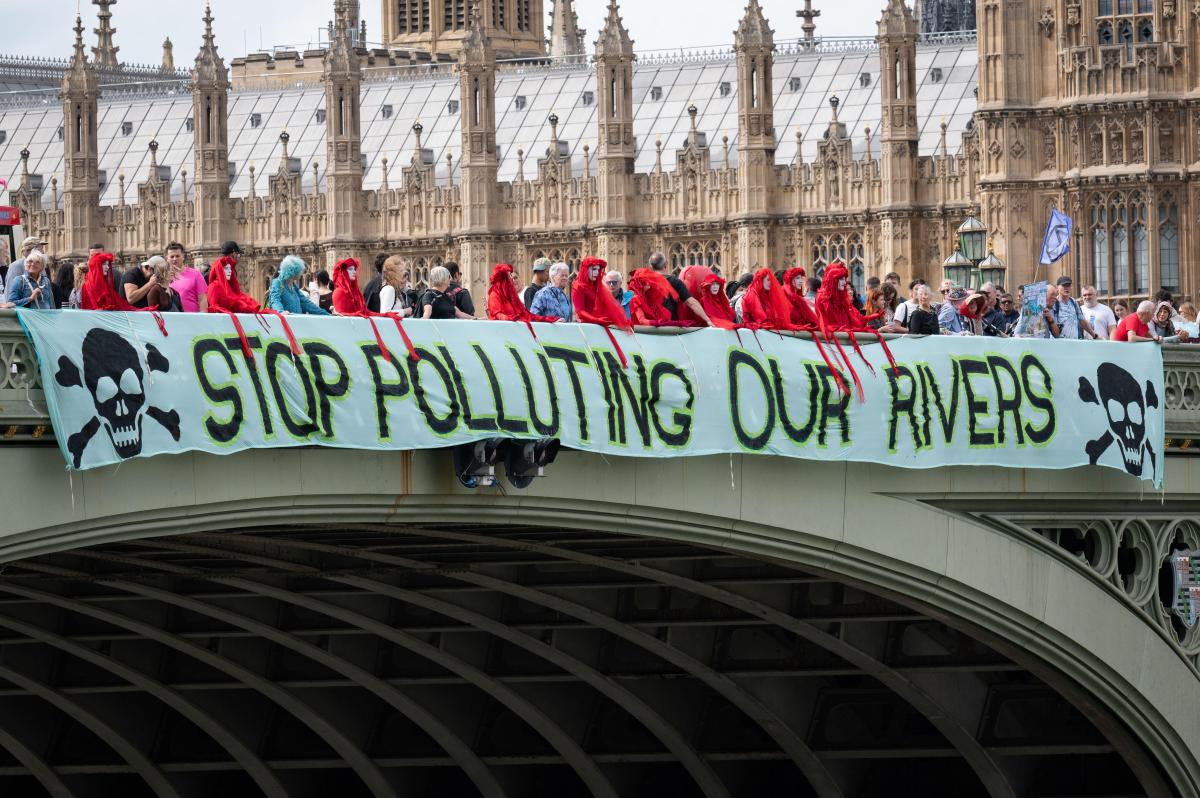
Featured image: London, UK. 30 August 2025. Environmental activists from Extinction Rebellion, accompanied by the Red Rebels mime troupe, drop a large banner demanding “Stop Polluting Our Rivers” from Westminster Bridge over the River Thames. According to the UK’s Environment Agency, raw sewage outflow into England’s rivers and seas doubled in 2023, with only 14% of rivers achieving “good” ecological status in 2025, while profits and dividend payouts of private water companies have soared. Credit: Ron Fassbender/Alamy Live News

 YourVoiz