
Monica Piccinini
18 March 2026
In Brazil, four women are killed by femicide every day. Behind the statistics lies a deeper crisis, where gender violence collides with racism, colonial legacies and territorial inequality, leaving Black, Indigenous and rural women at greater risk.
When Brazilian journalist Vanessa Ricarte was killed by her former fiancé, the case briefly dominated national attention. Ricarte was 42 years old, and according to police investigators, she had already endured abuse and periods of captivity before the murder. Friends later described a relationship that had grown increasingly controlling. The killing, devastating as it was, didn’t come out of nowhere.
Like many femicide cases in Brazil, the violence didn’t begin with the murder, it grew slowly, through intimidation, control and escalating abuse, long before it became fatal.
Across the country, this pattern repeats itself with unsettling frequency.
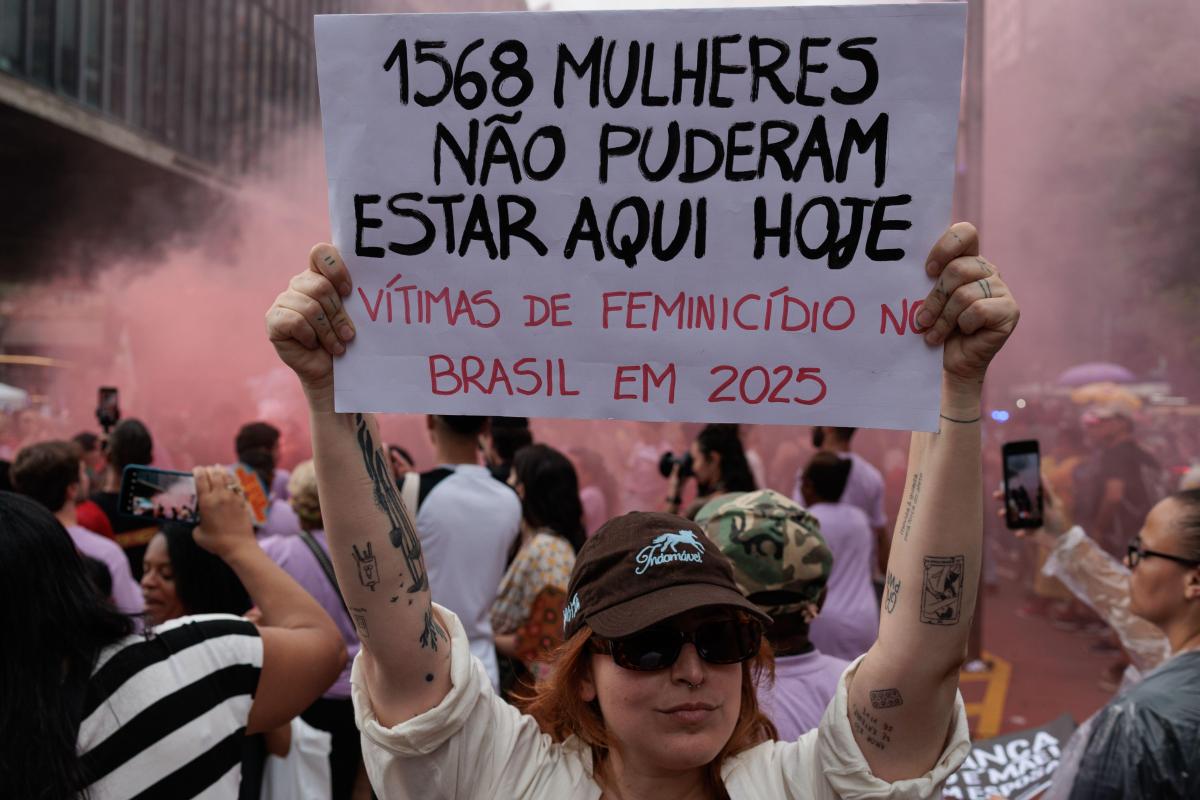
According to the Brazilian Forum of Public Security, 1,568 women were killed in femicides in Brazil in 2025. That means four women die every day. The number represents a 4.7 percent increase compared with the previous year, and it’s the highest number recorded since femicide was formally recognised a crime in Brazilian law in 2015.
Since the law came into force, at least 13,703 women have been killed simply because they were women. Over the past five years, the number of cases has risen by around 14.5%. Between 2021 and 2024, 97.3% of femicide cases were committed exclusively by men.
Numbers alone can’t explain what’s happening. In many cases, the violence builds slowly: intimidation, insults, coercion, isolation, and threats.
What begins as psychological control can escalate into physical aggression. By the time authorities become aware of the situation, the danger is often already severe.
Jesem Orellana, epidemiologist and researcher at the Oswaldo Cruz Foundation (Fiocruz), pointed to a critical gap between legislation and prevention. He said:
Brazil has a robust legal framework to protect women, including harsh penalties for femicide. Yet thousands of women have been killed in recent years. Despite strict laws, we’ve made little progress in effective prevention, especially in public health.
We do little in primary care and struggle to recognise and report different forms of violence against women. This leads to a lack of early or timely intervention to prevent femicide.
Outside Brazil, violence in the country is frequently associated with drug trafficking or organised crime. Femicide tells a different story. Most killings happen inside intimate relationships.
Data analysed by the Brazilian Forum of Public Security show that nearly 60 percent of victims are killed by a current partner, while around 21 percent are murdered by former partners. In other words, the person responsible is usually someone the victim once trusted, a partner, a husband or ex-partner.
The location of the crime reflects this reality.
In 66.3 percent of femicide cases, the killing takes place inside the victim’s own home. The weapons involved are rarely sophisticated. Knives and other sharp objects account for nearly half of all cases, while firearms are used in roughly a quarter.
Orellana’s research highlighted how warning signs are often visible long before the crime. He said:
Most femicides, especially those linked to domestic violence, are preceded by relationship or financial problems. Jealousy and a sense of ownership over women are common and should be treated as mental health issues. Financial dependence also plays a major role, many women are prevented from working, which increases their vulnerability to psychological and physical abuse, including attempted femicide.
He added that violence often intensifies when women try to leave:
It’s often in this context of extreme violence that women decide to end the relationship, and the cycle of threats and aggression escalates. Some obtain protective measures, but others are still killed, even if they are a minority, despite these protections.
The racial dimension of femicide
The statistics also reveal deep racial disparities.
According to the Brazilian Forum of Public Security, between 2021 and 2024, 62.6% of femicide victims were Black women, while 36.8% were white. Gender violence in the country can’t be separated from its long history of racial inequality and social exclusion.
Demographer Jackeline Ferreira Romio, interviewed by the independent outlet Outras Palavras, argues that femicide must be examined through intersection of race, gender and class. She said:
Femicide is a violence based on hatred.
When racism intersects with misogyny, the violence intensifies, leaving women who already face discrimination or poverty at much greater risk of lethal violence.
Look at where cases occur and the inequalities become clearer. Women living in peripheral urban neighbourhoods, rural regions or historically marginalised communities, often face the highest levels of violence while having the least access to institutional protection.
In that sense, femicide isn’t just a gender issue, it’s also a political and historical problem shaped by legacies of colonialism and structural inequality in Brazilian society.
Indigenous women and colonial violence
For Indigenous women, violence is often connected to longer histories of colonial dispossession and contemporary disputes over land.
Analysis by the platform Gênero e Número shows that reports of physical, psychological and sexual violence against Indigenous women more than tripled between 2014 and 2023. During the same period, sexual violence, often affecting girls, nearly quadrupled.
Between 2003 and 2022, violent deaths of Indigenous women increased by around 500 per cent.
Indigenous sociologist, Pagu Rodrigues, argues that this violence can’t be explained as part of Indigenous cultural traditions. Instead, it reflects centuries of colonial violence and patriarchy. She said:
Violence against women isn’t Indigenous culture, it’s part of a colonial process of violence, of patriarchy.
In many territories, violence is closely linked to conflicts over land and natural resources. Indigenous women often take leading roles in defending their communities and territories, which can place them in situations of heightened risk.
Rodrigues notes that sexual violence is sometimes used deliberately as intimidation. She explained:
Rape has been used as a strategy to demobilise Indigenous women leaders.
Where mining and large infrastructure projects, agribusiness expansion, and other extractive industries push into Indigenous lands, gender violence can become entangled with environmental and territorial conflict.
Geography and institutional absence
Where a woman lives in Brazil can influence whether meaningful protection is available.
Smaller municipalities with fewer than 100,000 residents record the highest femicide rates in the country, around 1.7 per 100,000 women, compared to the national average of 1.4.
Although only 41 percent of Brazilian women live in these towns, they account for roughly half of all femicides recorded nationwide.
Part of the explanation lies in the absence of specialised services. More than 70 percent of these municipalities lack women’s police stations, shelters or dedicated support centres.
Orellana stressed that territorial inequality directly increases lethal risk:
In municipalities with less state presence, whether in security, healthcare, the judiciary or social services, the chances of women being killed are even higher, because there’s no safe or timely support.
These women are often re-victimised by the state, which sometimes not only denies protection but blames them, revealing another face of structural machismo and patriarchy.
For women in rural areas, seeking help involve travelling long distances, or reporting to authorities who still domestic violence as a private matter rather than a crime. The gap between legal protection and everyday reality can be wide.
Laws fall short
Brazil is often recognised for having one of the most comprehensive legal frameworks in Latin America for addressing violence against women.
At its centre is the Maria da Penha Law, enacted in 2006, and marking its twentieth anniversary this year. The law remains the country’s main legal instrument for combating domestic and family violence. But the problem is no longer about creating new laws, but rather the ability to implement them effectively.
Orellana argued that the failure is systemic and requires coordinated action:
Femicide isn’t a problem that can be effectively tackled by a single sector. It requires coordinated action across social assistance, public health, the judiciary and public security.
We have not yet understood that prevention demands integrated, intersectoral responses and a cultural shift in how we recognise violence against women.
Evidence analysed by the Brazilian Forum of Public Security shows that in 13.1 percent of women killed in femicide cases had previously obtained court orders. The justice system had already recognised the risk, but the protection failed to prevent the killing.
Paula Bevilacqua, researcher at the Oswaldo Cruz Foundation (Fiocruz), said that violence itself is constantly changing.
Speaking at the Amazonian Seminar on Intelligence Surveillance of Femicide, she noted:
There will always be the fact that the data is outdated. There will always be a new violence recreated, invented or reinvented.
Some researchers believe prevention must begin earlier. The media can play a role by following reporting guidelines promoted by UN Women, avoiding narratives that implicitly justify violence or sensationalise victims.
Health professionals could also be better equipped to identify psychological abuse, which often appears long before physical violence. Earlier detection can make intervention possible.
A system that normalises violence
Some scholars argue that femicide persists not only because of individual perpetrators but because earlier forms of violence are frequently tolerated.
At the same seminar, Danúzia Rocha, a professor at the Federal University of Acre, described femicide as the final stage of a cycle of violence that repeatedly goes unchecked. She said:
Femicide happens because men have permission to kill. This death is legitimised.
Tolerance toward harassment, intimidation or physical aggression can allow violence to escalate over time.
Bevilacqua cited a controversial case in Belo Horizonte, the capital of the state of Minas Gerais, where a prosecutor released a man accused of repeatedly raping a 12-year-old girl, arguing that the acts had occurred “out of love” and with consent.
For Bevilacqua, cases like this illustrate how sexism and prejudice can still shape decisions within the justice system. When institutions fail to respond consistently, impunity becomes more likely.
The scale of the crisis
Even measuring femicide remains a challenge.
According to Fiocruz, Brazil still lacks a fully integrated national system capable of accurately recording these deaths. Information is often spread across police records, health systems and judicial databases, which can result in underreporting and inconsistencies in classification.
Violence itself is constantly evolving. Digital harassment and online threats increasingly form part of abusive relationships, creating additional challenges for institutions trying to monitor risk.
In response, Fiocruz has launched a national network of monitoring and prevention observatories known as Vigifeminicídio. Coordinated by Fiocruz Brasília, the initiative aims to bring together researchers, public authorities and civil society organisations to monitoring and prevention strategies.
Orellana, coordinator of Vigifeminicídio, explained how new monitoring tools could improve prevention:
We developed a fast, low-cost strategy to track and characterise killings of women, allowing us to gather comprehensive data within months, something official statistics fail to do due to underreporting. This is the main advantage of Vigifeminicídio: it enables near real-time monitoring of lethal violence patterns.
However, he warned that these tools are still underused politically:
With this data, we could act more effectively in prevention. But unfortunately, we are not allowed to advance in this direction, despite awareness within federal ministries. Violence against women is also frequently ignored in research funding calls, which reflects the powerful effects of structural machismo in Brazil.
Beyond statistics
Ultimately, femicide in Brazil can’t be understood through statistics alone. The killings reflect deep structural inequalities, shaped by colonial history, racial hierarchy, economic marginalisation and entrenched patriarchal norms.
Black women, Indigenous women, and those living in rural or marginalised territories remain the most exposed and the least protected. Their vulnerability isn’t accidental; it’s produced by systems that distribute safety and justice unevenly.
Addressing femicide requires more than criminal punishment, it requires long-term structural change, from education, to institutional reform and to stronger public policies, recognising violence long before it becomes fatal.
Until then, the country’s silent war on women continues, often unseen, unfolding behind the closed doors, in homes where the warning signs were once small enough to ignore.
Featured image: Demonstrators take part in a protest marking International Women’s Day on Paulista Avenue in central São Paulo, Brazil, on 8 March 2026. The mobilisation brings together feminist organisations and social movements protesting against femicide and gender-based violence in Brazil, while calling on authorities for stronger measures to protect women and ensure equal rights and justice for victims of violence. Credit: Vilmar Bannach/Alamy

 YourVoiz