
Monica Piccinini
8 June 2023
Our global food systems are highly complex and serve many constituent parts. It’s responsible for making available fresh produce throughout the year in countries and regions that historically have been very limited in their food produce. Viewed in a positive light, the systems serve the needs of many.
However, as the global food systems have evolved over time, it has increasingly been focused on monetary gain for corporate stakeholders and less about serving the needs of the global populous.
The increasing focus on economic gain from the global food systems can be evidenced as a cause of wide scale sickness, hunger, poverty, sickness, homelessness, poisoning of our land, water, air, plants, animals, our bodies and minds.
The food industry is considered as a major drive of climate change, responsible for one third of world GHG emissions (IPCC 2019), land-use change and biodiversity loss (40% of earth’s surface), major user of freshwater resources (70% of global freshwater) and a major polluter of terrestrial aquatic systems through the use of chemicals.
During the Extinction or Regeneration Conference 2023 in London, Philip Lymbery, global CEO of Compassion in World Farming, highlighted the fact that we rely more and more on a small number of countries for the production of major crops on which we depend on. When certain world events occur, such as conflicts and the Covid-19 pandemic, and global supply chains are disrupted, the entire food system is impacted.

The countries we rely on, mainly in the global south, are forced to invest in “cash crops” for exports, not producing enough to feed their own population. They produce raw materials that we then process and sell it back to them in the form of finished food products, mainly as a result of their huge debt, explained Lymbery.
Food security is another issue, as we have witnessed in recent years a record high in food prices, global hunger and social inequities that result from the industrial farming systems, not just from conflicts and climate change. We are producing enough food to feed the entire world, but what we’ve seen is a mismatch between supply and demand, a financialisation of agriculture systems and markets, as well as an increase in power concentration.
Lymbery said, “These companies are taking our food systems hostage for their thirst for profits.”
“Food systems are often shaped by politics, rather than policies”, he added.
Our food systems are also impacting our health and making us sick. According to Marco Springmann, senior researcher in environment and health at the Environmental Change Institute at University of Oxford, the cost of treating diet-related diseases is projected to exceed USD 1 trillion by 2030, also putting a strain on health systems around the world.
“Food that brings you sickness and disease is not food, it’s poison”, said Dr. Vandana Shiva, Indian environmentalist, physicist and author, during one of her speeches at the Extinction or Regeneration Conference 2023 in London.

Power Concentration
We are experiencing growing concentration in our food systems, as the number of corporations controlling everything, from inputs up through retail are getting smaller.
According to Jennifer Clapp, Canada research chair & professor, School of Environment, Resources and Sustainability at University of Waterloo, and IPES Food “Who’s Tipping the Scales” report, only top six agrochemical companies control 78% of the global market, the top six animal pharmaceuticals control 72%, the top six farm machinery control 50%, the top six seeds companies control 58% and the top five global grain traders control between 70-90%.
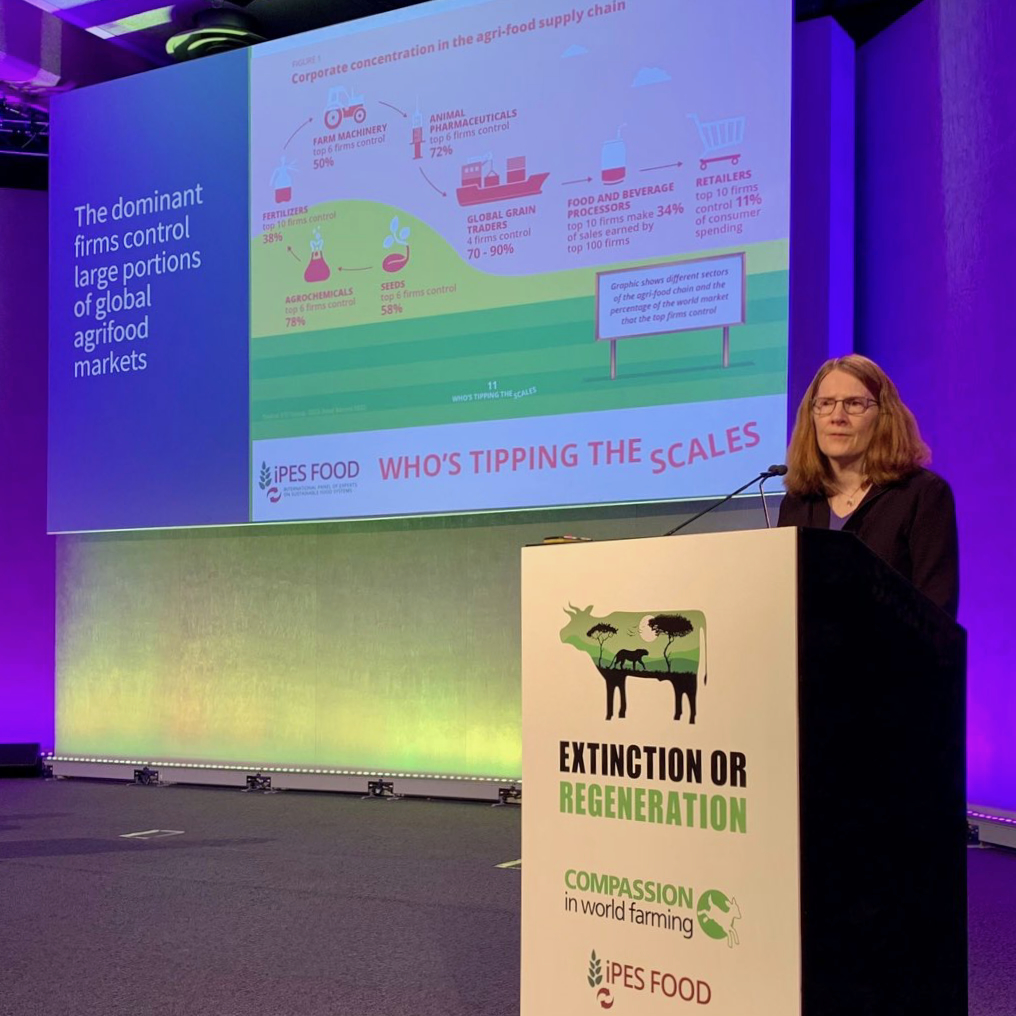
Four major grain traders control approximately 80% of the trade in cereals worldwide, the ABCD firms, ADM (Archer-Daniels-Midland), Bunge, Cargill and Dreyfus; and four major food processing and packaging companies dominate the global market, Nestle, PepsiCo, Anheuser-Bush InBev and JBS.
Since 2015, we’ve seen mega mergers in the seeds and agrochemicals industry, making these corporations even more dominant and powerful. Some of the mergers include Bayer and Monsanto, ChemChina and Syngenta, Dow and Dupont merged to form Corteva, Agrium and Potash Corp merged to form Nutrien.
Olivier De Schutter, UN Special Rapporteur on extreme poverty and human rights and co-chair of IPES-Food, mentioned that giant dominant food corporations acquired the position in decision making to veto any transformative change.
According to him, “it’s not because of corruption of politicians or the finance lobbyists working on their behalf, it’s because they are the champions of economic gain of large scale production that global commodities markets demand.”
“This allows these corporations to say to politicians, “trust us”, we know how to produce food for mass consumption, … if you impose too strong regulations on us, you’ll be faced with higher prices that your voters will have to face. This is what allows them to have a privileged access to politicians”, he added.
He explained that these companies manage to get protection from legislators for intellectual property rights for the new “breeds” that they develop, as well as the new technologies that they promote. Additionally, they can very easily challenge environmental regulations. The State ends up in the hands of these economic actors and ends up working for them.
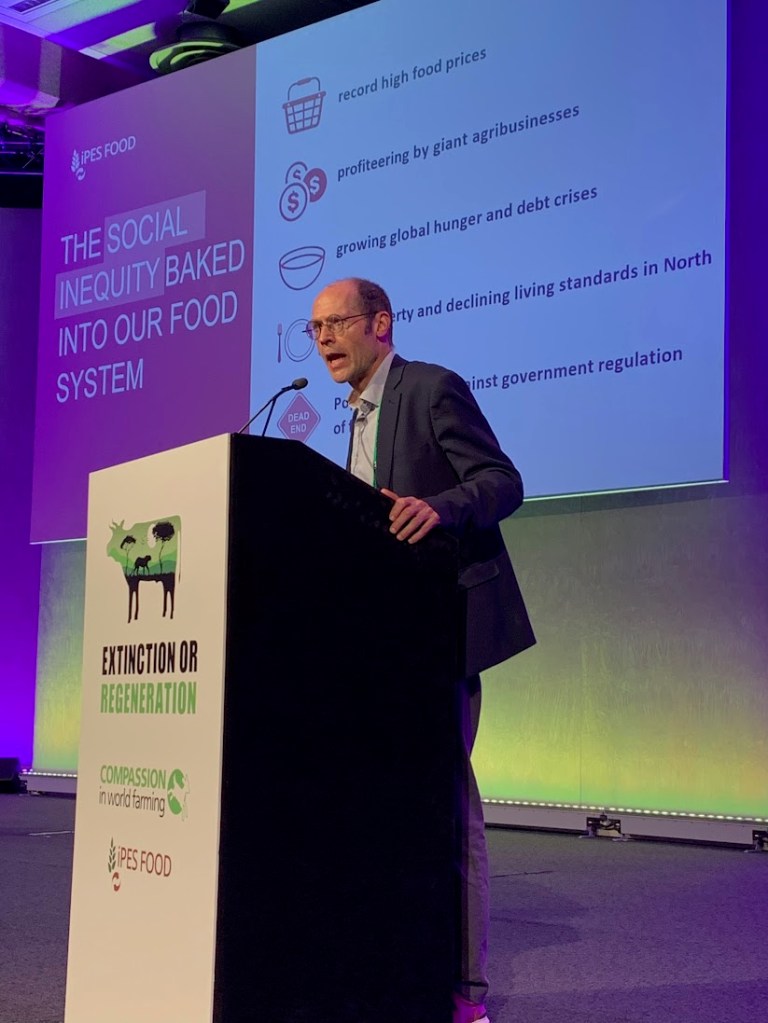
These corporations also control the labour conditions of the food system worker, the products that end up in the supermarkets shelves, and have the power to shape government policies. Small-scale producers don’t stand a chance when faced with such powerful competition.
In order to democratise our food systems, we need to increase transparency and accountability.
It’s necessary to set up a worldwide robust anti-trust and competition legislation and food policy, as well as creating a lobby register, which is already in place in some countries, in order to limit the concentration of power of the big agrifood corporations
We should be listening to farmers and working with them to identify solutions that will not only be beneficial to them, but also to our health and the environment, instead of filling the pockets of greedy corporations.
“We also need more public support for alternative food systems, in particular, research and development money going towards agroecology and organic agriculture”, mentioned Clapp.
She added that it’s now necessary for the State to step back in like they did in the past, when they played a prominent role during the last transition to industrial agriculture with R&D and hybridisation in fertilisers and other sectors.
There’s a need control those actors that have the power to shape our policy spaces, including measures that prevent conflicts of interests, where corporate officials end up as regulators and go back to work in the corporate sector.
Lastly, there’s the need to create an autonomous space for civil society to determine and control the rules and governance they’d like to see happen.
It’s a Profitable & Greedy Business

According to Planet Tracker, a non-profit think tank, nearly USD 9 trillion of private finance is currently supporting the global food system.
“Financial regulations have become weakened to the extent that they’ve allowed big financial institutions like banks and investment houses to create new financial products for investors to speculate on food commodities”, explained Jennifer Clapp during the Extinction or Regeneration Conference 2023.
The price of commodities can swing much higher or lower than supply and demand would normally indicate and this creates price volatility, consequently generating profit for these institutions.
“There’s another aspect of financial concentration, where asset management firms own huge portions of the global food systems. The ABCD firms, ADM, Bunge, Cargill and Dreyfus, make huge windfall profits when food commodity prices swing. We saw this happening in 2008, and once again, in 2022, when Russian invaded Ukraine”, added Clapp.
Asset management firms, Blackrock, Vanguard, State Street and Capital Group, manage people’s pensions, trillions of assets worth over USD 20 trillion in the global economy. They are buying shares in almost all the companies across the entire agrifood supply chain, which means they have a shared interest in those companies being profitable, therefore creating an incentive for collusion.
Clapp mentioned that economists are concerned about this issue, which is called common ownership, leading to a reduction in competition, as well as leading to higher prices and encouragement of mergers and acquisitions, creating even bigger companies.
The danger of this situation is the fact that it allows them to hold more power to shift food systems in a certain direction, enabling them to shape markets in a way that it can affect prices that consumers pay. Prices are kept low for the agriculture and livestock producers and high for consumers. They also have the power to determine what technologies are going to dominate the market.
Clapp proposed a few solutions to some of these problems, including stronger rules in the financial markets, rules to curb speculation, better reporting, better limits on financial actors in these markets, as well as rules limiting asset managers owning the entire scope of the food systems.
Health Hazards, New Pandemics & Antimicrobial Resistance

Industrial animal production may be a driver of future pandemics. The confinement of high number of animal in small spaces, leave them much more susceptible to viruses and infections, with the potential to evolve into more infectious types, explained Melissa Leach, social anthropologist and geographer, director of the Institute of Development Studies, IDS, during the Extinction or Rebellion Conference 2023.
All recent infectious diseases outbreaks and pandemics are zoonotic, as they originate in animals. Wildlife domestic and farmed animals and humans all interact in intense interfaces where spillover can occur.
The World Health Organisation, WHO, describes antimicrobial resistance, AMR, as the overlooked pandemic. It contributes to treatment failures, increasing human vulnerability to a wide range of infections.
Some of the latest figures suggest that AMR will cause 10 million deaths by the year 2050, more than from cancer, diabetes and pneumococcal diseases combined.
“Key causes of AMR are the overuse of antibiotics in livestock to promote growth and routinely prevent diseases, especially in intensified livestock farming”, mentioned Leach.
A study published by The Lancet, Global Burden of Bacterial Antimicrobial Resistance in 2019, estimates that there were 1.27 million deaths globally due to AMR in 2019, and 4.96 million deaths associated with AMR, compared with 6.9 million deaths globally from Covid-19 since the beginning of the pandemic in 2020.
According to Cóilín Nunan, scientific adviser to the Alliance to Save Our Antibiotics, certain types of antibiotics used in animal farming have led to the rise and spread of livestock associated strains of MRSA and clostidrium difficile.
There’s also the resistance to colistin, used as a last resort antibiotic in human medicine for treating life-threatening infections on patients who don’t respond well to other antibiotics, added Nunan.
Scientists from Oxford University released a study showing Escherichia coli bacteria that acquired resistance to colistin in animal farming. According to Nunan, this is an issue of concern and may be more dangerous than AMR, as it may be more able to cause infections in humans.
In Europe, over 60% of antibiotics are used in farmed animals, rather than in medicine. Globally, the figure rises to nearly 70%.

The health impact caused by our food systems is putting a real strain on health systems around the world. There’s been a rise in conditions, including type 2 diabetes, obesity, depression, cardiovascular diseases and certain types of gastro-intestinal cancer, amongst others, all related to our diets.
We can no longer deny the urgent need to embrace more sustainable food systems solutions, support and listen to our farmers, respect and protect Indigenous peoples, our land and the environment, which we are highly dependent on.
The concentration of power within our food systems should be limited and a new model replaced instead, to ensure there’s fairness and equality, access to healthy and nutritious food for everyone, everywhere, and that our health and the health of our planet is protected and respected.



 YourVoiz