The reconstruction of Amazon’s BR-319 highway in Brazil, connecting the capital Manaus in central Amazonia to the southern edge of the forest, Porto Velho, is an ambitious and controversial infrastructure project, supported by many politicians and organisations, and a possible catalyst to further social and environmental degradation in the region.
The BR-319 highway project could result in increased illegal logging, violence, violations of indigenous rights, and catastrophic consequences to local communities and the environment, including irreversible deforestation, warn scientists.
Officially inaugurated in March 1976 during the era of the military dictatorship led by General Ernesto Geisel, BR-319 fell into a state of disrepair by 1980. In 2015, during Dilma Roussef’s administration, a proposal to revitalize BR-319 was put forth.
BR-319 highway, linking Manaus, Amazonas, to Porto Velho, Rondônia. Image: Google Maps
BR-319 highway, a stretch of 885.9 km, serves as an unguarded gateway to illicit side roads in areas with a high density of indigenous territories, legally designated reserves, and protected conservation areas. This accessibility grants illegal miners, loggers, settlers, and land invaders entry into untouched forest.
According to a study by scientists, Lucas Ferrante and Philip Fearnside, the reconstruction of BR-319 and the building of planned connecting roads would act as spearheads for deforestation and forest degradation in the western portion of the Brazilian Amazon.
“BR-319 highway cuts through one of the most preserved blocks of the forest, where it contains an enormous stock of carbon. This project is a threat to 63 indigenous lands and 18,000 indigenous people, not to mention the environment and biodiversity”, mentioned Ferrante.
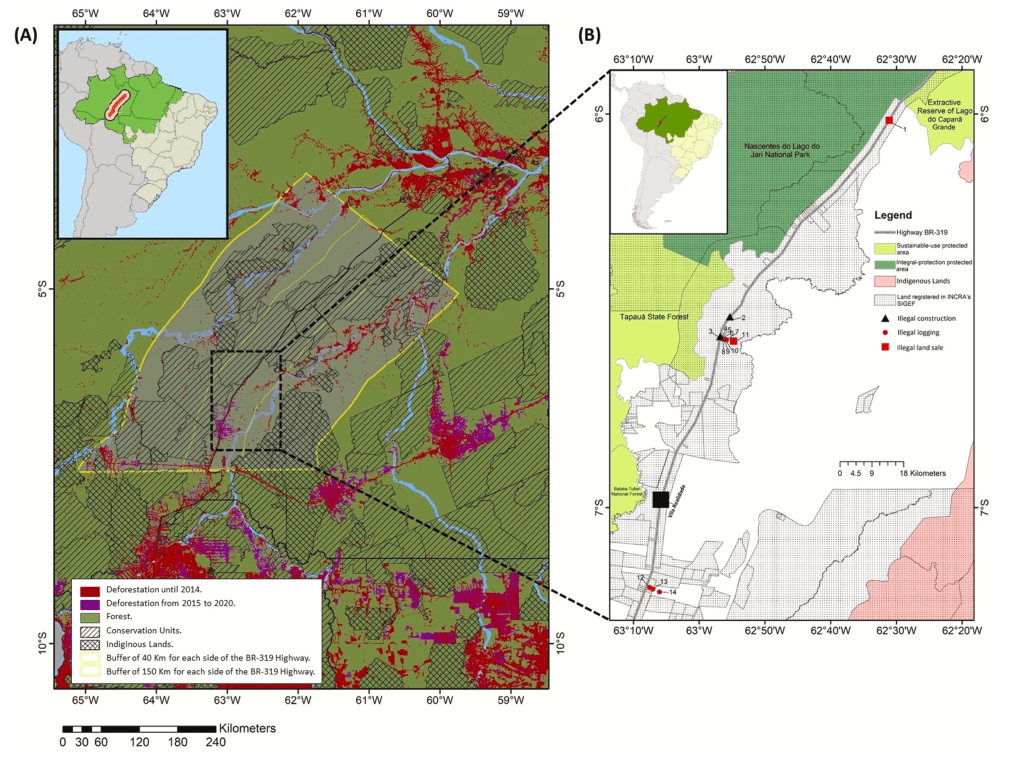
(A) Deforestation along BR-319 highway from 1988 to 2020 (PRODES data). Deforestation in red represents cumulative deforestation from 1988 to 2014 before the highway “maintenance” program began. Deforestation in purple represents cumulative deforestation from 2015 to 2020 (i.e., during the “maintenance” program). (B) Points with land grabbing, illegal logging, illegal mineral prospecting and illegal land sales observed on BR-319 highway. The inset map of South America shows Brazil’s “Amazon Biome” region in green, Highway BR319 as a black line, and the area of the larger map as a red rectangle. Image provided by researcher Lucas Ferrante.
In the Brazilian Amazon, a staggering 94% of deforestation happened in the vicinity of both official and native roads, vividly illustrating how highways are significant catalysts of deforestation.
A study by Ferrante and Fearnside suggests that BR-319 and its proposed planned side-roads will lead to a deforestation surge of over 1,200% in the region spanning from the highway to Brazil’s border with Peru, primarily in the central Amazon.
The Amazon rainforest plays a vital role in the regional and global climate system, acting as a carbon reservoir, aids in the dispersion of trace gases and aerosols, and is a crucial part of the water cycle. Its contribution of moisture to other regions is instrumental for maintaining hydrological stability on both regional and global scales.
Justifications
The primary justifications presented by the current government for repaving BR-319 highway involve improving access to healthcare and education in the region, in addition to addressing national security concerns.
“The highway actually increases disparities in public health, which also demystifies the justification for bringing healthcare to municipalities,” explained Ferrante.
According to Ferrante and Fearnside, the road is not a priority for “national security” because it is far from Brazil’s borders. This information was announced in 2012 by the Brazilian Army’s commander for Amazonia and not mentioned anywhere in the Brazilian military’s 2008 National Strategy for Defense.
While scientists have issued warnings about the potential adverse outcomes this project could have on the region, Brazil’s president, Luiz Inácio Lula da Silva, continues to view it as a top priority.
In June 2022, prior to his presidential election, Lula emphasised the significance of the highway for the economies of both Amazonas and Rondônia.
Last month, Brazil’s transport minister, Renan Filho, went as far as proposing the utilisation of the ‘Fundo Amazonia’ to finance the reconstruction of BR-319, which he dubbed as “the most environmentally friendly roadway on the planet.”
Scientists Expose Negative Impact
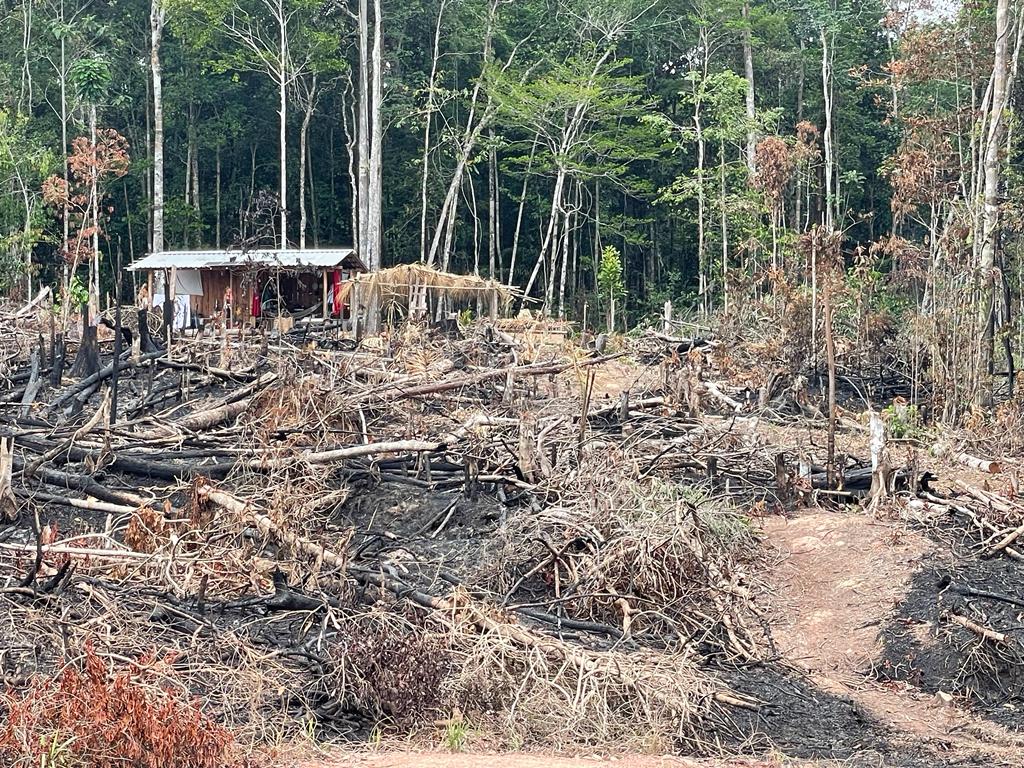
Unpaved illegal side road branching off BR-319. Photograph: The Mura Indigenous People
The potential consequences of reconstructing the BR-319 highway, including the risk of deforestation, could affect an area exceeding 300,000 square km within the Amazon, surpassing the size of São Paulo state, according to the result of a study conducted jointly by the CPI (Climate Policy Initiative)/PUC-Rio and the Amazônia 2030 project.
The researchers concluded that BR-319 highway’s impact is anticipated to affect a population of approximately 320,000 individuals in nine municipalities. Within the area of influence of BR-319 are also 49 indigenous territories, 49 conservation zones, and 140,000 square kilometers of publicly owned forests without designated purposes.
In his latest study, Fearnside revealed that by 2100, the reconstruction of BR-319 highway would increase deforestation not only around the highway, but also in the regions with roads directly connected to BR-319, by a staggering 60% in relation to deforestation in the projected scenario without reconstruction.
Amazonas road network connecting to BR-319 includes federal highways BR-174, BR-230, BR-174 and state highways AM-254 and AM-354.
There are additional planned projects to build highways connecting to BR-319, including AM-366, AM-360, AM-343 and AM-356. Some of these highways will reach one the most preserved areas in the Amazon, known as the “Trans-Purus” region.
The BR-319 highway reconstruction project is deficient in two essential aspects mandated by the law: firstly, it lacks an economic feasibility study, known as the EVTEA, as stipulated by Law 5917/1973. Secondly, it has failed to conduct the necessary consultations with indigenous communities, as required both by International Labour Organisation (ILO) Convention 169 and Brazilian law 10,088/2019.
“The deforestation occurring along the central stretch of the BR-319 highway has resulted in a rise in malaria cases by 400%. This serves as an indicator, underscoring the potential for environmental degradation driven by the BR-319 highway to contribute to the emergence of a new pandemic.”
The reopening of this highway would also enable agribusiness expansion into new territories, including activities such as cattle farming, soybean and palm oil cultivation, the expansion of monoculture for large-scale biofuel production, as well as meeting the needs of fossil fuel companies, hydroelectric dams, mining operations, and other industries.
Unpaved illegal side road and improvised bridge, branching off BR-319. Photograph: The Mura Indigenous People
Ferrante calls attention to the latest attempt in dismantling Brazil’s environmental agenda and how it may affect the area surrounding BR-319 highway:
“The recent changes made by the National Congress during Lula’s administration, which involved the reduction of environmental protection laws and the relocation of CAR (Brazil’s National Environmental Registry of Rural Properties) from the environment ministry, could lead to a further surge in deforestation within the BR-319 highway area. This initiative lacks the essential governance and environmental and economic viability required for the project.”
Ferrante delivers a final message to Lula’s government:
“Lula’s administration has consistently lacked a positive environmental track record and has more recently indicated its backing for the BR-319 highway reconstruction initiative. It is essential that the government reevaluates this unviable project and takes into consideration the advice of experts and the findings of scientific research.”
According to two prominent scientists, Lucas Ferrante and Philip Fearnside, and the result of their studies, the ambitious reconstruction of the BR-319 highway, linking the capital Manaus in central Amazonia to the southern edge of the forest, Porto Velho, might be a catalyst to rampant deforestation with irreversible and catastrophic consequences to the rainforest.
BR-319, a stretch of 830 km, connecting the ‘arc of deforestation’, was inaugurated in March 1976, during the military dictatorship, under the government of General Ernesto Geisel, and abandoned in 1988. In 2015, Dilma Roussef’s government proposed reopening BR-319.
“The BR-319 highway cuts through one of the most preserved blocks of the forest, where it contains an enormous stock of carbon. This project is a threat to 63 indigenous lands and 18,000 indigenous people, not to mention the environment and biodiversity”, mentioned Lucas Ferrante, environmental scientist.
Brazilian Amazonia and Highway BR-319 (Manaus-Porto Velho). Source: map produced by scientist Lucas Ferrante in the ArcGIS software, deforestation data from INPE 2021.
Despite the warnings from scientists about the negative consequences this project may bring to the region, it’s considered a priority for Brazil’s new president, Luiz Inácio Lula da Silva. During an interview with a radio station in Manaus last September, he mentioned:
“We do not want to transform the state of Amazonas into a sanctuary for humanity. Millions of people live in the state of Amazonas. We have to give these people the right to civility, the right to live well, the right to come and go. It is entirely possible for you to work the climate issue correctly, work the environmental issue correctly and provide the necessary security so that you can build good roads that can connect the state of Amazonas with the rest of the country.”
However, according to Lucas Ferrante, the newly elected president of Brazil, Luiz Inácio Lula da Silva, only replicates a political boast that it is possible to establish territorial governance.
“We need to make some things clear, this is just political rhetoric, a bravado that does not consolidate. According to a study we published at Land Use Policy, the BR-319 highway area had a deforestation rate of up to 2.6 times higher than the deforestation rates observed in other parts of the Amazon, i.e., the state of Amazonas is no longer a isolated sanctuary, yet another area increasingly occupied by criminal organisations that encourage land grabbing and deforestation”, argues Ferrante.
“In addition, people have always had the right to come and go by other modes of transport, but they do not have the right to collapse one of the most biodiverse blocks of the rainforest, which is home to a wide variety of native peoples and which consequently, if deforested, could collapse the global climate,” added Ferrante.
Scientific Studies Raising Red Flags
Lucas Ferrante, environmental scientist, and Philip Fearnside, a biologist at Brazil’s National Institute of Amazonian Research (INPA) and Nobel Peace Prize winner for climate research (2007), both published various scientific studies highlighting the negative effects of this project on the Amazon rainforest.
The highway is a free path to illegal side roads in areas of large concentration of indigenous land, legal reserves and conservation units, giving illegal miners, loggers, squatters and land grabbers access to untouched forest and public lands.
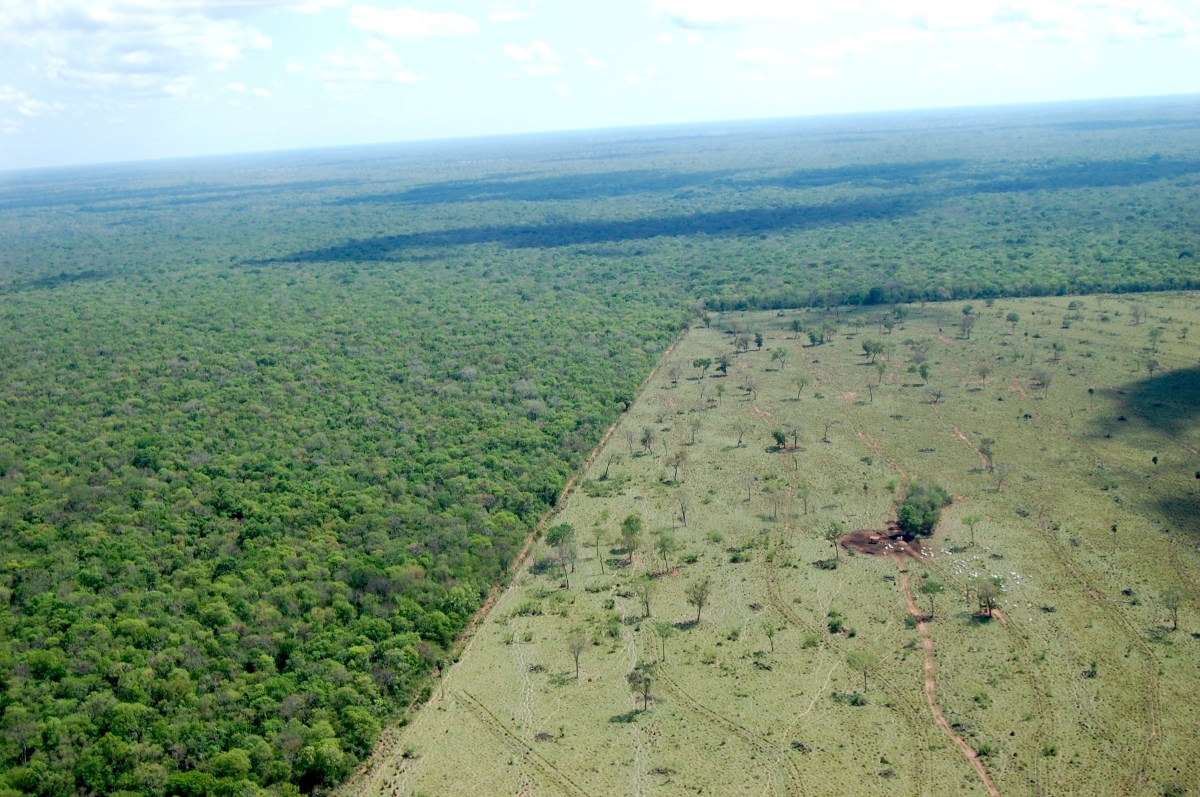
Illegal timber seized by IBAMA agents along the BR-319 highway. Photo by scientist Lucas Ferrante.
As a consequence, these invaders are bringing a wave of destruction, instability, pollution, violence, disease, decay and death to the traditional communities, indigenous people and the environment around them.
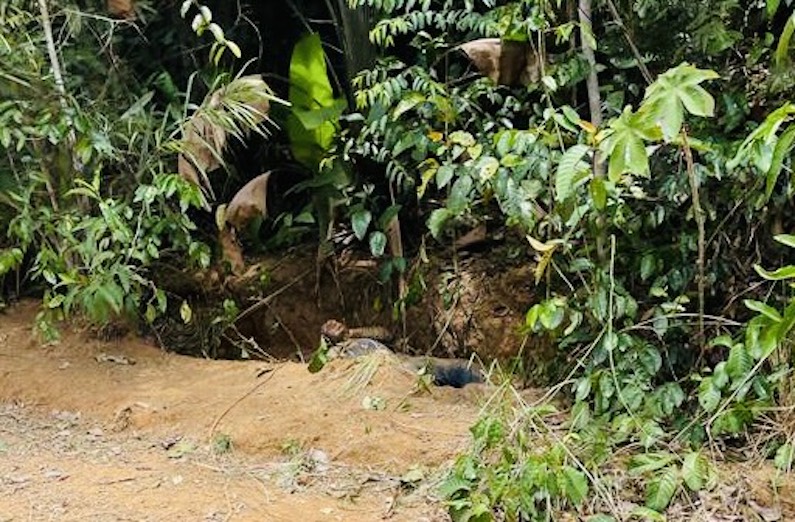
In October 2021, a Washington Post journalist, Terrence McCoy and scientist Lucas Ferrante, set themselves on a journey across the length of BR-319 highway, showing the path of destruction and devastation caused by illegal deforestation, land grabbing, mining, fires, violence and even killings. The burnt body of a dead man was found along the way after he had reported land-grabbing activities in the area to the federal police.
Photo of a burnt dead body around BR-319. Photo by scientist Lucas Ferrante.
In 2017, buildings belonging to IBAMA (Institute for the Environment and Renewable Natural Resources) and the Chico Mendes Institute for Biodiversity Conservation (ICMBio) in Humaitá were set on fire by miners and remain inoperative.
It is estimated that BR-319 and planned side roads will generate an increase of the deforested area by more than 1,200% between the highway and Brazil’s border with Peru. This projection relates to central Amazon alone, if extended to Peru, the numbers would increase significantly.
According to a scientific article published in the journal Land Use Policy by both Ferrante and Fearnside, despite environmental legislation requiring an environmental impact assessment (EIA) for one of the stretches of the highway, the project was given the green light from a judge, who authorised it without an EIA.
Additionally, the reconstruction of the highway lacks an economic viability study, EVTEA, required by law 5917/1973, as well as consultation with indigenous people required by International Labour Organisation (ILO) Convention 169 and by Brazilian law 10,088/2019.
The main transport route used in the region has always been via the Madeira River, making it a cheaper, cleaner and safer way to transport goods.
Fernanda Meirelles, executive secretary of the BR-319 Observatory, commented during our interview earlier this month:
“The LP, Preliminary License, was issued without consultations with the indigenous people and traditional communities, an important stage of the process that was not respected. We do not know whether consultations will be carried out in this current government or whether an intervention by the MPF (Federal Public Ministry) will be necessary to fullfil the obligation of consultation”,
“Public hearings were held during the pandemic, but in an inadequate way. There was no logistical support to guarantee the presence of traditional communities and indigenous people, in additional to having been held at a very inhospitable moment for any time of contrary opinion or manifestation. We even witnessed attacks suffered by researcher and scientist, Phillip Fearnside, during these public hearings”, added Meirelles.
According to data released by SEEG, the Greenhouse Gas Emissions Estimation System, between 2018 and 2019, the municipalities surrounding BR-319 highway had a staggering 16% increase in greenhouse gas emissions from land use and agriculture.
The reopening of this highway would also give agribusiness access to more land for expansion, including cattle farming, soy and palm oil plantations, monoculture expansion for large-scale biofuel production, as well as fossil fuel companies, hydroelectric dams, mining, etc.
As various studies indicate, including the ones published at Land Use Policy, and Environmental Conservation, these practices are already happening with the maintenance works of the road and would increase exponentially with the reconstruction of the BR-319 highway.
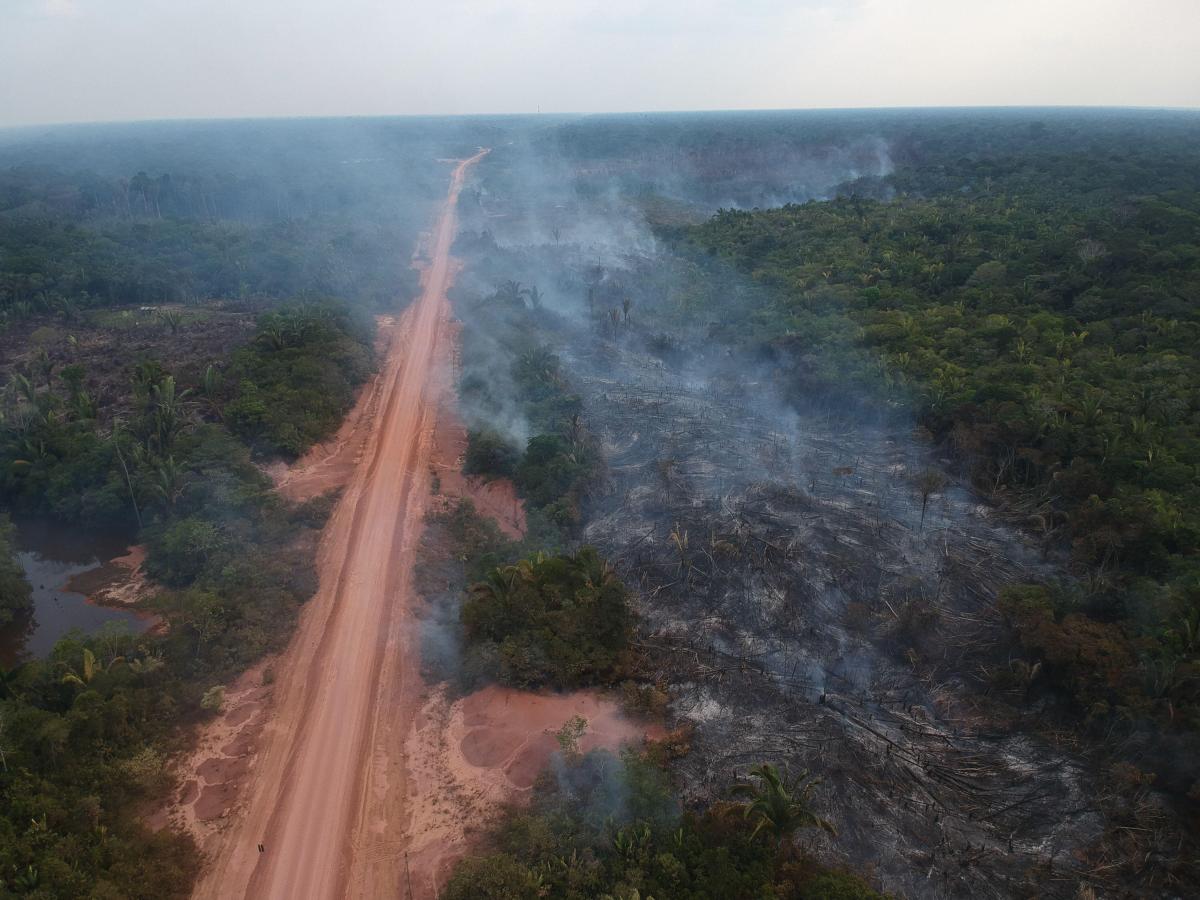
Deforested and burned area along the middle stretch of BR-319 highway. Photo by scientist Lucas Ferrante.
There’s still no information about the costs and sources of funds for this gigantic project. The same applies to a very essential monitoring system project, which was never presented.
Profiteers – All Eyes Focused on the Amazon
There are countless politicians, corporations, governmental agencies and organisations with either a hidden or visible interest in the reconstruction of BR-319 and hoping it succeeds. This project is a gateway to a heaven of natural resources waiting to be exploited and the highway will make their journey a much smoother process.
According to Fearnside, Rosneft, a giant Russian oil and gas company, with drilling rights to 16 extraction blocks located west of BR-319, approximately 35 km from the Purus River, by the SolimõesBasin, would be one of the beneficiaries of the project.
Another very concerning sector is biofuel production in the Amazon. Biofuels are produced based on agricultural products, including sugar cane, corn, castor bean, palm oil and raw materials of animal origin.
According to a Global Witness report, BBF Group (Brasil Biofuels) and Agrapalma, two Brazilian palm oil (azeite de dendê) giants, are accused of various violations in the Amazon, including conflict with local communities, violent campaigns to silence indigenous communities and fraudulent land grabs.
BBF is the largest producer of palm oil in Latin America, also active in thermoelectric generation and biodiesel in the Amazon region (Acre, Amazonas, Rondônia, Roraima and Pará). The company announced that it‘s going to invest R$5 billion over the next three years in the production of biofuels, including corn ethanol. The BR-319 project would certainly facilitate their business developments in the region.
Studies coordinated by Ferrante point out that the expansion of plantations for the production of biofuels in the Amazon tends to encourage deforestation and collapse the forest, in addition to providing zoonotic jumps of viruses stored in the forest, generating a new global pandemic.
Based on scientific research, Ferrante managed to overthrow a presidential decree that released sugarcane to the Amazon, but according to him, corn and palm oil are still crops that have an enormous potential for environmental damage and to generate deforestation, demanding economic ecological zoning mainly for the BR-319 highway area.
Politicians, infrastructure companies, national and international corporations, all show great interest in this ambitious project, as the highway would be key to their business expansion.
The voice of a public figure and politician, the governor of Amazonas, Wilson Lima, would have been a great opportunity for us to understand more about this challenging project. Unfortunately, Lima did not respond to a request for an interview.
The only NGO in the region that agreed to be interviewed about the BR-319 project was IDESAM/BR-319 Observatory.
Fundo JBS pela Amazônia mentioned that they we were unable to contribute to this matter, because the reconstruction of BR-319 had nothing to do with the fund and that this is not something that directly impacts their projects.
WWF Brasil did not have a spokesperson available to answer questions related to the project and asked that any questions be directed toBR-319 Observatory.
National and international media, politicians, corporations, governmental agencies, as well as some NGOs, seem to be reluctant to talk about the reconstruction of the BR-319 highway.
All studies so far show that this project lacks environmental governance and would be detrimental to the local communities as well as the rainforest. It also lacks an economic viability study, a monitoring system plan and consultation with the traditional and indigenous communities.
This appears to be a politically motivated plan with every president elected repeatedly making the same promise, selling the idea that the reconstruction of BR-319 highway would bring prosperity to the region, without considering that it may also bring pollution, illegal activities, violence, diseases, rampant and irreversible deforestation and destruction to the rainforest with catastrophic consequences to Brazil and the rest of the world.
If completed, this project may put in jeopardy the future and survival of the Amazon rainforest, all in the name of what they call “progress”!
Environmental and human rights violations may have been committed as a result of one of the Amazon rainforest most gigantic and ambitious infrastructure projects, the reconstruction of BR-319 highway, a stretch of 830 km, connecting the ‘arc of deforestation’ in the southern Amazon to the capital, Manaus.
There are many national and international supporters and financiers with hidden interests behind the reconstruction of this extensive highway project, including a Russian state-owned oil and gas company, a bioenergy company, ‘ruralistas’ (large land-holders and their representatives), illegal miners and loggers, investors, politicians, the government, and many more. Their motivation is driven by profit and power, no matter how much it costs.
The Amazon rainforest plays a key role in controlling both South America’s rainfall and global climate. In addition, the rainforest is home to a third of the world’s biodiversity and a wide variety of indigenous people.
The rainforest has lost more than 830,000 sq km, corresponding to 21% of the forest and roughly 17% is already degraded.
According to Carlos Nobre, renowned earth system scientist, the Amazon rainforest, one of the most biodiverse places on earth, is on the edge of the precipice, showing clear signs of destruction and perilously close to a tipping point of irreversible collapse, triggered by deforestation, degradation, forest fires, logging, illegal cattle ranching, mining, and oil and gas developments.
BR-319 connects Manaus, in central Amazon, to Porto Velho, in the “arc of deforestation”, on the southern edge of the forest. The highway is a free path to illegal side roads in areas of large concentration of indigenous land, legal reserves and conservation units, giving illegal miners, loggers, squatters and land grabbers access to untouched forest.
As a consequence, these invaders are bringing a wave of destruction, instability, pollution, violence, disease, decay and death to the communities and the environment around them.
The highway was inaugurated in March 1976, during the military dictatorship and under the government of General Ernesto Geisel, and abandoned in 1988. In 2015, Dilma Roussef’s (Labour party) government proposed reopening BR-319.
“BR-319 cuts through one of the most conserved blocks of the forest where it contains an enormous stock of carbon. This project is a threat to 63 indigenous lands and 18,000 indigenous people, not to mention the environment and biodiversity”, said ecologist and researcher, Lucas Ferrante, during our interview this month.
According to Ferrante, who took part of a study published at the Die Erde – Journal of the Geographic Society of Berlin, neither environmental studies nor consultation with indigenous peoples were carried out for some sections of the highway, as established by ILO Convention 169.
Ferrante published various academic studies independently and conjointly with Philip Martin Fearnside, a researcher at the National Institute for Research in the Amazon (Inpa) and Nobel Peace Prize winner (2007), on the impacts the BR-319 project will bring to the Amazon, the environment, indigenous communities and the world.
The reconstruction of BR-319 does not have an economic feasibility study (EVTEA). Independent studies show that for every R$1,00 spent on the highway, the ROI is only R$0,33, mentioned Ferrante.
The main transport route used has always been via the Madeira River, making it a cheaper and safer way to transport goods. In his view, the highway project would be a huge social, economic and ecological disaster.
A study published at the Environmental Conservation, indicates that Brazil could lose more than US$1 billion a year in agricultural production if deforestation in the Amazon region is not contained.
“We have already identified that the Amazon rainforest has passed its tolerated limit of deforestation. The flying rivers that supply the south and southeastern regions of Brazil are already compromised, including an area of the arc of deforestation, corroborating changes and climate events within the country, even affecting agribusiness”, said Ferrante.
According to Ferrante and various studies, one additional topic of great concern, as exploitation of indigenous lands increases, is the risk of new pandemics. The Amazon rainforest is considered a possible source of the next pandemic, as deforestation offers opportunities for disease agents from the region’s large reservoir of different types of coronavirus and various other pathogens to jump into the human population.
The Amazon interior has a precarious healthcare system, making the surge of a new pandemic originating in this region extremely difficult to identify and contain.
A company with many interests in supporting the reconstruction of BR-319 is Russian state-owned Rosneft, one of the largest oil and gas companies in the world.
Rosneft’s CEO, Igor Sechin, is considered to be the second most powerful man in Russia after Putin. In February 2022, just before Russia invaded Ukraine, Bolsonaro travelled to Russia to meet with Putin to discuss a possible energy partnership.
BR-319 highway gives access to AM-366, a planned state highway that passes through the first drilling blocks of “Solimoes Sedimentary Basin” project for oil and gas extraction, an area larger than the state of California. Rosfnet bought 16 blocks in this area.
This is a project of huge concern, as questions are raised about how much influence Rosneft may have on the government’s policies and decisions on the reconstruction of this highway, as well as the impact it may have on the local communities and the environment.
Millenium Bioenergia is another strong supporter of BR-319 reconstruction project. A bioenergy company formed in 2014 by mill owners from São Paulo and grain producers from the Midwest, the company’s initial focus was the production of biofuels. However, the company decided to partner with the indigenous communities to produce corn, chicken, fish and pigs in a confined system. This is the perfect recipe to trigger new pandemics as a result of zoonotic leaps due to environmental degradation.
In the states of Amazonas and Roraima, their goal is to produce biofuels from monocultures in indigenous lands and other communities. According to their plan, indigenous people and communities would carry out these activities with unpaid work or, as one would openly describe it, slave labour. These products would then be exported to Asia, Europe and the United States.
According to a study published bySpringer, Millenium has not honoured its obligation to carry out environmental studies that are legally required for the installation of an industry. Instead, they have proposed the building of a hospital for the indigenous people as a form of compensation.
The government’s ‘death agenda’ includes abolishing the legal reserves and opening conservation units and indigenous lands to mining, agriculture and ranching.
Jair Bolsonaro’s government, with the full support of ‘ruralistas’, has intentionally weakened the country’s environmental agencies and forest code, also denying the existence of climate change.
They have reduced protected areas, cut government funds for environmental protection, weakened the systems for monitoring and combating environmental crimes, approved 1682 new pesticides, leaving an open door to pollution, deforestation, violence, crime and devastation across the region and communities in the Amazon and the rest of the country.
Politicians in Manaus and across the country claim that BR-319 would be a “model of sustainability for the world”, but indications and studies carried out so far suggest otherwise. They follow the same rhetoric, stating the highway is a symbol of progress and sovereignty, and that the Amazon rainforest belongs to Brazil, no foreign interference should be allowed.
BR-319 has brought crime and violence to this region by illegal miners, loggers, squatters and land grabbers, threatening to kill anyone who refuses to comply with their rules.
According to Ferrante, the highway also attracted criminal gangs and organised crime to the area, with the full participation of high scale politicians.
There are countless national and international organisations financing illegal mining associated with drug and illegal arms trafficking. Organised crime has exploded and taken over the Amazon rainforest.
Bolsonaro’s gun law, the CAC (Collectors, Snipers and Hunters) license, allows Brazilians to purchase a wide variety of guns if they have no criminal record, are registered with a shooting club, and can demonstrate proficiency with a firearm.
The loosening of firearms restrictions law is creating new mechanisms for criminal groups to purchase weapons legally, consequently increasing violence in the Amazon and Brazil.
Another issue of concern is the maintenance of clandestine airstrips, mainly for mining and also serving organised crime.
According to information obtained by The Intercept, the Pulitzer Center and Earthrise Media, there are 362 clandestine airstrips, without registration with Anac, the National Aviation Agency, in the Legal Amazon. But this number almost triples, if you consider the runways open without authorisation and registration, amounting to at least 1,269 landing and takeoff lanes.
Indigenous and traditional communities are also victims of constant violent verbal and physical threats, sometimes ending in fatalities, but they are not the only ones.
Ferrante, a scientist who has spent many years exposing the situation in the region by publishing his studies in academic journals, was faced with various threats and violence against his own life.
He received countless death threats by anonymous calls and text. A “fake” Uber driver told Ferrante he should keep quiet because he was interfering in national security matters. Chemicals thrown into his home’s water system also poisoned him. Ferrante was terrified and withdrawn, unable to go out for a few months.
There is not doubt the BR-319 reconstruction project will impact local traditional and indigenous communities, as well as the environment, biodiversity and climate change, with very serious consequences to Brazil the rest of the world.
Brazil is the world’s largest exporter of beef and soy, which are the two commodities responsible for 90% the Amazon rainforest deforestation. Research shows that 70% of the chopped down Amazon is populated by cattle.
It’s essential to understand that the reconstruction of BR-319 highway has a national as well as an international long list of powerful supporters defending their own interests.
Agribusiness Watch report reveals that international banks and funds are financing Brazil’s agribusiness lobby in the country, including JP Morgan Chase, BlackRock, and Bank of America, each having invested US$1 billion in livestock. American International Group, AIG and Citigroup are also provider of funds to Brazilian agribusiness companies.
European investors include Allianz and Deutsche Bank, Barclays, Standard Chartered, BBVA, Santander, BNP Paribas, ABN-Amro and Rabobank, among others, have invested $4.5 billion in IPA companies, part of Instituto Pensar Agro, supporting FPA (Agricultural Parliamentary Front) and responsible for a package of anti-environmental measures being considered in the Brazilian Congress.
The report also lists various companies, including JBS, Suzano, Marfrig, ADM and Cargill that use their influence in Brazilian politics against the interests of environmental policies and indigenous groups.
Brazilian banks financing the agribusiness sector include BTG Pactual, Safra, Verde Asset Management, Vinci Partners, and XP Investimentos, maintaining bonds estimated at US$ 9.3 billion.
According to De Olho nos Ruralistas, in 2019, Agribusiness Watch revealed some of the multinationals that were affiliated by associations that maintain the IPA (Instituto Pensar Agro): Bayer, Basf and Syngenta, Cargill, Bunge, ADM and Louis Dreyfus; JBS, Marfrig, Nestlé and Danone.
During Bolsonaro’s administration, agribusiness companies met 278 times with government officials of MAPA, the Ministry of Agriculture, Livestock and Supply. Part of the agenda was the relaxation of rules for pesticides.
There’s no doubt that the reconstruction of BR-319 will benefit most of the above mentioned players, who continuously support and invest in the agribusiness sector in Brazil, including banks, agrochemical companies, governments, politicians and corporations, in Brazil and abroad.
The same can’t be said about the environment, climate change, local traditional and indigenous communities and the entire world population, who will pay a hefty price for these callous actions.
This is a decisive political moment for Brazil and the world, as the second term of the presidential elections draws to a close at the end of October and Brazilians will be choosing their next president, Jair Bolsonaro or Luiz Inácio Lula da Silva (Lula), both battling for the pole position.
Ferrante mentioned what may happen if Lula is elected Brazil’s next president:
“I was present during Lula’s statement during his visit to Manaus in September 2022, when he mentioned that he will choose three major infrastructure projects for each state in Brazil, mainly roads, which means the BR-319 highway project may be on the top of his list. He explicitly said that he isn’t against the highway, but the environmental rites and the consultation of indigenous peoples must be followed”,
“The BR-319 highway project is at a very advanced stage. We urgently need the suspension of the maintenance license, pending appropriate studies and consultations with indigenous peoples. It is necessary to create a task force to supervise the actions of INCRA, the National Institute for Colonisation and Agrarian Reform and the Ministry of the Economy, as they continuously try to legalise these lands”, added Ferrante.
When asked about the message he has to the international community, Ferrante replied:
“Countries that import commodities from Brazil need to review their trade agreements, mainly for meat, soy, ores, biofuels and now oil and its derivatives that come from the Amazon, extracted by Rosfnet. Brazilian agribusiness has become a threat to the Amazon, to traditional peoples and to the global climate”,
He added:
“All countries in the world need to turn their eyes to what is happening in the Amazon now, especially on the BR-319 highway. This is a matter for the world to discuss because the consequences of this highway are global, including new pandemic outbreaks and accelerating climate change that is already causing waves of heat leading to mortality in Europe. The environmental damage caused here exceeds the borders of Brazil and should be monitored by the whole world”.
Is President Jair Bolsonaro’s inadequate response to the COVID19 pandemic, with its resulting horrendous loss of Brazilian lives, a symptom of a much bigger Brazilian virus?
A virus that has been contaminating Brazilian politics and its social fabric for decades. The result being an erosion of trust, a belief that everyone is out for themselves, a breakdown of social cohesion, the net effect being the rise of populism. A wave that Bolsonaro has ridden.
How did an ex-military, far right populist politician with extremist views manage to win the 2018 election in Brazil?
Since his election, Bolsonaro has seemingly actioned a strategy to create a culture of ‘denialism’ across all levels of Brazilian politics and society, a similar approach used by his friend and apparent role model, former US President, Donald J. Trump. This denialism giving license to deny and set a ‘false truth’, which suits a politician’s own agenda. In the early 2000’s, the term ‘spin doctor’ was common. Politicians like Bolsonaro, Trump and many of their followers have taken that term to a new level. No longer spinning a truth to reflect a different viewpoint, but now actively denying the truth and instead instilling a falsehood.
The start of the social and political virus can be seen in earlier times. Matias Spektor, Associate Professor and Founder of the School of International Relations at FGV, Fundação Getulio Vargas, believes that perhaps, due to the high incidence of violence that started to rapidly increase in Brazil in 2017, reaching 64,000 homicides that year alone, combined with the lack of belief in a political system that continuously failed to provide good governance, incessant corruption scandals, high degree of inequality, as well as the fact that a newcomer who spoke a language that was reminiscent to a language spoken during the dictatorship (1964-1985) claiming he would end endemic corruption, loosen gun laws, give police force autonomy in order to fight violence, made him an ideal candidate for president at the time. He also mentioned that Bolsonaro may not be the cause of democracy decay in Brazil, but rather a symptom.
Perhaps the very populism that put Bolsonaro in to office in 2018, will be the force that removes him. The very visible and real effects of the COVID 19 virus may actually cause the end of one strain of the social and political virus that has permeated Brazil for decades.
We can’t forget that 225,000 (as of February 2) Brazilians have lost their lives to Covid-19 so far, the second highest number of deaths in the world, and the numbers keep rising.
Brazil has been facing many crises due to the pandemic and a new covid-19 variant, initially detected in Manaus, and spreading ferociously across the country. Brazilians have a negligent president as a leader, who has constantly refused to take adequate measures in order to contain the spread of covid-19 and protect its population from further unnecessary deaths.
In the past few weeks, across many Brazilian states and across the world, Brazilians have gone out in the streets protesting against Bolsonaro’s leadership and requesting for his impeachment. Bolsonaro and his government may also face charges of genocide and crimes against humanity at the International Criminal Court for the way they handled the pandemic.
Recently, 63 requests for impeachment of the president were presented to Rodrigo Maia, speaker of the Chamber of Deputies, but unfortunately, on February 1, Maia’s last day in office, he took the decision and refused to open an impeachment case against Jair Bolsonaro. Maia was replaced by Arthur Lira, who is one of Bolsonaro’s allies. Lira faces charges of taking bribes in the Car Wash scandal and other probes.
“Jair Bolsonaro has gone beyond all limits and is in no condition to continue governing the destiny of more than 200 million Brazilians. In addition to committing crimes of responsibility since the first day he stepped in the Planalto Palace, the president acts irresponsibly and criminally during the coronavirus crisis “, explains Congresswoman Fernanda Melchionna on her official website and who was present in the impeachment request protocol in the Chamber.
A recent study and investigation by NGO Conectas Derechos Humanos and São Paulo University (USP), obtained by Spanish newspaper EL PAÍS, accuse Jair Bolsonaro of allowing Covid-19 to spread freely across Brazil.
“Our research has revealed the existence of an institutional strategy to spread the virus, promoted by the Brazilian government under the leadership of the President of the Republic.”
According to Luiz Henrique Mandetta, doctor and former health minister, who was dismissed by Bolsonaro in March last year due to a disagreement over the use of chloroquine and action guided by the World Health Organisation’s advice, this new variant could trigger a mega-pandemic in Brazil over the next two months.
“We had a new disease and a system with old problems. I had to protect this system and reorganise within a government environment extremely hostile to any reorganisation initiative,” said Mandetta, recalling that he chose to have direct communication with the population. “As there was no government campaign and the president did the opposite, I started to communicate with society so that it could build a line of defense”, he commented on his disagreements with Jair Bolsonaro.
During an interview at Manhattan Connection in January 27, Mandetta spoke about the five critical crises Brazil has been going through in the last year.
Mandetta mentioned that the first crisis took place when Bolsonaro decided to sabotage the prevention system. He dismissed the danger of covid-19 and called it “the sniffles”. Bolsonaro was firmly against the use of masks and social distancing measures. His refusal to act in order to contain the spread of the virus was an indication of his advocacy to herd immunity. “This is a neurosis. 70% of the population will catch the virus. There is nothing I can do. It’s madness”. Bolsonaro said in May last year.
The second crisis arose when Bolsonaro decided to ally with former US President, Donald Trump, and together they created a narrative with the exact same speech, defending the use of chloroquine, contaminating the treatment policy and undermining preventative measures. Bolsonaro mentions the use of hydroxychloroquine as a treatment for covid-19. His government was betting on the use of this drug to diminish the pandemic in the country, instead of establishing an adequate vaccination strategy.
“I have been talking about the use of hydroxychloroquine in the treatment of covid-19 for 40 days. The use of chloroquine is increasingly found to be effective”, said Bolsonaro outside Planalto Palace last April. Last October, he insisted on the issue saying “In Brazil, if you take chloroquine at the onset of the symptoms, you have 100% cure”.
Mandetta articulated that the lack of a testing system was Brazil’s third crisis. At the end of November, the newspaper “O Estado de S. Paulo” revealed that 7.1 million tests are in the ministry’s warehouse, that is, they were not sent to SUS (Brazil’s health care system) in the middle of a pandemic. Of the total stockpiled, 96% (about 6.86 million units) expired between December 2020 and January 2021.
The fourth crisis hit Brazil when Bolsonaro decided to turn his back on a key solution, a vaccination strategy, joining the anti-vaccine movement. Brazil’s vaccination program has not been short of mishaps and confusion, leaving its population lost and in despair.
Bolsonaro’s government failed to set up an efficient vaccination program, even with the fact that Brazil has a long history of successful vaccination campaigns and its state funded facilities are able to produce and distribute vaccines on a large scale.
According to Pfizer, Bolsonaro’s government missed the opportunity to order 70 million doses of the vaccine back in August with delivery in December 2020.
Astra Zeneca was Brazil’s main choice for its vaccination program. On June 27 2020, Brazil signed and agreement to start manufacturing the 30 million doses of the vaccine locally, by Fiocruz Institute. On August 31, Bolsonaro’s government signed another agreement with Astra Zeneca, this time to produce 100 million doses of the vaccine. On January 22, 2021, Astra Zeneca sent Brazil 2 million doses of the vaccine, sourced in India, as an emergency use.
Fiocruz and Butantan Institutes were expected to manufacture the Pfizer and Sinovac vaccines respectively, but due to lack of the active ingredients needed to make the vaccines, the project has been delayed until February/March 2021. This delay may have been the result of Bolsonaro’s open criticism to China.
On January 17, the National Health Surveillance Agency, Anvisa, authorised the emergency use of both the CoronaVac (developed by Chinese Sinovac in partnership with Butantan Institute) and the Astra Zeneca vaccines in Brazil. CoronaVac was the first covid vaccine shot administered in Brazil in January 17.
In less than one year, Brazil had three health ministers. Luiz Henrique Mandetta, doctor and politician, who trusted WHO guidelines and against the use of chloroquine, was dismissed by Bolsonaro. Nelson Teich, oncologist and health consultant, was appointed to Health Minister soon after his Mandetta’s departure. Teich was in power for less than one month and resigned in May 2020 due to a disagreement with Bolsonaro on topics such as the use of chloroquine and isolation measures.
Eduardo Pazuello, former Army General and no previous health experience, was appointed to health minister. At this point, it was clear that Bolsonaro’s government switched their vaccination strategy, betting on the use of hydroxychloroquine alone to fight Covid-19.
Bolsonaro announced publicly he would not take the vaccine himself and started a misinformation campaign about the vaccine’s terrible side effects.
“At Pfizer, it is very clear in the contract: we are not responsible for any side effects. If you become a chipanz … if you become an alligator, it’s your problem. I’m not going to talk about another animal here, not to mention bullshit. If you become Superman, if a beard is born in a woman or a man starts talking thinly, they have nothing to do with it. Or even worse, tampering with people’s immune systems. How can you compel someone to get a vaccine that has not completed its third trials yet?, said Bolsonaro in December last year.
As of February 1, Brazil vaccinated 2,051.29 million people, approximately 0.5% of the population.
According to Manddetta, the fifth crisis may be about to explode with the new covid variant from Manaus spreading across all states, which may create a “mega-epidemic”.
The recent events of Manaus, where people died asphyxiated due to lack of oxygen supplies and the collapse of the health system, could be replicated across the entire country. The Ministry of Health pressured the Health Secretariat of Manaus to use anti-viral medications early in the treatment of Covid-19, such as chloroquine, hydroxychloroquine, ivermectin, azithromycin, nitazoxanide, corticoid, zinc, vitamins, anticoagulant, rectal ozone and chlorine dioxide.
“Ladies, gentlemen, there is no other way out: we are no longer discussing whether this professional agrees or not. The federal and regional councils have already positioned themselves, the councils are in favor of early treatment, of clinical diagnosis”, said Pazuello during an interview in Manaus on January 11.
“The treatment must be immediate and the drugs must be made available immediately. The patient needs to take the medication and be accompanied by a doctor, no doubt about it ”, added Pazuello.
There is no question and it is clear that Bolsonaro and his government have failed Brazilians at so many levels, by lack of planning and action, as well as employing a denialism approach to a lethal and highly transmissible virus, which was left to spread freely through the entire population. Bolsonaro and his administration should carry the burden and consequences already visible and felt by most Brazilians. Unfortunately, the man hangs on to his position as fiercely as he can, without any signs of remorse. His decision to sacrifice life over the economy is unacceptable for most and may haunt him for many years to come.








 YourVoiz