Who Controls What We Grow and Eat?

Monica Piccinini

9 May 2023

Similar to our current political & economic systems, the food system is no longer serving us; mainly driven by power, profit and greed, resulting in global food insecurity and impacting directly on our health and the environment.

We’ve seen a sharp increase in food insecurity worldwide, driven not only by climate change and multiple conflicts, but also by an unbalanced food system fuelled by corporate power. 

As the world population is projected to reach 9.8 billion in the next 27 years, there’s an urgent need to address issues related to our food system, or we may be facing a worldwide famine sooner than expected. We’ve already seen signs of this in many parts of the world.

“The right to food is the right to have regular, permanent and unrestricted access—either directly or by means of financial purchases— to quantitatively and qualitatively adequate and sufficient food corresponding to the cultural traditions of the people to which the consumer belongs, and which ensure a physical and mental, individual and collective, fulfilling and dignified life free of fear”, according to the United Nations.

Corporate Power

Photo 77536321 © Daniil Peshkov | Dreamstime.com

Giant agribusiness corporations hold the power and control over our food systems, with the ability to influence governments and decision-makers, through lobbying, with the direct intention of shaping policies in many ways.

Their objectives and tactics are questionable, with the tendency to favour their own interests, focusing on profits and maximising shareholder value, rather than addressing hunger and malnutrition.

According to ‘Who’s Tipping the Scales’, a report published by IPES Food, the international panel of experts on sustainable food systems:

“A bold, structural vision to counter the corporate takeover of food-related global governance – one that support central roles for people, governments, and democratic, public-interest-based decision-making, is urgently needed.”

It’s clear that the voices of the most vulnerable communities across the world, and mostly affected by hunger and environmental impact caused by this industry, must be heard.

These giant and dominant agribusiness corporations influence the global organisations we most trust, which should be there to defend our interests. To the surprise of many, agribusiness associations were sitting directly at the UN governance table at the 2021 UNFSS, UN Food Systems Summit.

One must also question the kind of relationship between the private sector and international governance bodies and institutions about potential conflicts of interest.

According to the IPES Food report, in 2020, a private philanthropic foundation, The Bill and Melinda Gates Foundation, was the second largest donor to the CGIAR, the Consultative Group on International Agricultural Research.

Another partnership that raises some eyebrows is the FAO’s, the Food and Agriculture Organisation of the United Nations, partnership with CropLife International, CLI, an agrochemical lobby organisation, whose members include Syngenta, BASF, FMC and Bayer (acquired Monsanto in 2018).

PAN North America, Pesticide Action Network, mentioned that instead of putting the profit of CropLife International members before farmers and consumers worldwide, the FAO must invest in solutions, including agroecology and take stronger action on ending the usage of highly hazardous pesticides, HHPs. 

We’ve also seen increase in consolidation, a large number of mergers and acquisitions, allowing these corporations to dominate the agribusiness sector. This allows these giants to have a profound influence on governance and the structure of our food system, resulting in anti-competitive market practices.

Our Health & the Environment

Illustration 273587833 / Food Food © Altitudevs | Dreamstime.com

These corporations have significant funding at their disposal to influence policies and regulations, such as pesticides, biosafety, patents, intellectual property, as well as trade and investment agreements.

Bayer AG spent over USD 9 million lobbying the US government in 2019, after it acquired Monsanto. At the time, they were reviewing the re-registration of one of the company’s main products, glyphosate (Roundup), which is considered a toxic herbicide. In the US, Bayer has been contesting billion of dollars in settlement claims to end lawsuits over accusations that glyphosate causes cancer.

They are also responsible for shaping science by sponsoring academic research favouring their corporate interests, influencing governance and policies. This was seen in the agrochemical and processed food sectors.

As proof of this, below is an internal email between Monsanto executives obtained by lawyers representing plaintiffs in the Roundup® litigation, where they suggest ‘beating the s**t out of’ a mother’s group expressing concern over the effects of GMOs and Roundup® on their children.
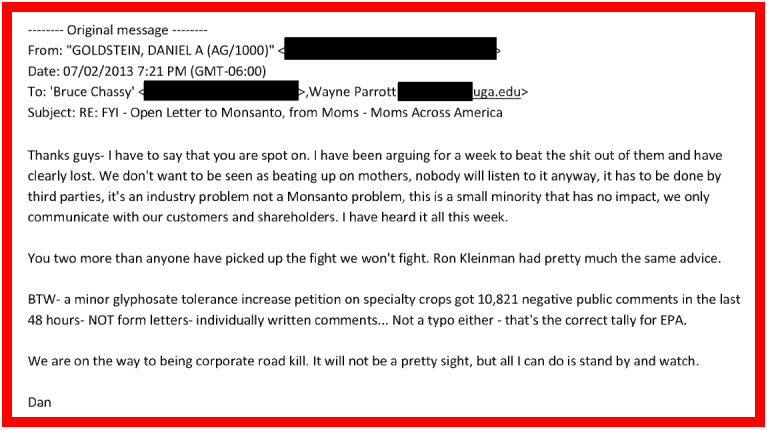
Photograph: Main Street Law Firm PLLC

Monsanto also tried to influence science by sponsoring various ghostwriting academic articles questioning scientific studies that raised concern over its product’s safety, glyphosate.

Another very concerning issue related to the health of our children is the fact that this industry continuously lobbies against mandatory public health measures, including taxes on ultra-processed foods, UPF, sugary drinks and front of package labeling, as well as restrictions on marketing of unhealthy foods to our children. This has a gigantic impact on their health and also creates pressure on our health systems.

A reported example of this was when a children’s cereal manufacturer attempted to sue Mexico after the country tried to amend a food packaging regulation called NOM-5, in order to protect their children from the marketing of unhealthy foods. The regulation established that certain unhealthy products would be prohibited from putting children’s animations and characters on their packages.

The invention of novel foods also raises some red flags. On March, The Defender, a publication defending children’s health, published a piece on Bill Gates’ latest invention, an edible food coating called Apeel, which is an odourless, colourless and tasteless coating for vegetables and fruit, which potentially extends the life span of these products, keeping it fresher for up to two times longer.

Apeel has already received the green light from US regulators, but some questions still remain unanswered surrounding the safety of the product, as the company is relying mainly on existing scientific studies, as no new science has been required to evaluate and test the product.

We seem to be completely exposed and reliant on these corporations to carry out their own safety studies, without the scrutiny of independent regulators and scientific studies.

According to the 2011 UN Guiding Principles on Business and Human Rights, companies are expected to develop their own internal procedures to identify, prevent, mitigate, and account for how they address their impacts on human and environmental rights in global supply chains.

It’s clear that the way we grow our food has a massive impact not only on our physical and mental health, but also on our environment, affecting fauna and flora, the health of our soil, water and air.

Recently, we have seen a sharp increase of fungal disease in crops, affecting 168 crops listed as important in human nutrition, according to FAO of the United Nations. Despite spraying fungicides, farmers are losing between 10-23% of their crops to fungal disease every year, including rice, corn, soybeans and potatoes.

According to a study published at Nature journal, this issue is mainly because of the adaptability of fungi to meet modern agricultural practices. Monocultures entail vast areas of genetically uniform crops, an ideal ground for fast-evolving organisms, such as fungi. Another problem is the increasingly widespread use of antifungal treatments, leading to fungicide resistance.

The use of pesticides and toxic chemicals are increasing exponentially across the world, causing havoc to our health, the soil, polluting water sources, the air, animals and plants.

Industrial agriculture, including cattle farming, soybean, palm oil, sugar cane, corn, wheat, GMOs, monoculture production, is responsible for the deforestation of rainforests, the Cerrado, and many other parts of the world, causing destruction and degradation.

In Brazil, 2.8% of landowners own over 56% of all arable land, and 50% of smallholder farms have access to only 2.5% of the land. Overall, the land is in the hands of a small number of industrial farms.

We must rethink the way we grow our food and we all have the right to access nutritious and healthy food and decide what we eat.

Digital Farming

Photo 225876642 © Andrey Popov | Dreamstime.com

The agribusiness sector spends vast amounts on research and development, making it extremely hard for smaller companies to compete with them, capitalising on patent protection and intellectual property rights.

Why? Because they can!

Patent protection and intellectual property is another issue that should be catching everyone’s attention.

Giant tech companies, such as Amazon and Microsoft, among others, entered the food sector focusing on power, control and profit. Small farmers and local food systems are struggling, as they can’t afford to use this high tech data gathering technology. They are also located in remote areas where these types of services can’t reach.

We can see an increasing movement of powerful integration and control between the companies that are supplying products to farmers, such as tractors, drones, pesticides, etc., and the tech giants. They feed and control farmers with information, and at the same time have direct access to consumers.

The aim is to integrate millions of farmers into a wide centrally controlled network by encouraging and forcing them to buy their products. This digital infrastructure is run by platforms developed by tech companies that run cloud services.

Fujitsu farm workers, located just outside Hanoi, carry smartphones supplied by the company, which monitors their every single movements, productivity, the amount of hours they work, etc., all stored on the company’s cloud. This is extremely worrying, as this practice could easily lead to labour exploitation.

Similar to Fujitsu, other companies investing heavily on this type of digital farming platforms include Microsoft’s Azure FarmBeats, Bayer’s Fieldview, BASF’s Xarvio, Syngenta’s CropWise, Yara’s Yaralrix and Olam’s OFIS, Olam Farmer Information System.

It’s essential to point out the extent of data gathering these platforms are capable of, including real time data and analysis on the farmers soil condition and water, crops growth, pests and diseases monitoring, weather, humidity, climate change, tractor monitoring, etc.

Some of these corporations are also trying to eliminate the “middlemen” by selling directly to consumers, which may be attractive proposition to many, if the idea is mainly to help farmers and small vendors directly, but somehow they may use digital platforms to increase their pricing power over farmers.

An important question we must ask these companies, regulators and our governments: who controls all this data, what do they do with it and who gives the advice?

The influence a few powerful corporations have in food governance must be scrutinised. Governments should be leading in the field of food security and not leaving it in the hands of those that put profit over longevity of life. It may seem a drastic change to the world as we know it, but it may be the only way to bring back a balance in the global food system and secure our quality of life and ultimately our survival.

Chemical Explosion in Brazil

Monica Piccinini

2 Nov 2021

Pesticides are silent, invisible and ruthless killers. They are chemicals that can have a long lasting and tragic effect on one’s life as well as creating irreversible consequences to our precious environment.

These chemicals are sold in large amounts at huge profit by the callous agrochemical industry, without extensive, thorough, transparent and independent investigations.

Why is it that pesticides, which are a class of chemicals, do not have to go through a testing regime similar to the clinical trials that pharmaceutical drugs are put through?

Recently, the EPA (US Environmental Protection Agency) announced they will end the use of chlorpyrifos, a broad-spectrum chlorinated organophosphate, as it’s associated with neurodevelopmental problems and impaired brain function in children. Some countries continue to use this toxic chemical, including Brazil.

Brazil has been the country with the highest consumption of pesticides since 2008. In 2020 alone, the agrochemical industry’s turnover was over US$ 12.1 billion. The area treated with pesticides increased 6.9% in 2020, compared to the previous year, to an area of 1.6 billion hectares. A staggering 1.05 million tons of pesticides were applied in the country in 2020.

Fossil fuels and green house gases are great contributors to climate change, but Highly Hazardous Pesticides (HHP’s), which affect the health of large parts of the population and our environment, have gone largely unrecognised.

Agrochemical organisations across the world, along with the agribusiness industry are making substantial profits at the expense of people’s lives and health, as well as contributing to damage to wildlife, water contamination, environmental degradation and biodiversity loss.

Bayer, BASF, Syngenta, Corteva and FMC, members of Croplife International lobby group, are the world’s five largest agrochemical companies. 

Jair Bolsonaro’s Poisonous Package

The Pesticides Law in Brazil established in 1989, was defined as:

“The products and agents of physical, chemical or biological processes, intended for use in the sectors of production, storage, and processing of agricultural products, in pastures, in the protection of forests, native or implanted, and of other ecosystems as well as urban environments, hydrological and industrial, whose purpose is to change the composition of flora or fauna, to preserve them from the harmful action of living beings considered deleterious; and substances and products, used as defoliants, desiccants, stimulators and growth inhibitors”.

Brazil’s president, Jair Bolsonaro, has recently incorporated a Presidential Decree 10.833/2021, amending the 1989 pesticides law, by making the approval process of pesticides even more flexible, including the approval of chemicals that have already been banned in the US and Europe.

With the new amendment, chemicals that cause cancer, genetic mutations and fetal malformation, will be given approval to be used as well as manufactured, if a “safe exposure limit” is determined.

Additionally, the current Brazilian legislation does not provide for a minimum period for the renewal of pesticides licensing. Pesticides that have been in the Brazilian market for more than 4 decades are still being used today, without ever undergoing an assessment of environmental and health issues.

It’s a fact that the approval process of pesticides has never been made easier, as more power has been given to the Ministry of Agriculture on the decision making process, leaving ANVISA (National Health Surveillance Agency) and IBAMA (Brazilian Institute of Environment and Renewable Natural Resources) excluded from the final decision.

There are currently a whopping 3,477 pesticides on the Brazilian market, 40% of all chemicals were approved in the last 3 years, all under Bolsonaro’s government. In 2020 alone, 494 products were authorised, totaling 997 new products in just two years.

According to a recent joint report by IPEN (International Pollutants Elimination Network) and ABRASCO (Brazilian Association of Collective Health), 53% of pesticides licensed in Brazil between 2019 and 2020 were manufactured in China, 22.1% in Brazil, 9.4% in India, 4.5% in the United States and 3% in Israel.

Another worrying issue is the number of illegal pesticides smuggled in from China. According to a study carried out by FIESP (The Federation of Industries of the State of São Paulo), at least 25% of the pesticides in Brazil are illegal, smuggled through Paraguay with Chinese origin.

In January 2021, the Department of Border Operations (DOF/PM) apprehended 3.5 tons of smuggled pesticides in Maracaju, MS. The cargo was valued at approximately USD 1.2 million, according to Campo Grande News.

“The smuggling of pesticides is growing in the country at the rate that Brazilian agriculture grows… This smuggling has become a major concern as it is no longer a small market, but a large economy controlled by specialized gangs,” director of Brazil’s Institute for the Economic and Social Development of Borders (Instituto de Desenvolvimento Econômico e Social de Fronteiras – IDESF) Luciano Stremel Barros, told the Brazilian Senate in September 2019.

Accidental Poisoning, Suicide, Violence and Deaths

Highly toxic chemicals that have already been banned in many countries, including in the European Union, are still being used in Brazil. Many of these products are used as a suicide and violence tool.

Aldicarb, a carbamate insecticide and an illegal rat poison, popularly known as “chumbinho”, is one of the chemicals used not only for suicides, but also for the practice of aggression.

My auntie, a farmer, committed suicide by swallowing “chumbinho” a few years ago. By the time she was found and showing regret about her decision, it was already too late, as she met a horrible and painful death. This is not an isolated case in Brazil, and it affects the most vulnerable.

In May this year, 60 rural workers were rushed to hospital with symptoms of pesticide poisoning in the metropolitan are of Goiânia, after a plane sprayed pesticides over the fields where they worked. Most reported headaches, vomiting, dizziness and some passed out.

In 2018, 475 pesticide poisonings were reported in the State of Goiás alone. In 2019, the number rose to 516. 18% of all poisoning were caused by glyphosate. It was also reported 99 attempts of suicide with pesticides.

The number of accidents and poisonings is far worse than reported. Workers are usually reluctant to report their cases to companies or to the Brazilian Social Security Institute (INSS). Many are afraid to denounce the companies or seek justice, as it risks their employment credentials in the future. Others take the word of campaigns aimed at convincing workers that pesticides are not dangerous and that their symptoms are instead caused by stress and tiredness.

For workers without a formal contract, the situation is even worse. “When intoxication occurs, the company sends the employee home with no rights or anything. The INSS cannot make the payment of sickness benefits because there is no proof of employment,” explained Gabriel Bezerra, president of the National Confederation of Human Responsible and Rural Employees.

Toxic Substances

According to the World Health Organisation and the FAO, HHP’s are described as “pesticides that are acknowledged to present particularly high levels of acute or chronic hazards to health or the environment according to internationally accepted classification systems”.

The forms of exposure to pesticides can vary, through inhalation, dermal or oral contact, via spraying, contaminated food and water and also via a worker’s clothing. The main health effects are acute, when they appear fast, or chronic, when they appear after repeated exposure to small amounts over a long period.

Symptoms from pesticides exposure can range from mild sickness, such as skin irritation, burning, allergies, cough, chest pain, respiratory problems, mental confusion, depression, nausea, vomiting, stomach pain, diarrohea, to extreme ones, such as, endocrine disruption, congenital malformations, neuro developmental problems, Parkinson’s disease, cancer and death.

Additionally, the intensive use of pesticides influences the immunological system and industrialised food production promotes obesity and the vulnerability to COVID-19.

Glyphosate is no doubt one of the most popular pesticides in Brazil, representing 62% of the total herbicides used in the country. Glyphosate is the key ingredient in the Roundup herbicide and was first patented by Monsanto in 1974. Bayer acquired Monsanto for USD 63 billion in 2018.

According to a survey by Princeton, Fundação Getulio Vargas (FGV) and Insper (Insper Learning Institute), the spread of glyphosate in soybean crops led to a 5% increase in the infant mortality in South and Midwest Brazil that receive water from soy growing regions. This represents a total of 503 additional child deaths every year associated with the use of glyphosate in soybean farming.

“It is absolutely clear that glyphosate can cause cancers in experimental animals”, affirmed former Director of the US Agency for Toxic Substances and Disease Registry, Chris Portier, who worked on the IARC, International Agency for Research on Cancer review of glyphosate. “And the human evidence for an association between glyphosate and cancer is also there, predominantly for non-Hodgkin’s lymphoma”.

In the US, Bayer has been fighting billion of dollars in settlements to end lawsuits over accusations that glyphosate causes cancer.

Mexico has made the decision to ban glyphosate, which will take effect in 2024.

The list of active ingredients consumed in Brazil with the authorisation of ANVISA is alarmingly extensive, including acefate, chlorpyrifos, atrazine, 2,4-D (2,4-dichlorophenoxyacetic acid), diazinon, metomyl, amongst many others.

Chlorpyrifos (CPF) is also a broad-spectrum chlorinated organophosphate (OP) used in crops, vegetables, fruits, as well as households. Exposure to this chemical during pregnancy or childhood has been linked with lower birth weight and neurological changes, such as cognitive and behavioural performance.

The toxicity of CPF has also been associated with neurological disfunctions, endocrine disruption, cardiovascular diseases. It can also induce developmental and behavioural anomalies, genotoxicity, oxidative stress and hematological malignancies, as evidence by animal modeling.

CPF has been banned for use in the EU.

Atrazine has innumerous adverse effects on health, such as increased risk of miscarriage, reduced male fertility, tumours, ovarian, breast, prostate and uterine cancers, leukemia and lymphoma. It’s an endocrine disrupting chemical, causing havoc to one’s regular hormone function, causing birth defects and reproductive tumours.

A group of scientists, including Tyrone Hayes found that 10% of male frogs reared in atrazine water turned into females.

2,4-dichlorophenoxyacetic acid is a widely used agricultural weed-killer and endocrine disruptor shown to have links to cancer, including non-Hodgkin’s lymphoma. It was first marketed in 1945 and one of the main ingredients in the Agent Orange, used to destroy forests during the Vietnam war.

Acute symptoms of exposure to 2,4-D include coughing, burning, loss of muscle coordination, dizziness, nausea, vomiting, diarrhea, nervous damage, fatigue, coma and death. Additionally, poor semen quality has been associated with exposure to the chemical.

Acefate is an organophosphate (OP) insecticide used on food crops, as well as a seed treatment. People can be exposed by breathing or on their skin. Acefate has been associated with TGCT, testicular germ cell cancer, particularly strong amongst Latinos, according to a study by the American Association for Cancer Research (AACR).

Brazilians are not the only ones being poisoned by toxic chemicals, in fact, you and your family could be consuming these toxic substances unknowingly, via products being imported into your country.

It has been reported that Germans are already consuming products containing pesticides that have already been banned in the European Union.

At the request of Greenpeace, tests were carried out at 70 Brazilian fruits sold in German cities by an independent German laboratory. 11 substances that have already been banned in the EU have been detected, totaling 35 different pesticides found in mangos, lemons, papaya and figs, 21 of those were considered Highly Hazardous Pesticides (HHP’s).

In order to stop the world being poisoned by chemicals that affect our health and our environment, a tougher international regulatory system needs to be implemented, including proper thorough, independent and transparent assessments of such toxic substances.

It’s time for the greedy agrochemical industry and our governments to put our health and the health of our planet above their rapacious profit, once and for all!

Do We Fully Understand the Implications of GMOs?

Monica Piccinini

16 Sept 2021

The subject of genetically modified foods has been debated for many years. In fact, genetically modified produce is freely available in a number of developed countries. The benefits as well as the negative side-effects have polarised opinion in the scientific world, advanced economies and amongst health conscious populations.

Technological advances in key areas of science are now lifting the debate to new concerning levels.

“GMOs appear the focus of a stunning program: to privatize biology itself, turning sovereign soils and the very act of farming, as much as its produce, into commodities”, wrote Rob Wallace in his book “Big Farms Make Big Flu”.

GMOs (genetic modified organisms) describe foods that have been created through genetic engineering. Scientists identify what trait they want a plant, animal or microorganism to have (such as resistance to pesticides, herbicides or insects), they then copy it and insert the gene into the DNA of the plant, animal or microorganism.

In 1866, Gregor Mendel, an Austrian monk, was able to breed two types of peas, identifying the basic process of genetics. In 1922, the first hybrid corn was produced and sold commercially. In 1994, the first genetically modified produce created through genetic engineering becomes available for sale, a genetically modified tomato.

Since then, science has been advancing and progressing rapidly, as we enter a new phase of genetic engineering. NBT’s (new breeding techniques) such as CRISPR and RdDM, as well as synthetic biology, allow more complex changes to the genetic makeup.

What seems like incredible biological acts of ‘science fiction’ are still very early in their development. Moving too fast in order to commercialise these technologies will undoubtedly see the negative side effects with unintended consequences.

CRISPR cuts the cell’s DNA at a particular site. Like a wound, the cell attempts to heal itself by resealing its break using DNA repair mechanisms. This process can be faulty and not always works perfectly, causing unforeseen problems with unexpected results (new DNA).

In the 1960’s plant scientists in the U.S. bred a new potato variety that was ideal for making into crisps but also contained dangerously high levels of natural toxins. The potato had to be withdrawn from the market in 1970.

There is large concern over GMOs across the world with the sense that gene editing could give rise to dangerous mutations or crops that could be patented by large agribusiness corporations trying to monopolise staple crops.

There are also other factors involved, such as the creation of plants, animals and microorganisms we have not seen before, and by doing so, the impact it may have on our health, the environment as well as evolutionary patterns. Potential risks and biosafety concerns are associated with it. Little is known about the long-term effects and safety associated with GMOs.

According to GMWatch, a number of disadvantages of GMOs foods to humans and the environment have been listed, including allergic reaction by allowing a certain allergen present in the GM crop to enter the body and stimulate an immune response.

Toxicity is also in question. GM foods may increase the production of toxins at levels harmful to humans, as toxins are produced when there is damage in the “gene of interest” during the insertion process. Another concern is reduced nutritional value of GMOs. By making a plant more resistant to pests, the antioxidant phytochemicals are reduced. 

Toxins may also be released into the soil causing environmental damage.  An example of this is soil bacterium, bacillus thuringensis, present in larval caterpillars, which has a gene that produces certain toxins that destroys insects as well as pests. This gene is inserted into the corn to make it resistant to pests, resulting in the release of toxins into the soil, therefore turning the soil less fertile.

In addition to this, there is also the danger of resistance of pests to toxins, antibiotic resistance, genetic hazards, flow of genetic information, generation of super-weeds, and disruption to biodiversity by interfering the natural process of gene flow.

The United States, Canada, Brazil, India and Argentina have been growing GMO products made from modified soya beans and corn for many years. The majority of U.S. corn, canola, soy, cotton and sugar beets crops are GMOs.

“Let’s start now to liberate the UK’s extraordinary bioscience sector from anti-genetic modification rules, and let’s develop the blight-resistant crops that will feed the world”, said Boris Johnson in his first speech as UK’s prime minister.

Michael Antoniou, professor of molecular genetics at King’s College London, mentioned that the answer is to change our food delivery systems in the direction of “agroecology” by reducing the use of synthetic ferlitisers, pesticides and herbicides, and planting a diverse range of plant strains, to build resistance into the system. At the very least, any crops produced by using genetic editing must be labeled as such.

Liz O’Neill, director of GM Freeze, argues that genetic engineering should undergo strict regulation. She said:

“If this group of genetic engineering techniques escape classification as GM, they could be completely unregulated. The crops they produce could find their way into our fields and on to our plates without environmental or food safety risk assessments. They would not be traceable and, without labeling, consumers would have no way to identify and avoid them should they wish to do so”.

Since the UK left the EU, it has the power to authorise new GMOs. Brexit legislation gave Defra (Department for Environment, Food and Rural Affairs) more power to amend existing GMO laws without going to Parliament.

“Gene editing is a sticking plaster, diverting vital investment and attention from farmer-driven action and research which could be yielding results, right now”, said Gareth Morgan, SA’s (Soil Association) head of farming and land use policy.

“Consumers and farmers who do not want to eat or grow genetically modified crops or animals need to be offered adequate protection from this. The focus needs to be on how to restore exhausted soils, improve diversity in cropping, integrate livestock into rotations and reduced the dependence on synthetic nitrogen and pesticides”, added Morgan.

Recently, GMWatch reported that a U.S. based fake meat maker, Impossible Foods, that uses genetically engineered ingredients, have gone past regulators, mainly in the U.S. and Canada, and are looking into expanding its products into the New Zealand and Australian markets.

Impossible Foods adds GM soy leghemoglobin (SLH), 0.8% and not labeled, in order to make its product look and feel as if it’s bleeding, just like real meat. The issue is that SLH does not have a history of safe use in food.

A rat feeding study that Impossible Foods commissioned on SLH showed worrying effects in the rats, including signs of inflammation, decreased blood clotting ability, changes in blood chemistry, kidney disease and possible signs of anemia.

Would you swop a vegetable burger that tastes of vegetables to a burger that tastes and bleeds like real meat but has been genetically modified with SLH, a product that has not been tested extensively? Are we going too far and too fast without calculated risks? What is the limit to greedy corporations?

Reported by GMWatch this month, five hundred tons of unauthorized GMO rice flour that had been illegally imported by India and sold in the European Union had to be recalled, but authorities could not guarantee that all products would be removed from the market. These batches of white rice were imported into Europe, transformed into rice flour, and sold on the market as an ingredient, including chocolate sweets from the Mars company.

Do we have the assurances and guarantee that genetic engineering will not be responsible for the creation of new disease organisms with no natural resistance and no available cure? Do we have the confidence that these “novel foods” will not harm our environment and our health? Will our scientists, world leaders and corporations assure the world GMOs are 100% safe?

Many questions are yet to be answered. Discussion and debate over the benefits and risks of genetic engineering as well as the ethical questions raised by this technology is essential. We must ask for total transparency and full participation in the decision making process. There is too much at stake, as this may lead us to a path of no return.