Official UK government pesticide usage data reveals that the use of glyphosate in UK farming is increasing, despite a recent government promise to “reduce reliance on the use of conventional chemical pesticides.”
According to analysis by Pesticide Action Network UK (PAN UK) and the latest figures, the amount of glyphosate used in UK agriculture grew by more than 360 tonnes (16%) between 2016 and 2020, while the area of land sprayed with the pesticide increased by 9%, amounting to 230,000 hectares, three times the size of Greater Manchester.
Nick Mole, PAN UK’s policy officer, mentioned:
These latest figures, while shocking, are actually a huge underestimation of our exposure to glyphosate since they only relate to farming. Meanwhile, glyphosate is also sprayed liberally in most UK towns and cities.
The negative impacts of glyphosate on human health and the environment are well-documented. With cancer rates and biodiversity loss both rising, it’s crazy that we continue to endanger the health of rural residents, farmworkers and wildlife when there are plenty of safer and more sustainable alternatives available.
One of the primary concerns associated with glyphosate is its potential impact on human health. Several studies have suggested a possible link between glyphosate exposure and various health issues, such as an increased risk of cancer, particularly non-Hodgkin’s lymphoma.
Environmental concerns are another area of contention surrounding glyphosate use. The herbicide’s widespread application can lead to its presence in soil, water bodies, and food crops, potentially impacting ecosystems and non-target organisms.
Glyphosate has been linked to adverse effects on aquatic organisms, including fish and amphibians, and there are concerns about its potential impact on pollinators, such as bees, which are crucial for agricultural productivity and biodiversity.
Additionally, the long-term use of glyphosate can lead to the development of herbicide-resistant weeds, commonly known as “super-weeds.” Continuous exposure to glyphosate can exert selection pressure on weed populations, promoting the growth of resistant individuals that are no longer susceptible to the herbicide. This phenomenon necessitates the increased use of glyphosate or other herbicides, leading to potential environmental harm and higher costs for farmers.
PAN UK’s report also reveals that the use of a number of other highly hazardous pesticides (HHPs), a UN concept used to identify particularly harmful pesticides, is also on the rise, including:
2,4D, a herbicide highly toxic to bees and possible carcinogen and suspected endocrine disruptor, which can interfere with hormone systems;
Imazalil, a fungicide linked to cancer and classified as a ‘developmental or reproductive toxin’, which can negatively affect sexual function and fertility;
Cyantraniliprole and lambda-cyhalothrin, insecticides highly toxic to bees.
With the clock ticking on the biodiversity crisis, and the UK already one of the most nature-depleted countries in the world, we must move further and faster. Absolutely key is supporting farmers to transition away from chemical dependence and towards more nature-friendly methods of production, warned Mole.
Whilst conducting their analysis, PAN UK’s noted some major problems with the government’s pesticide usage figures, including numbers being changed retroactively and discrepancies between data sets that are supposed to be identical.
The organisation is calling on the UK government to urgently improve pesticide usage monitoring and data, increase support for farmers to reduce pesticide use and introduce non-chemical alternatives, establish reduction targets to drive a decrease in both use and toxicity, end use of pesticides that are harmful to bees and other pollinators, and finally publish the long-awaited National Action Plan on Sustainable Use of Pesticides that was promised for 2018.
The debate surrounding glyphosate and HHPs’ health risks, environmental impact, and the need for alternative weed control methods continues to evolve.
It is essential for the government, regulatory agencies, scientists, farmers, and the public to remain vigilant, informed, and engaged to ensure toxic chemicals are urgently replaced with non-chemical alternatives.
Our global food systems are highly complex and serve many constituent parts. It’s responsible for making available fresh produce throughout the year in countries and regions that historically have been very limited in their food produce. Viewed in a positive light, the systems serve the needs of many.
However, as the global food systems have evolved over time, it has increasingly been focused on monetary gain for corporate stakeholders and less about serving the needs of the global populous.
The increasing focus on economic gain from the global food systems can be evidenced as a cause of wide scale sickness, hunger, poverty, sickness, homelessness, poisoning of our land, water, air, plants, animals, our bodies and minds.
The food industry is considered as a major drive of climate change, responsible for one third of world GHG emissions (IPCC 2019), land-use change and biodiversity loss (40% of earth’s surface), major user of freshwater resources (70% of global freshwater) and a major polluter of terrestrial aquatic systems through the use of chemicals.
During the Extinction or Regeneration Conference 2023 in London, Philip Lymbery, global CEO of Compassion in World Farming, highlighted the fact that we rely more and more on a small number of countries for the production of major crops on which we depend on. When certain world events occur, such as conflicts and the Covid-19 pandemic, and global supply chains are disrupted, the entire food system is impacted.
Philip Lymbery at the Extinction or Regeneration Conference 2023, London
The countries we rely on, mainly in the global south, are forced to invest in “cash crops” for exports, not producing enough to feed their own population. They produce raw materials that we then process and sell it back to them in the form of finished food products, mainly as a result of their huge debt, explained Lymbery.
Food security is another issue, as we have witnessed in recent years a record high in food prices, global hunger and social inequities that result from the industrial farming systems, not just from conflicts and climate change. We are producing enough food to feed the entire world, but what we’ve seen is a mismatch between supply and demand, a financialisation of agriculture systems and markets, as well as an increase in power concentration.
Lymbery said, “These companies are taking our food systems hostage for their thirst for profits.”
“Food systems are often shaped by politics, rather than policies”, he added.
Our food systems are also impacting our health and making us sick. According to Marco Springmann, senior researcher in environment and health at the Environmental Change Institute at University of Oxford, the cost of treating diet-related diseases is projected to exceed USD 1 trillion by 2030, also putting a strain on health systems around the world.
“Food that brings you sickness and disease is not food, it’s poison”, said Dr. Vandana Shiva, Indian environmentalist, physicist and author, during one of her speeches at the Extinction or Regeneration Conference 2023 in London.
Extinction or Regeneration Conference 2023, London – Photo Credit: Robbie Blake, IPES-Food
Power Concentration
We are experiencing growing concentration in our food systems, as the number of corporations controlling everything, from inputs up through retail are getting smaller.
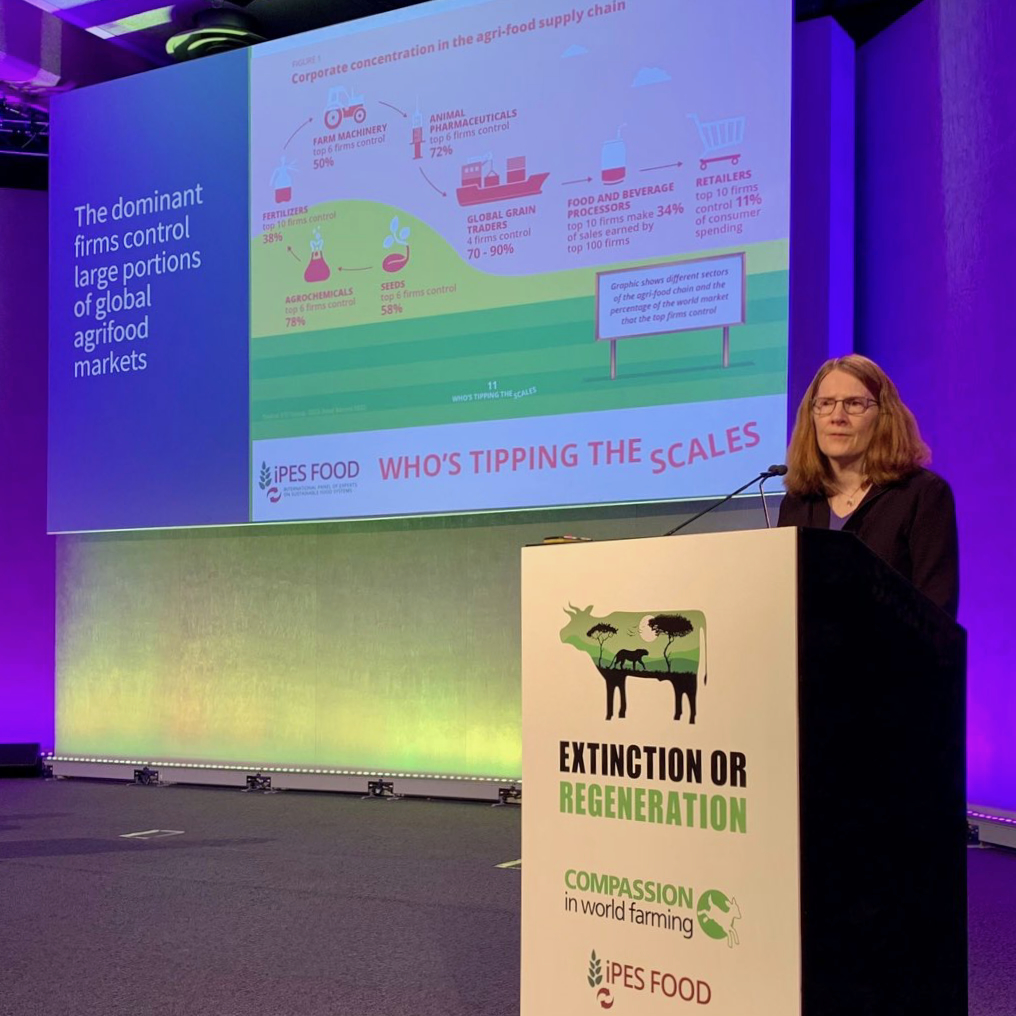
According to Jennifer Clapp, Canada research chair & professor, School of Environment, Resources and Sustainability at University of Waterloo, and IPES Food “Who’s Tipping the Scales” report, only top six agrochemical companies control 78% of the global market, the top six animal pharmaceuticals control 72%, the top six farm machinery control 50%, the top six seeds companies control 58% and the top five global grain traders control between 70-90%.
Jennifer Clapp at the Extinction or Regeneration Conference 2023, London – Photo Credit: Robbie Blake, IPES-Food
Four major grain traders control approximately 80% of the trade in cereals worldwide, the ABCD firms, ADM (Archer-Daniels-Midland), Bunge, Cargill and Dreyfus; and four major food processing and packaging companies dominate the global market, Nestle, PepsiCo, Anheuser-Bush InBev and JBS.
Since 2015, we’ve seen mega mergers in the seeds and agrochemicals industry, making these corporations even more dominant and powerful. Some of the mergers include Bayer and Monsanto, ChemChina and Syngenta, Dow and Dupont merged to form Corteva, Agrium and Potash Corp merged to form Nutrien.
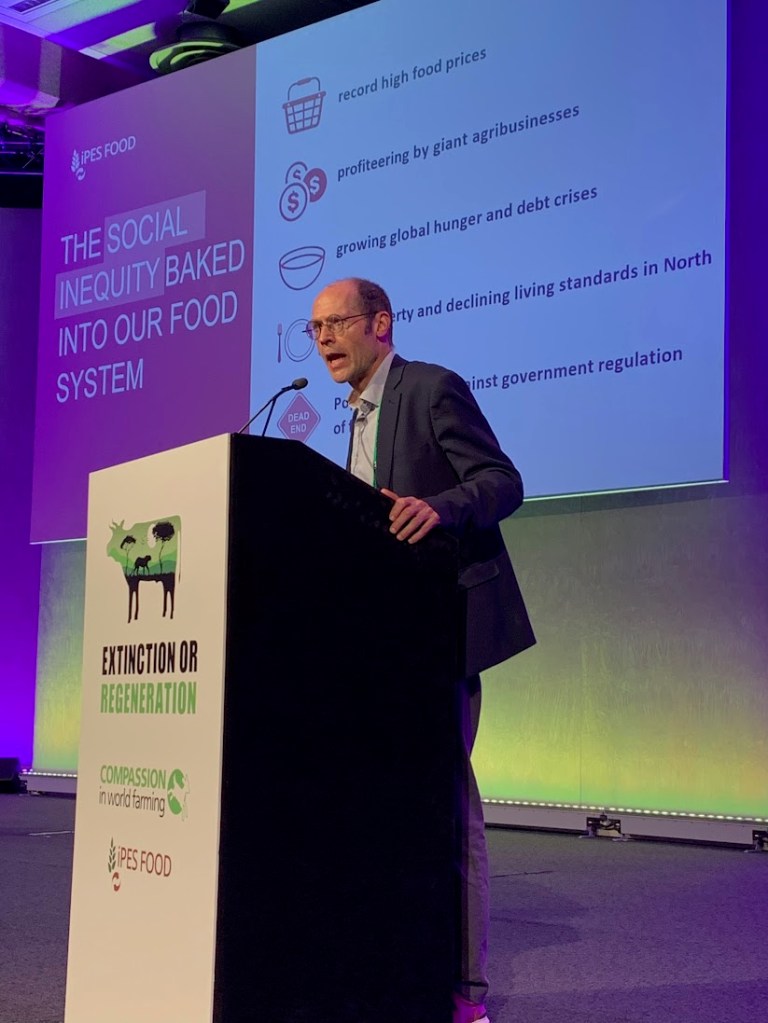
Olivier De Schutter, UN Special Rapporteur on extreme poverty and human rights and co-chair of IPES-Food, mentioned that giant dominant food corporations acquired the position in decision making to veto any transformative change.
According to him, “it’s not because of corruption of politicians or the finance lobbyists working on their behalf, it’s because they are the champions of economic gain of large scale production that global commodities markets demand.”
“This allows these corporations to say to politicians, “trust us”, we know how to produce food for mass consumption, … if you impose too strong regulations on us, you’ll be faced with higher prices that your voters will have to face. This is what allows them to have a privileged access to politicians”, he added.
He explained that these companies manage to get protection from legislators for intellectual property rights for the new “breeds” that they develop, as well as the new technologies that they promote. Additionally, they can very easily challenge environmental regulations. The State ends up in the hands of these economic actors and ends up working for them.
Olivier De Schutter at the Extinction or Regeneration Conference 2023, London – Photo Credit: Robbie Blake, IPES-Food
These corporations also control the labour conditions of the food system worker, the products that end up in the supermarkets shelves, and have the power to shape government policies. Small-scale producers don’t stand a chance when faced with such powerful competition.
In order to democratise our food systems, we need to increase transparency and accountability.
It’s necessary to set up a worldwide robust anti-trust and competition legislation and food policy, as well as creating a lobby register, which is already in place in some countries, in order to limit the concentration of power of the big agrifood corporations
We should be listening to farmers and working with them to identify solutions that will not only be beneficial to them, but also to our health and the environment, instead of filling the pockets of greedy corporations.
“We also need more public support for alternative food systems, in particular, research and development money going towards agroecology and organic agriculture”, mentioned Clapp.
She added that it’s now necessary for the State to step back in like they did in the past, when they played a prominent role during the last transition to industrial agriculture with R&D and hybridisation in fertilisers and other sectors.
There’s a need control those actors that have the power to shape our policy spaces, including measures that prevent conflicts of interests, where corporate officials end up as regulators and go back to work in the corporate sector.
Lastly, there’s the need to create an autonomous space for civil society to determine and control the rules and governance they’d like to see happen.
According to Planet Tracker, a non-profit think tank, nearly USD 9 trillion of private finance is currently supporting the global food system.
“Financial regulations have become weakened to the extent that they’ve allowed big financial institutions like banks and investment houses to create new financial products for investors to speculate on food commodities”, explained Jennifer Clapp during the Extinction or Regeneration Conference 2023.
The price of commodities can swing much higher or lower than supply and demand would normally indicate and this creates price volatility, consequently generating profit for these institutions.
“There’s another aspect of financial concentration, where asset management firms own huge portions of the global food systems. The ABCD firms, ADM, Bunge, Cargill and Dreyfus, make huge windfall profits when food commodity prices swing. We saw this happening in 2008, and once again, in 2022, when Russian invaded Ukraine”, added Clapp.
Asset management firms, Blackrock, Vanguard, State Street and Capital Group, manage people’s pensions, trillions of assets worth over USD 20 trillion in the global economy. They are buying shares in almost all the companies across the entire agrifood supply chain, which means they have a shared interest in those companies being profitable, therefore creating an incentive for collusion.
Clapp mentioned that economists are concerned about this issue, which is called common ownership, leading to a reduction in competition, as well as leading to higher prices and encouragement of mergers and acquisitions, creating even bigger companies.
The danger of this situation is the fact that it allows them to hold more power to shift food systems in a certain direction, enabling them to shape markets in a way that it can affect prices that consumers pay. Prices are kept low for the agriculture and livestock producers and high for consumers. They also have the power to determine what technologies are going to dominate the market.
Clapp proposed a few solutions to some of these problems, including stronger rules in the financial markets, rules to curb speculation, better reporting, better limits on financial actors in these markets, as well as rules limiting asset managers owning the entire scope of the food systems.
Health Hazards, New Pandemics & Antimicrobial Resistance
Industrial animal production may be a driver of future pandemics. The confinement of high number of animal in small spaces, leave them much more susceptible to viruses and infections, with the potential to evolve into more infectious types, explained Melissa Leach, social anthropologist and geographer, director of the Institute of Development Studies, IDS, during the Extinction or Rebellion Conference 2023.
All recent infectious diseases outbreaks and pandemics are zoonotic, as they originate in animals. Wildlife domestic and farmed animals and humans all interact in intense interfaces where spillover can occur.
The World Health Organisation, WHO, describes antimicrobial resistance, AMR, as the overlooked pandemic. It contributes to treatment failures, increasing human vulnerability to a wide range of infections.
Some of the latest figures suggest that AMR will cause 10 million deaths by the year 2050, more than from cancer, diabetes and pneumococcal diseases combined.
“Key causes of AMR are the overuse of antibiotics in livestock to promote growth and routinely prevent diseases, especially in intensified livestock farming”, mentioned Leach.
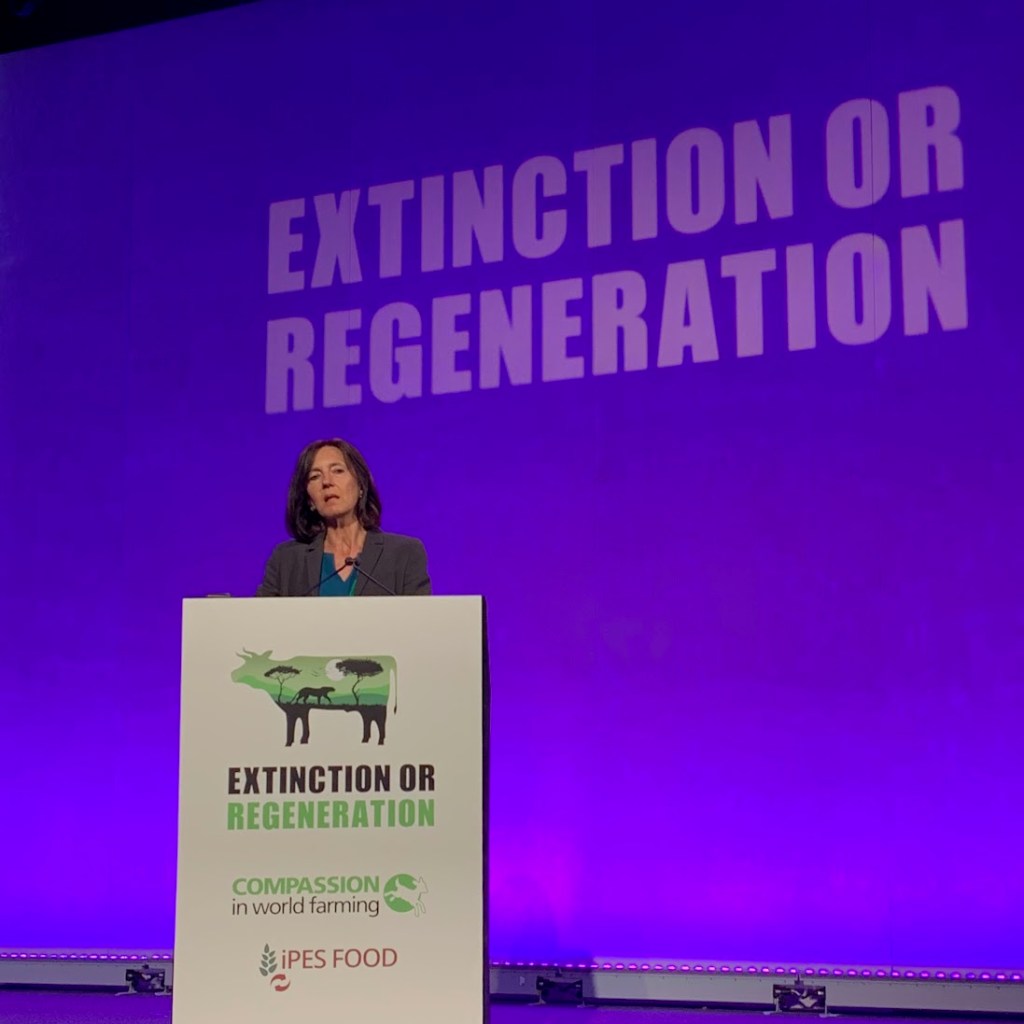
Melissa Leach at the Extinction or Regeneration Conference 2023, London – Photo Credit: Robbie Blake, IPES-Food
A study published by The Lancet, Global Burden of Bacterial Antimicrobial Resistance in 2019, estimates that there were 1.27 million deaths globally due to AMR in 2019, and 4.96 million deaths associated with AMR, compared with 6.9 million deaths globally from Covid-19 since the beginning of the pandemic in 2020.
According to Cóilín Nunan, scientific adviser to the Alliance to Save Our Antibiotics, certain types of antibiotics used in animal farming have led to the rise and spread of livestock associated strains of MRSA and clostidrium difficile.
There’s also the resistance to colistin, used as a last resort antibiotic in human medicine for treating life-threatening infections on patients who don’t respond well to other antibiotics, added Nunan.
Scientists from Oxford University released a study showing Escherichia coli bacteria that acquired resistance to colistin in animal farming. According to Nunan, this is an issue of concern and may be more dangerous than AMR, as it may be more able to cause infections in humans.
In Europe, over 60% of antibiotics are used in farmed animals, rather than in medicine. Globally, the figure rises to nearly 70%.
The health impact caused by our food systems is putting a real strain on health systems around the world. There’s been a rise in conditions, including type 2 diabetes, obesity, depression, cardiovascular diseases and certain types of gastro-intestinal cancer, amongst others, all related to our diets.
We can no longer deny the urgent need to embrace more sustainable food systems solutions, support and listen to our farmers, respect and protect Indigenous peoples, our land and the environment, which we are highly dependent on.
The concentration of power within our food systems should be limited and a new model replaced instead, to ensure there’s fairness and equality, access to healthy and nutritious food for everyone, everywhere, and that our health and the health of our planet is protected and respected.
The election of Brazil’s president Luiz Inácio Lula da Silva, ‘Lula’, in October 2022, brought a sense of relief and hope to the Brazilian scientific community.
Just over three months into his administration, Lula’s challenging task to fulfill all the promises he made before he came into power became apparent. The populous of Brazil, along with the rest of the world, is watching what happens next.
In the past four years, the country has faced considerable challenges, including budget cuts in science and technology, the spread of misinformation leading to the denial of climate change, anti-vaccine movements, and the use of ineffective drugs against COVID-19, amongst many others.
“Brazil is once again reconciling economic growth with social inclusion. Rebuilding what was destroyed and moving forward. Brazil is once again a country without hunger. While preparing the ground for infrastructure work that was abandoned or ignored by the previous government, Brazil is again taking care of health, education, science and technology, culture, housing and public safety”, declared Lula during the meeting at Brasilia’s Planalto Palace in April.
A group of five renowned scientists share their views and expectations about scientific policies in Brazil, published at Nature Human Behaviour this month.
Mercedes Maria da Cunha Bustamante, biologist, Pedro Gabriel Godinho Delgado, doctor and psychiatrist, Lucas Ferrante, ecologist and researcher, Juliana Hipólito, biologist, and Mariana M. Vale, ecologist, highlight key areas of concern to be addressed by the current government.
According to Lucas Ferrante, the past government was notable for the prominent role of scientific denialism. Ministers were chosen for their ideology, rather than their technical ability, and scientific advice was simply ignored.
The second catastrophic COVID-19 wave in the Amazon, making Brazil one of the global epicentres for the disease, could have been prevented if the past government had listened to scientific advice.
The absence of a technically oriented government under Jair Bolsonaro’s administration also increased deforestation in the Amazon rainforest at an alarming rate, threatening the environment, traditional and indigenous communities, as well as climate change goals, wrote Ferrante.
He also mentioned that despite the change in government, there’s the need to remember past events.
During Lula’s two previous terms as president (2003-2010), he showed worrying denialistic tendencies, ignoring scientific reports and scientists’ advice. An example of this was the Belo Monte hydroelectric dam disaster, which affected the Xingu River and traditional communities, causing a catastrophic socio environmental impact.
Essential plans should include blocking major infrastructure projects in the Amazon rainforest, such as the reconstruction of BR-319 highway linking Manaus to Porto Velho, which will affect traditional and indigenous communities, biodiversity and increase deforestation in the region, as well as agriculture production chains that could give rise to a new pandemic.
Brazil’s biodiversity is extremely rich, but lacks surveys of viruses circulating in its fauna, therefore a well established surveillance programme is required in order to reduce the risk of new pandemics emerging through viral spillover, declared Mariana M. Vale.
Nísia Trindade, Brazil’s health minister, mentioned during a lower house hearing last month that the country should be gearing up for future pandemics by investing in science, technology and Brazil’s national healthcare system, SUS (Sistema Único de Saúde).
Juliana Hipólito highlighted another significant issue of concern, society’s lost value and interest of science in their daily lives. As a consequence, this lead to an increase in deforestation rates, climate change denialism, anti-vaccine movements and the use of ineffective unproven drugs against COVID-19.
The past government’s dismantling of environmental policies increasing deforestation and the approval of a large number of toxic pesticides is also something the science community expects to be reversed, she added.
According to experts, Brazil’s use of pesticides increased exponentially in the last few years, growing 300,000 tonnes since 2010. Approximately 80% of the pesticides authorised for commercialization in Brazil are prohibited in at least three countries of the Organization for Economic Cooperation and Development (OECD) of the European community.
In the field of mental health, Pedro Gabriel Godinho Delgado expects to see development of long-term projects to better understand the interfaces between mental health suffering and the profound social inequality and precariousness of life in Brazil.
According to him, urban violence, racism, stigma, gender prejudice, loss of childhood and adolescence and their relationship with human suffering, should no longer be marginal and must be included amongst the priorities of research. The long-term consequences of COVID-19 on mental and physical health also deserve special attention from researchers.
Divestment is an issue of concern, as Brazil’s previous government cut considerably investment in scientific and educational organisations. There was a huge drop in investments in INPE (National Institute for Space Research), INPA (National Institute of Amazonian Research), CNPq (National Council for Scientific and Technological Development), and federal universities.
According to Hipólito, budget cuts skyrocket during the past government. Research funding and the budget of leading science and technology funding agencies were reduced by 60% from 2014 to 2022.
Socio-economic conditions have been sacrificed as a result of the cuts, therefore affecting the country’s capacity for the innovation and economic diversification.
Mercedes Maria da Cunha Bustamante mentioned the urgent need to support vulnerable groups (women, the youth and the poorest – most of them people of colour) in Brazil with the demand for public policies that would put the country back on track towards social justice and equity.
Reducing poverty, combating climate change and biodiversity decline are intrinsically connected.
The current administration also needs to focus on improving education from elementary level, adds Bustamante. A similar scenario is seen at public universities, which were affected by budget reductions under the last government. Brazilian public universities account for most of the national scientific production and are major drivers of social inclusion.
It’s essential to increase diversity, she added, as it’s vital for addressing societal demands through the generation of new knowledge, making Brazil attractive again for young scientists and allowing science to have a more prominent role in policy making.
Vale pointed out that white male individuals still dominate Brazilian academia and highlighted the need to strengthen and improve existing policies on diversity, equity and inclusion in science, especially regarding black and indigenous people.
Brazil has seen a massive exodus of scientists, leaving their jobs to work abroad, where their skills are most valued. The current government should set up a development and retention plan, encouraging and supporting scientists across the country.
Although the scientific community remains confident and positive, it’s crucial that they continue to defend science, and that the general population are not deceived into thinking that a change in governance alone is sufficient to bring about the needed improvements in public health and the environment, mentioned Ferrante.
The voice of scientists who dedicate their entire lives to protecting and bettering our daily lives couldn’t be louder and should be heard. Perhaps it’s time for Brazilian society, politicians, institutions and corporations to fully support this community that has been undervalued for so long.
Solar geoengineering, SG, is the latest billionaires’ techno-utopian dream to reverse the impact of climate change.
As we have shown little progress in coming to an agreement to use conventional and sensible measures of climate change mitigation and adaptation, a ‘privileged club’ appears to be pursuing a worrying and ambitious plan to change our global weather.
Politicians and fossil fuel giants may also use SG as a way to buy time and as an excuse to delay the switch to a neutral carbon economy.
What’s Geoengineering?
Goengineering is a set of technologies used with the purpose to manipulate the weather and the environment to counterbalance the impacts of climate change.
This technology is divided in two categories. The first one is carbon geoengineering or carbon dioxide removal (CDR), which seeks to remove carbon dioxide from the atmosphere.
The second and most important one is solar geoengineering, solar radiation management (SRM), stratospheric aerosol injection (SAI) or stratospheric albedo hacking (SAH), which seeks to reflect fraction of sunlight back into space to cool the planet.
This technology mimics a volcano eruption, where sulfate aerosol (or calcium carbonate, aluminum or diamond dust) is released into the atmosphere creating particles reflecting sunlight back into space, therefore cooling the earth. One of the ideas is to send high-flying aircrafts to inject sulfate dioxide particles into the atmosphere.
There are a considerate growing number of parties interested and invested in deploying this technology for a variety of reasons.
Billionaires, financial and technology institutions within Silicon Valley and Wall Street are funding and supporting the research and governance of geoengineering technology. They consist of a group of individuals and organisations with strong ties to corporate power.
FICER is Bill Gates’ fund for geoengineering research, managed by Harvard Solar Geoengineering researchers David Keith and Ken Caldeira. Silver Lining is another firm funded by LowerCarbon Capital and First Round Capital with Goldman Sachs and JP Morgan executives on the board.
Billionaire and co-founder of Facebook, Dustin Moskovitz, and partners Cari Tuna and Holden Karnofsky, formerly Bridgewater Associates, also fund a geoengineering project by Open Philanthropy Project.
Additional players funding such projects include EDF, Environmental Defense Fund, which have partnerships with Citigroup, GE, McDonald’s Shell, Tyson and Walmart. Others include Alfred P. Sloan Foundation of General Motors, Pritzker Innovation Fund, founders of the Hyatt Hotels, and VK Rasmussen Foundation, founded by the Swedish inventor and businessman Villum Kann Rasmussen.
As the fossil fuel industry refuse to commit and scale down production worldwide and transition to renewables, denying and ignoring the negative impact they are causing to climate change and continue to do business as usual, governments, investors and researchers see an extraordinary opportunity to push for geoengineering technology to be deployed sooner rather than later.
According to a few scientific studies, this technology would result in an immediate cooling effect worldwide, with a possibility of reducing the rise of sea level, extreme weather and heat waves.
Additionally, other studies also suggest that SG would be a financially attractive solution to climate change. Obviously, cost efficiency is extremely appealing to governments and corporations.
The Aspen Institute Climate Policy Enters Four Dimensions paper by David Keith and John Deutch, suggests that the direct costs of implementing SG appear to be “quite small, with the global annualised costs perhaps under $20 billion per year well into the latter half of the century. By comparison, the damage-reduction benefits could be 100 times this amount”. SG is a fairly inexpensive technology and politically practical.
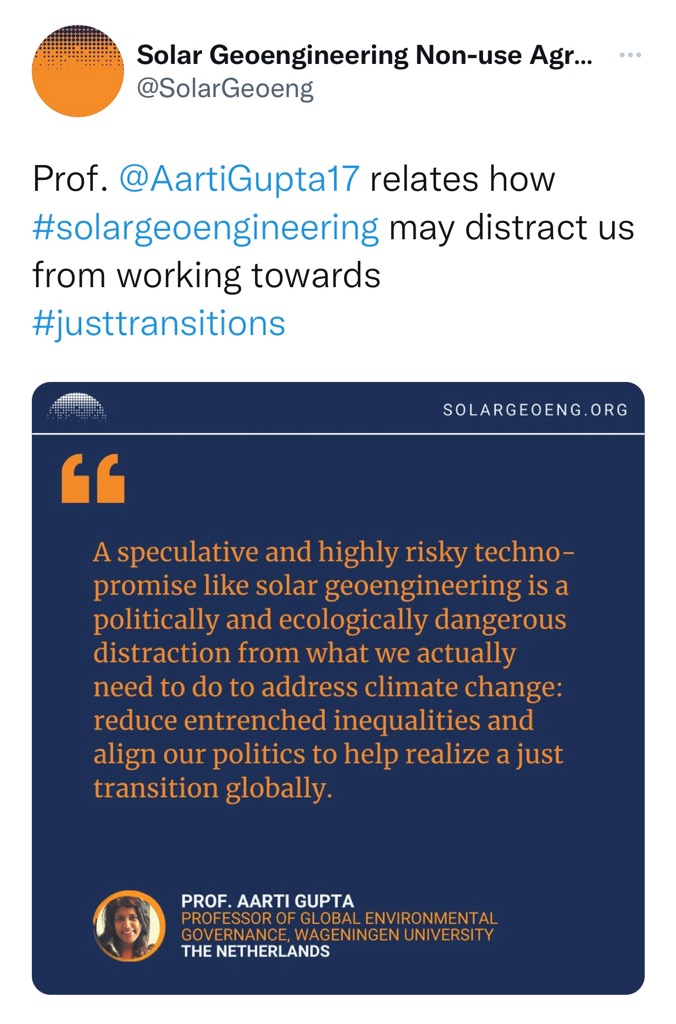
“Solar geoengineering is not necessary. Neither is it desirable, ethical, or politically governable. The normalisation of solar geoengineering as a research topic and as a speculative policy option must be stopped”, said Frank Biermann, professor of global sustainability governance, Copernicus Institute of Sustainable Development, Utrecht University.
In January, a coalition of over 370 academics, 30 organisations in 54 countries, signed a letter in calling for an international non-use agreement on SG. They argue that this technology poses an unacceptable risk if deployed as a future climate policy option. Signatories include professor Frank Biemann, Utrecht University, professor Melissa Leach, CBE, FBA, Institute of Development Studies, amongst many others.
To some, the proposal of spraying the stratosphere with aerosols to block incoming sunlight in order to cool the planet is allegedly a frightening and dangerous idea. Besides, this technology, which has not yet proven to be successful, could discourage the urgent need to reduce green house gas emissions and put a pause to climate action.
Various concerning negative impacts from SG have been discussed within the scientific community, including the disruption of the climate system, affecting rain fall patterns and increasing droughts. Agriculture would be hit hard and the world would experience extreme famine.
Sulfates injected into the atmosphere eventually come down as acid rain, which affects soil, water reservoirs, and local ecosystems. The spraying of this chemical into the atmosphere forms very fine particles that can cause respiratory illness.
This technology is not entirely understood and not proven to be successful, as research is entirely based on modeling and not on external experiments.
Once SG is deployed, we may be locked into it forever, without a reverse gear. It’s called “termination shock”. Furthermore, once SG is stopped, the natural cycle will take over once again and we will see a rapid rise in temperatures, therefore we would see a disruption of every major system on earth, without time for adaptation and resulting in the destruction of ecosystems.
Who gets to decide on the climate?
Perhaps another frightening aspect of SG relates to geopolitical risks and issues around governance. A single or combination of powerful nations may “lead the pack” and decide to deploy this technology, which will impact and cause immediate and direct harm to other regions.
This technology may be used as a war tool and a form of weaponisation, causing inequality, ramping up disputes and conflicts across the globe. We already live in a political system that has no ability to make collective, serious and fair agreements.
The White House Office of Science and Technology Policy announced that they are coordinating a five-year research plan to SG technology. Their focus is to develop a cross-agency group to coordinate research on such climate interventions, in partnership with NASA, the National Oceanic and Atmospheric Administration (NOAA), and the Department of Energy.
“ You cannot judge what the country does on solar-radiation modification without looking at what it is doing in emission reductions, because the priority is emission reductions”, mentioned Janos Pasztor, executive director of the Carnegie Climate Governance Initiative.
“Solar-radiation modification will never be a solution to the climate crisis”, Pasztor added.
Political control over SG would affect and impact the poorest and most vulnerable countries. The poorer nations are extremely vulnerable to any changes in their environment and would be threatened the most by side effects that might result from the deployment of SG at a global scale.
We are working against the clock and can’t afford to make even bigger mistakes than we already have. We know what to do about climate change, and yet, the biggest polluters and fossil fuel giants refuse to accept the blame and make the necessary changes in order to reverse the effects of climate change.
For every crisis the world faces, window of opportunities unlock for the ones who have their eyes focused on power, control and profit. The hungry “visionaries”, a group comprising of politicians, capitalists, corporate power, billionaires and scientists, are trying to push for the deployment of an untested technology that my drive us into a steep dive towards a catastrophic and irreversible chaos.















 YourVoiz