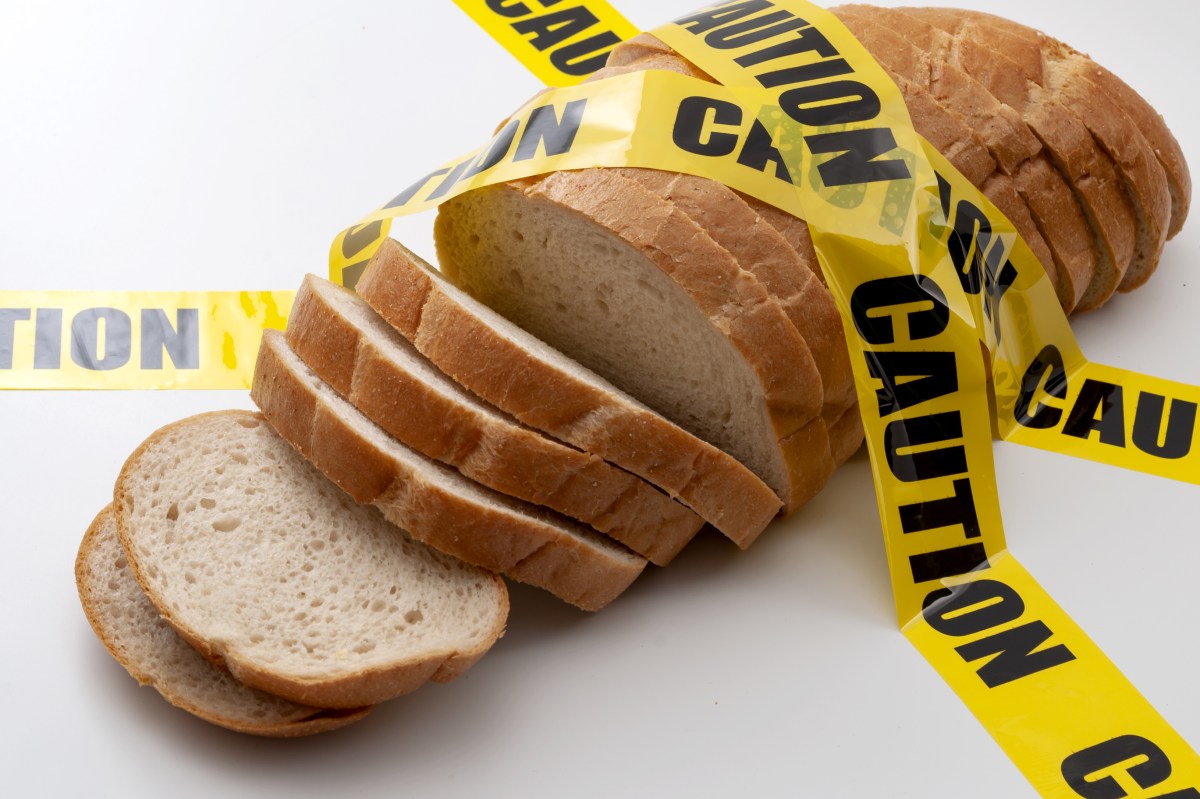
Public Health Warning in the UK: 50% of Bread Containing Potentially Hazardous Pesticide Cocktails

“We are choosing to play Russian roulette with people’s health”

Monica Piccinini

2 Nov 2022

Official figures reveal that the proportion of bread in the UK containing two or more pesticides has doubled to more than 50% in the past year.

The UK government tests are carried out by an expert committee on pesticide residues in food (Prif) and a total of 11 different pesticides, including five with links to cancer (glyphosate, fosetyl, cypermethrin, deltamethrin and flonicamid), were found in a range of bread products – from standard white, brown, to crumpets, scones and muffins.

Bread products containing traces of one or multiple pesticides were found in supermarket own-brands including Aldi, Asda, Co-op, Iceland, Lidl, Marks & Spencer, Morrisons, Ocado, Sainsbury’s, Tesco and Waitrose. They were also found in some top brands: Hovis, Kingsmill, Jacksons, La Boulangerie, New York Bakery, Warburtons, and many more.

Nick Mole, Pesticide Action Network UK (PAN UK) policy officer, said:

“With the cost of living crisis forcing people to spend less on food, it’s vital that consumers can trust that relatively cheap products like bread won’t expose them to dangerous mixtures of chemicals.

The government claims that it’s committed to tackling pesticides, so why have pesticide cocktails been allowed to double in a staple food that most of us eat at least once every day?”

Pesticides used in agriculture can leave traces of chemicals in our food known as residues. Pesticide residues detected on a specific food item will depend on which pesticides are used and how persistent they are. Some food may contain one single residue or multiple ones (‘cocktail effect’).

“There is a growing body of evidence showing that pesticides can become more harmful when they’re combined with each other. And yet we continue to set safety limits for just one chemical at a time.

We actually have no idea of the long-term impacts of consuming tiny amounts of hundreds of different chemicals. We are choosing to play Russian roulette with people’s health”, mentioned Mole.

We should be aware of the implications caused by ingesting food containing not only one but also multiple pesticides, especially if consumed over a long period of time, during our childhood, adult life and especially during pregnancy.

Some pesticides, known as endocrine disrupting chemicals (EDCs), have the potential to disrupt our hormone systems, and can play a role in the development of cancers, including colorectal and breast cancers. Pregnant and breastfeeding women, as well as young children, are particularly vulnerable.
Photo 211558990 © Bruno D Andrea | Dreamstime.com

The most recent data published by the UK government, which relates to testing conducted in 2021, reveals that pesticide cocktails are also a significant problem for fruit and vegetables, with 30% of vegetables and more than 60% of fruit found to contain residues of more than one chemical.

Based on government data, PAN UK launched its annual “Dirty Dozen”, a list of fruit and vegetables most likely to be contaminated with multiple pesticides:
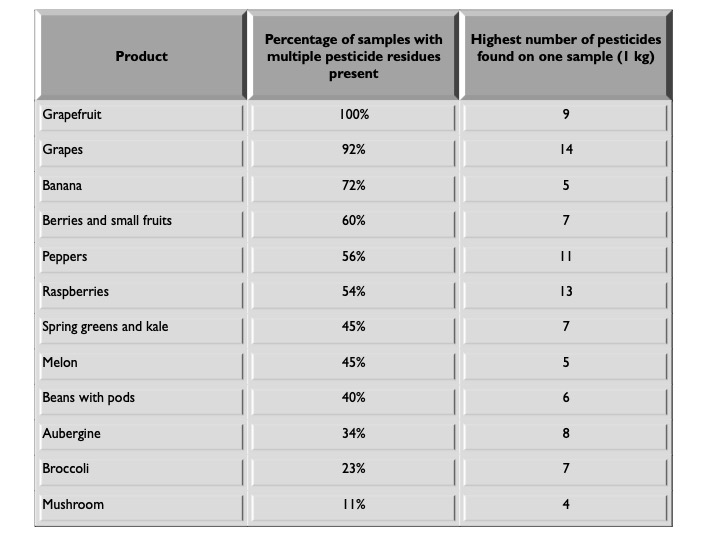

PAN UK analysis of the most recent results from the government’s testing programme found a total of 137 different pesticide residues across all produce, including many linked to serious chronic health effects. Specifically, the produce tested contained:

46 carcinogens, which are capable of causing different types of cancer.

27 endocrine disruptors (EDCs), which can interfere with hormone systems and cause birth defects, developmental and reproductive disorders (infertility).

11 ‘developmental or reproductive toxins’, which can have adverse effects on sexual function and fertility, causing miscarriages.

14 cholinesterase inhibitors that reduce the ability of nerve cells to pass information to each other and can impair the respiratory system and cause confusion, headaches and weakness.

Over a third of the total pesticides found are not approved in the UK, meaning that the British farmers aren’t permitted to use them.

“These pesticides residues should not be making onto the plate of UK consumers.

They are either slipping past our shoddy border checks unnoticed, or foreign producers are being handed a competitive advantage by being allowed to use pesticides banned in the UK.

At a time when we are asking our own farmers to produce more sustainably, we should not be making it harder for them to earn a living”, said Mole.

The most effective way to tackle pesticide cocktail in our food is to ensure that the new trade agreements don’t lead to an influx of pesticide-laden imports and to reduce dramatically the chemical use in domestic farming.

Weakening of pesticide standards via trade deals with countries where pesticide regulation is less rigorous, means the population in the UK may be consuming products with higher level of pesticides that are already banned in the country.

“To protect the health of their customers, some UK supermarkets are beginning to sit up and take notice of pesticide cocktails. Meanwhile, the government’s key strategy on pesticide reduction is already five years late.

Our new environment secretary, Dr. Thérèse Coffey, must take urgent action to reduce pesticide-related harms. How much longer should consumers and farmers have to wait?” added Mole.

This is a significant ongoing issue that requires immediate attention and action from the government, regulators, corporations, supermarkets and also the British population, who may be paying a hefty price for these senseless actions, with their own health!

UK Supermarkets Urged to Remove Killer Pesticides from their Soya Supply Chains Linked to Mass Poisonings in the Amazon

Monica Piccinini

28 Apr 2022

Demand from British food consumers are unknowingly fuelling the poisoning of people and wildlife in the Amazon in a “hidden scandal”, according to the Soil Association.

Chicken sold in a number of UK supermarkets is reared on soya feed grown in toxic pesticide heavy lands within Brazil’s Amazon region, highlights the Soil Association‘s new ‘Stop Poison Poultry’ campaign.

Launching a petition calling for action, Soil Association Campaigns Advisor, Cathy Cliff, said: “British shoppers should be able to walk into a supermarket and buy food that isn’t harming children, killing bees, or threatening rare and treasured wildlife thousands of miles away”.

According to a Soil Association survey carried out in January 2022, none of the 10 leading UK supermarkets are monitoring or restricting the use of highly hazardous pesticides in their soya supply chains. Soya linked to pesticide poisonings in Brazil is exported to the UK to feed livestock, primarily chickens.

“Our research has found that the 10 leading UK supermarkets are all ensnared in a broken system that is damaging communities, animals and ecosystems. British retailers are already taking good steps to address deforestation in their soya supply chains, and now we need them to address these hazardous pesticides”, said Cathy.

“The scale of highly hazardous pesticide use in Brazil is terrifying, as is our chicken’s industry reliance on these soya crops. It is a hidden scandal that both British shoppers and farmers are largely blind to, and it must no continue – we must stop the poisoning associated with UK poultry farming”, added Cathy.

Brazil is the world’s third largest user of pesticides, only behind China and the US.

President Jair Bolsonaro’s administration has recently incorporated a presidential decree amending the 1989 pesticides law, by making the approval process of pesticides even more flexible, including the approval of chemicals that have already been banned in other countries.

Most of the pesticides used on Brazilian soya are banned for use in the UK, but some are being produced and sold abroad by companies operating out of Britain and Europe.

One example is highly hazardous pesticide paraquat, which is manufactured by Chinese ChemChina owned Syngenta in Huddersfield, banned for use in the UK and associated with poisonings abroad.

Recently, the Landworkers’ Alliance (LWA), representing smaller and ecological farmers, has demanded the UK government stops the export of paraquat and other pesticides that are banned for use in the UK, but still made here.

Brazil, Soya and Pesticides

The Amazon region has been suffering from deforestation due to many official policies, with large natural areas replaced by monoculture with an indiscriminate spread of pesticides. Soy cultivation is a major driver of deforestation in the Amazon basin, with 80% destined for animal feed.

Soya beans are Brazil’s largest export to the UK, worth approximately 220 million USD in 2020 and these crops account for 60% of the country’s pesticide use. Brazil’s pesticide use has risen to a staggering 900% since 1990.

These chemicals are contaminating surface and groundwater, the soil, killing bees, bugs, and the animals that eat those insects, are being found with a cocktail of chemicals in their bodies. Between 2013 and 2017, more than 1 billion bees were lost due to pesticide poisoning in Brazil, including honeybees and wild bees.

According to ABRASCO, the Brazilian Association of Public Health, 70,000 people, including children, who are usually the most severely affected, suffer from acute and chronic pesticide poisonings in Brazil every year.

There are 150 pesticide products approved by the Brazilian government for use on soya.  Of the 22 most commonly used in Brazilian soya production, 80% are classified as ‘highly hazardous’, and of these 66% are not approved for use in the EU or UK, including:

  • Paraquat, a herbicide which is ‘fatal if inhaled’, associated with farmer suicides, and exported by Syngenta, a company operating out of Britain;
  • Acefate, an organophosphate (OP) insecticide used on food crops, as well as a seed treatment. It’s known to be ‘highly toxic to bees’;
  • Chlorpyrifos (CPF), a broad-spectrum chlorinated organophosphate (OP), known to be ‘highly toxic to bees’ and ‘probably carcinogenic to humans’;
  • Diuron, a herbicide ‘likely to be carcinogenic to humans at high doses’;
  • Imadacloprid, an insecticide known to be ‘highly toxic to bees’.

The Brazilian Association of Collective Health estimates that pesticides contaminate approximately 70% of food consumed by Brazilians, and they drink nearly 7.5 L of pesticides per year – the highest per capita consumption rate in the world.

According to a recent study published by MDPI, Multidisciplinary Digital Publishing Institute, there are numerous toxic effects of pesticides, particularly inflicting rural workers, inducing from hematological abnormalities, DNA damage, cell death, skin and eye irritations, pain, infertility, altered hormone levels, fatigue, tremours, hearing loss, neurological symptoms, miscarriage, fetal malformation, effects on cardiac, muscular and development of related metabolic diseases, overweight, underweight, insulin resistance, diabetes and various types of cancer.

Source: MDPI – Impacts of Pesticides on Human Health in the Last Six Years in Brazil (March 2022)

The Soil Association is calling for UK supermarkets to ‘clean’ UK supply chains, has lined up some proposals/solutions to be taken by the government in order to address this issue. They are also asking for the British public to get involved and sign the petition.

We are living challenging times and it’s often easy to forget how much we are all connected and how much we influence each other’s lives and the world.  

Our actions as consumers have a strong direct impact not only on our health, but also on the health of people living some 5,529 miles away in Brazil, as well as on wildlife and the environment. It’s up to us to get involved and make powerful positive changes to all living creatures and our planet!

The Soil Association‘s full report: https://www.soilassociation.org/media/23919/stop-poison-poultry-report-final-220222.pdf