Toxic ‘forever chemicals’ found in UK food

Monica Piccinini

9 April 2024

New research reveals that a significant number of commonly consumed food items in the UK contain persistent PFAS pesticides, raising concerns about their potential impact on human health and the environment.

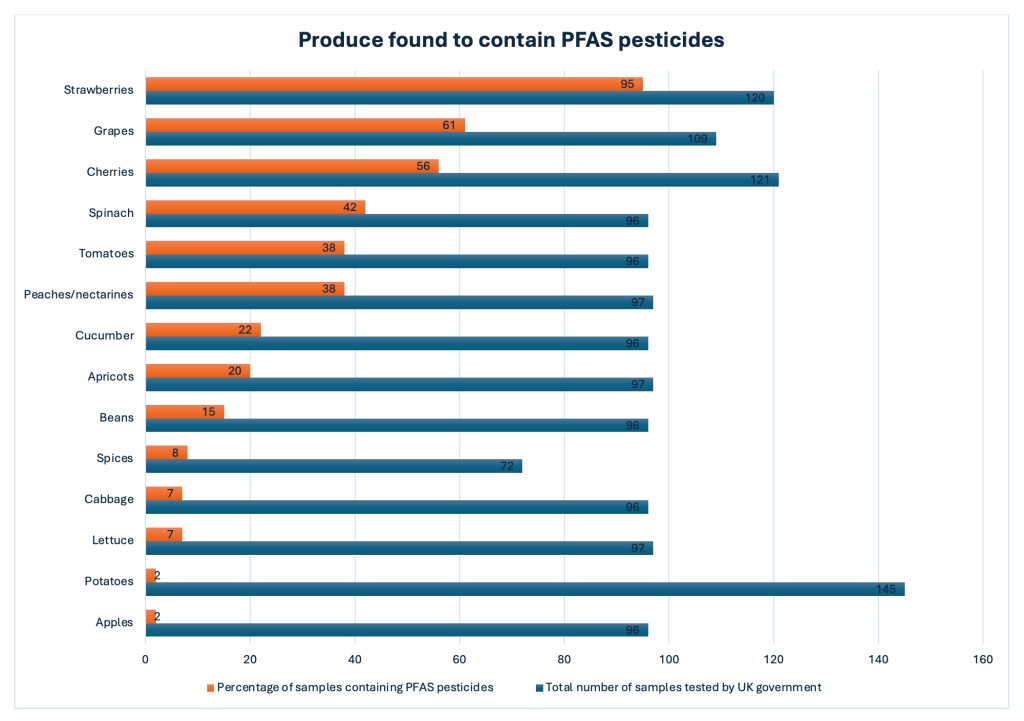
Pesticide Action Network UK (PAN UK) conducted an analysis on the most recent findings from the UK government’s residue testing programme. The results unveiled the presence of 10 distinct PFAS pesticides in various fruits, vegetables, and spices such as grapes, cherries, spinach, and tomatoes. Among these, strawberries emerged as the primary culprits, with PFAS detected in 95% of the 120 samples examined.
Approximately 10,000 chemicals have been classified as ‘forever chemicals’ due to their persistent nature, enabling them to remain in the environment and accumulate in the bloodstream, bones, and tissue of various organisms, including humans. The degradation period for PFAS in the environment is estimated to vary from a decade to well over 1,000 years.

According to CHEM Trust, a recent study found that PFAS have been detected as far as in the Arctic (123 tons) and North Atlantic oceans (110 tons).

Dr. Shubhi Sharma from CHEM Trust explained:

“PFAS are a group of entirely human-made chemicals that didn’t exist on the planet a century ago and have now contaminated every single corner. No one gave their consent to be exposed to these harmful chemicals, we haven’t had the choice to opt out, and now we have to live with this toxic legacy for decades to come. The very least we can do is to stop adding to this toxic burden by banning the use of PFAS as a group.”

Health and Environmental Impact

Despite significant evidence illustrating the widespread presence of ‘forever chemicals’ in the bloodstreams of most individuals, there is a scarcity of research in the UK exploring the associated health issues. This circumstance is often exploited by both the government and the chemicals industry to postpone necessary actions.

Nonetheless, peer-reviewed research carried out in other nations have established links between PFAS exposure and various severe health concerns, such as increased cancer risk and reductions in fertility as well as the immune system’s capacity to combat infections.

Childhood exposure to PFAS is of significant concern due to its association with behavioural changes, developmental effects, and delays in children, including low birth weight and accelerated puberty.

Nick Mole, PAN UK’s policy officer, noted:

“Given the growing body of evidence linking PFAS to serious diseases such as cancer, it’s deeply worrying that UK consumers are being left with no choice, but to ingest these chemicals, some of which may remain in their bodies long into the future.

“With some plastic food packaging also contaminated with PFAS, and PFAS present in UK drinking water and soil, we urgently need to develop a better understanding of the health risks associated with ingesting these ‘forever chemicals’ and do everything we can to exclude them from the food chain.”

Currently, there are 25 PFAS pesticides being used in the UK, six of them falling under the classification of ‘Highly Hazardous‘. Among these is lambda-cyhalothrin, an insecticide considered both a ‘forever chemical’ and extremely toxic to both humans and bees.

The Environment Agency doesn’t conduct regular sampling of rivers for any of the 25 PFAS pesticides presently used in the UK. Consequently, the degree to which these chemicals are leaching off agricultural lands to pollute rivers and other water reservoirs remains uncertain.

In 2022, an astounding 9,200 kg of lambda-cyhalothrin was administered across 1.69 million hectares of UK land, which equals 11 times the size of Greater London. Typically, farmers remain unaware that they are applying ‘forever chemicals’ to their crops as there is no label information provided.

As per PAN UK’s analysis of the latest testing results from the UK Government Expert Committee on Pesticide Residues in Food (PRiF) in 2022, the 10 PFAS pesticides identified in UK food were as follows:
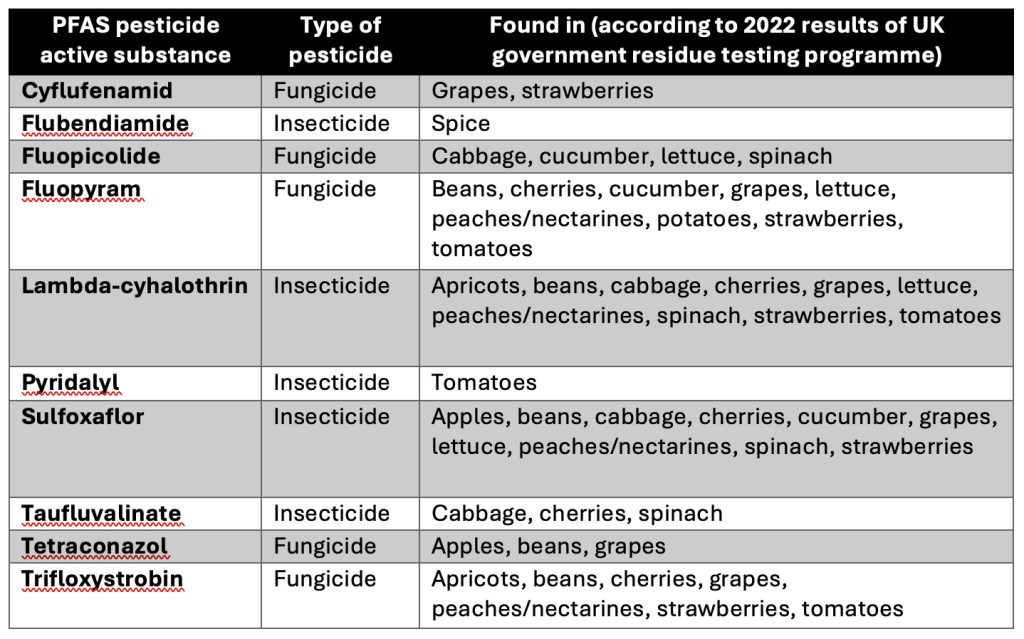
PAN UK’s discoveries align with recent studies indicating that traces of 31 distinct PFAS pesticides were identified in European fruit and vegetables from 2011 to 2021.

Pesticides are the only chemicals that are designed to be toxic and then release intentionally into the environment. Despite this, the UK government’s much-delayed plans for limiting the negative impacts of PFAS focus solely on industrial chemicals, ignoring pesticides entirely.

“PFAS pesticides are absolutely unnecessary for growing food and are an easily avoidable source of PFAS pollution. Getting rid of them would be a massive win for consumers, farmers, and the environment”, added Mole.

The Department for Environment, Food and Rural Affairs (Defra) spokesperson shared the following statement: 

“We set strict limits on the pesticides residue levels in both food for consumers and feed for animals. These limits are set to protect public health and are set below the level considered to be safe for people to eat as well as applying to both food produced in the UK and those imported from other countries.”

PAN UK is urgently calling on the UK government to ban the 25 PFAS pesticides currently in use and to increase support for farmers in shifting away from chemical dependency towards safer and more sustainable alternatives. In line with health and environmental NGOs, the organisation is emphatically advocating for the UK to work towards achieving a PFAS-free economy by 2035.

A Sobering Reality: Cocktail of Hazardous Pesticides in Wine Has Tripled

Monica Piccinini

13 December 2023

Official statistics, examined by Pesticide Action Network UK (PAN UK), reveal that the presence of harmful pesticide mixtures in wine has increased by over threefold since 2016.

Findings from the testing programme conducted by the UK government indicate a significant rise in the percentage of wine with multiple pesticide residues, surging from 14% in 2016 to 50% in 2022.

The analysis of 72 wine samples in PAN UK’s report reveals residues of 19 pesticides, nine of which are linked to cancer. A single wine sample was discovered to contain six different pesticides.

Nick Mole, PAN UK’s policy officer, mentioned:

“This massive rise in ‘pesticide cocktails’ should be of grave concern because we know that chemicals can become more harmful when combined, and yet we continue to set safety limits for just one chemical at a time. Wine lovers shouldn’t have to risk exposure to an array of hazardous pesticides when they fancy a tipple. The organic wine sector is flourishing, proving that it is 100% possible to produce wine without relying on toxic chemicals.”

The excessive use of pesticides in the production of wine not only poses a threat to the health of consumers, but also endangers the wellbeing of individuals living and working in wine-producing regions.

In a study conducted in France in October, it was found that children living near vineyards had a higher likelihood of contracting leukemia. Additionally, a Canadian research revealed that individuals employed in the wine industry were at a higher risk of developing illnesses, attributed to their exposure to elevated levels of pesticides.

A French study published in the Environmental Research journal suggested that agricultural practices and pesticides used in vineyards could have been linked to the occurrence of Parkinson’s disease.

Pesticides in Food

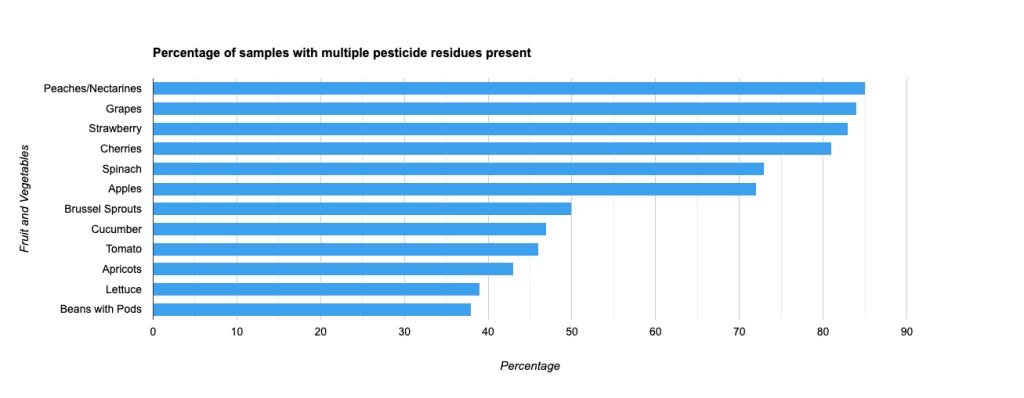
According to PAN UK’s findings, there seems to be a rising trend in the occurrence of pesticide combinations in the food consumed by Britons. The total percentage of fruit and vegetables with residues from multiple pesticides has consistently stayed below 48%, but this year it unexpectedly spiked to an astonishing 53%.

Mole added:

“This year’s results show that, just like our rivers, much of our food is increasingly contaminated with pesticide cocktails. We have no idea what his ongoing exposure to tens – or even hundreds – of different chemicals is doing to our health over the long term.”

In a report by PAN UK and the Soil Association, it is highlighted that despite the prevalence of pesticide cocktails and the evidence pointing to their potentially greater harm compared to individual pesticides, the UK’s regulatory system continues to assess the safety of each chemical independently. Safety evaluations for pesticide residues in our food are conducted based on the analysis of individual chemicals.

Today, PAN UK launched its yearly ‘Dirty Dozen‘ list, identifying the fruit and vegetables with the highest likelihood of being contaminated by multiple pesticides.

Source: data presented based on PAN UK analysis of the UK Government’s Expert Committee on Pesticide Residues in Food (PRiF) four quarterly data spreadsheets for 2022.

PAN UK’s analysis revealed that among 134 different pesticide residues found in all produce, 50% fall under the category of ‘highly hazardous pesticides.’ Furthermore, 45 of these are carcinogens, 25 act as endocrine disruptors, impacting hormone systems and leading to birth defects, developmental disorders, and infertility.

Additionally, 14 are considered developmental or reproductive toxins, affecting sexual function, fertility, and potentially causing miscarriages, while 10 are cholinesterase inhibitors capable of impairing the respiratory system.

“Rates of chronic diseases such as cancer and Parkinson’s are rising”, added Mole. 

“We urgently need to take a precautionary approach and do everything we can to tackle pesticides in our food chain. But the UK government’s key strategy on pesticides is almost six years late now, and their proposal to introduce pesticide reduction targets never happened.

“Our new environment secretary, Steve Barclay, must do better than his recent predecessors and finally make good on the government’s promise to better protect human health and the environment from pesticides.”

The Department for Environment, Food and Rural Affairs (Defra) spokesperson said: 

“In Great Britain, we set strict limits on the pesticides residue levels that are allowed to remain in both food for consumers and feed for animals. These limits are set to protect public health and are set below the level considered to be safe for people to eat. The limits apply to both food produced in the UK and those imported from other countries.”

In 2018, the UK government committed in its 25 Year Environment Plan to decrease pesticide usage and reassess the UK National Action Plan for the Sustainable Use of Pesticides (NAP) by the year’s end. However, the publication of the NAP is still pending.

“In line with Defra’s 25 Year Environment Plan, the forthcoming National Action Plan on the Sustainable Use of Pesticides (NAP) will se out our ambition to support pesticide users to maximize non-chemical control approaches. The NAP will be published in due course,” added a Defra spokesperson.

Pesticides have to be approved by the Chemicals Regulation Directorate (CRD), and authorised by the Health and Safety Executive before they can be sold, distributed, stored or used in the UK.