
Monica Piccinini
1 September 2026
Brazil is betting that the Amazon can be protected by making its forests economically valuable, through timber, forest products and carbon credits. But as more public forest is opened to business, the challenge is to establish whether commercial use can stay within the forest’s ecological limits.
The Amazon has always attracted people looking for something valuable. Since Brazil’s colonial times with the arrival of the Portuguese in 1500, natural resources, including wood, sugar, gold, diamonds, rubber, coffee, minerals, cattle and land have all brought waves of extraction into the forest.
Today, public forests can provide oils, seeds, fruits, timber, environmental services and, under newer rules, carbon credits, while remaining officially protected and standing.
Brazil calls this sustainable forest management. The idea is that if a living forest has economic value, there’s less incentive to destroy it. Forest recovery, however, happens on a much longer timescale than commercial planning. Trees take decades, sometimes centuries, to grow. What matters is what remains after logging and whether commercially valuable trees have recovered before harvesting starts again.
A study published in Forest Ecology and Management tested 27 different logging scenarios in the Brazilian Amazon to see whether commercial timber production could be maintained over repeated harvests.
Under conditions like those used in Brazilian forest concessions today, harvesting around 15-20 cubic metres of timber per hectare and returning after 35 years, timber production could be maintained for the first cycle, but not at the same level after that.
Plinio Sist, senior forest scientist at Forests and Societies Research Unit at CIRAD (the French Agricultural Research Centre for International Development) and lead author of the research, explained:
The problem is not necessarily whether the forest remains standing after logging. Forest biomass and biodiversity can recover relatively well when logging is carefully controlled. The problem is the valuable timber trees. They recover much more slowly.
Under the current harvesting cycle, studies suggest that only around half of the original timber volume may have recovered by the time loggers return. So, a forest can look green and healthy from above while no longer containing enough commercial timber to support the same level of harvesting.
The most sustainable scenario in the study involved harvesting 10 cubic metres per hectare every 60 years. CIRAD’s subsequent explanatory material describes the corresponding cutting cycle as 65 years. It also assumed that 90 per cent of potentially harvestable timber species would have commercial value, compared with around 20 per cent under current practices.
Sist argues that for genuinely sustainable timber production, the industry may have to accept taking considerably less from the forest and waiting much longer before returning. He said:
Our simulations suggest that logging should be limited to around 10 cubic metres per hectare, that a wider range of timber species should be used, and that forests should be given around 60 years before being harvested again.
Under those conditions, timber harvesting could be sustainable over the long term. But there is an important trade-off: genuinely sustainable harvesting would produce much less timber than the market currently demands. We must recognise that the forest has ecological limits. We cannot simply ask it to keep producing the same amount indefinitely.
A forest becomes an investment
Pau-Rosa is part of a much wider expansion of forest concessions across the Amazon. The Pau-Rosa National Forest covers around 828,000 hectares, and lies between the Madeira and Tapajós rivers, a region of immense ecological richness. Around 249,000 hectares are currently proposed for sustainable forest management concession. As of August 2026, the project had not yet been auctioned. Brazil’s development bank, BNDES, scheduled the tender notice for late 2026 and the auction for the first quarter of 2027.
Government project documents say the concessions are intended to protect biodiversity and support sustainable development while allowing the forest to be used commercially. The same forest is expected to be both commercially productive and conserved.
Pau-Rosa is only one of several concession projects across the region. The Castanho Glebe Forest, the Amapá Forest, the Jatuarana (four Forest Management Units, FMUs), Iquiri, Anauá, Bom Futuro (two FMUs), and Balata-Tufari National Forests (three FMUs) are among the other Amazonian forests involved in concession projects, although the projects are at different stages, from studies and tender preparation to auction and contracted concessions.
These projects are coordinated by the Brazilian Forest Service (SFB) linked to Brazil’s Ministry of the Environment and Climate Change, and supported in their structuring by Brazil’s development bank, BNDES.
Each concession has its own boundary and management plan, but across the region, more public forest is being expected to produce timber and other forms of income while remaining standing.
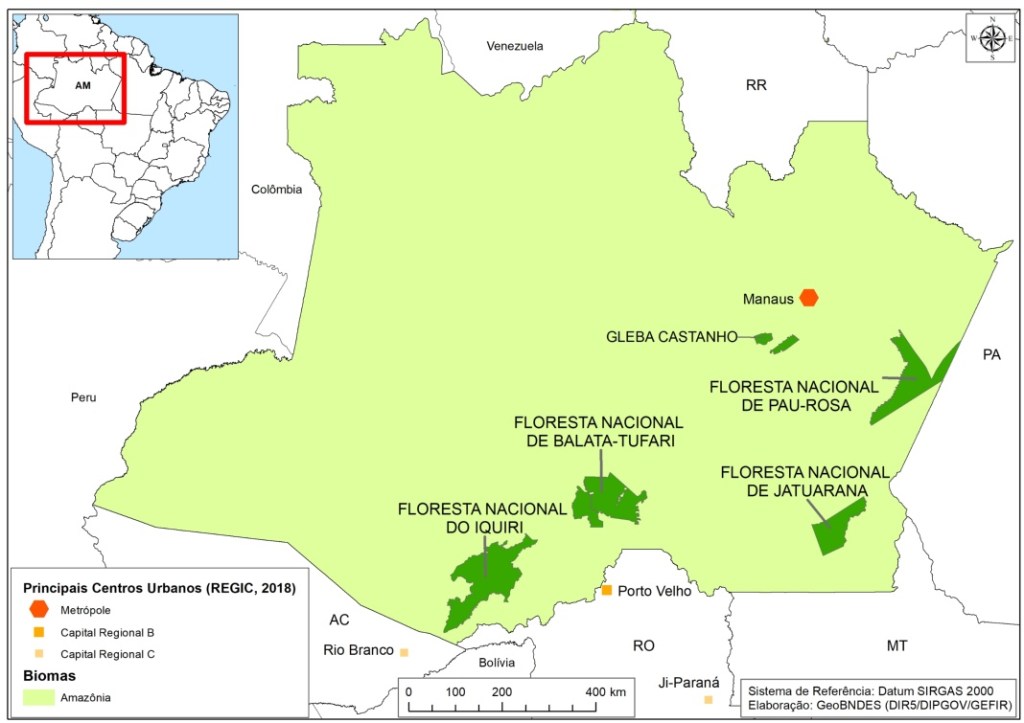
Some of these public forests and concession units lie within or are affected by the wider area influenced by transport infrastructure associated with the BR-319 highway corridor.
Research and environmental assessments have repeatedly identified improved road access in this part of the Amazon as a driver of pressure on remote forests protected areas and Indigenous communities. Existing and planned roads can create pathways for illegal logging and mining, land grabbing, organised crime, and other illicit activities, while also increasing the risk of deforestation and degradation.
Sustainable timber
A management plan means little if the origin of the timber cannot be trusted.
A 2025 study published in One Earth examined timber records and satellite observations covering 2009-2019 in the Brazilian state of Pará and found significant gaps between what was recorded on paper and what could be observed in the forest. Although 96 per cent of the timber volume entering the formal supply chain could be linked to a logging permit by location, only 45 per cent of the logging detected by satellite matched areas with legal authorisation.
The researchers also found cases where the amount of timber reported as coming from an authorised area appeared inconsistent with the amount of logging actually visible there. According to the researchers, these inconsistencies create opportunities for logging permits to be used to launder timber illegally harvested elsewhere.
But the problem hasn’t disappeared, as recent enforcement operations and investigations have continued to find evidence that fraudulent permits, forest credits and other documentation can be used to disguise the true origin of illegally harvested timber.
In 2025, an investigation by the Environmental Investigation Agency (EIA) linked around 53,000 cubic metres of timber associated with sanctioned or irregular operations to supply chains reaching the United States and Europe.
Timber may appear traceable and legal in an official database without the paperwork proving that the wood really came from the forest stated in its records.
Much of the Amazon is remote, and logging beneath the canopy can be difficult to compare with what happens in official records. A management plan can set out how logging should happen but verifying that those rules are followed on the ground is much harder.
A standing tree becomes a commodity
Timber is no longer the only way a forest can generate money. In October 2025, Brazil’s Forest Service introduced rules allowing forest management concessions already in force to add activities aimed at reducing emissions from deforestation and degradation, with a view to generating, certifying and commercialising carbon credits.
On 25 March 2026, Brazil held its first federal auction for a forest concession focused on ecological restoration in the Bom Futuro National Forest in Rondônia. Re.green won the auction for a roughly 51,200-hectare management unit. The concession runs for 40 years and allows revenue to be generated through environmental assets, including carbon credits and products from native species silviculture.
Re.green was the 2025 Earthshot Prize winner. Their customers and partners include Microsoft, Nestlé, Vivo and Danish pharmaceutical company Novo Nordisk. Their investment and support come from asset manager Dynamo, private holding company of the Moreira Salles Group – Brasil Warrant (BW), private equity and investment firm Lanx Capital, private equity firm Principia Capital and Gávea Investimentos.
The voluntary carbon market adds another source of revenue. A standing tree can generate income through the carbon it stores. Its carbon is measured, calculated and turned into a credit that can be traded. For restoration projects, carbon credits can provide money to restore degraded land, but they also turn the forest’s natural ability to store carbon into something that can be bought and sold.
Dr Thales AP West, a tenured assistant professor at the Institute for Environmental Studies (IVM) at the Vrije Universiteit Amsterdam, spoke about the carbon credit market’s safeguards:
If companies buy credits from forest projects, the forest must be there. If it disappears, the credits disappear too. The problem is that even certified and audited calculations may still lack credibility – certification alone doesn’t necessarily guarantee anything.
Most projects last only a few decades; once they expire, their credits could eventually expire too. Yet no one wants to talk about that because it’s inconvenient. The voluntary market has simply chosen to not take the issue of permanence seriously.”
Timber volumes and tonnes of carbon describe only part of a forest’s value. Forests support soils, water, wildlife and relationships between species. For people who have lived in and depended on them for generations, they are also home, food and medicine.
Voluntary carbon markets put a measurable, tradeable value on one function of a wider system, carbon storage and climate mitigation. Critics have a name for this: “green extractivism”, arguing that it can continue to define forests through the economic value they generate, even when the trees remain standing.
Sist argues that putting a price on a standing forest can help protect it, but only if conservation doesn’t become another justification for endless economic growth. He said:
There is always a danger when we put a financial value on nature. At the same time, generating income from a standing forest can give people a strong reason to conserve it.
I think the concept of bioeconomy is not very useful because it means a lot of things and everyone has their own definition and vision of what is bioeconomy. I think that the bioeconomy should be implemented within an economic system that advocates degrowth, rather than as a miracle solution within a capitalist system that cannot exist without growth.
An old relationship with a greener name
For centuries, the Amazon rainforest has been exploited, viewed as a source of rubber, hardwoods, minerals, oil, cattle pasture and land. Today’s forest concessions operate under regulation and monitoring, with management rules intended to limit the damage associated with uncontrolled extraction.
Those rules do not, by themselves, make the model transparent or sustainable. A system that values forests mainly through timber, oils, carbon and other marketable products still risks overlooking ecological and social values that are harder to price.
Whether these concessions are sustainable will depend on what happens in the forest over time: the recovery of harvested trees, the condition of rivers and soils, the survival of wildlife, the influence local and Indigenous communities have over decisions, and how much of the wealth generated remains in the places where it is produced.
Together, they provide a more meaningful picture of the forest’s long-term condition than the value of a concession or the number of carbon credits it produces.
Brazil needs alternatives to illegal logging, land grabbing and forest clearing. Carefully managed concessions could perhaps reduce some of those pressures, but their long-term sustainability still depends on whether ecological recovery and effective oversight can be maintained across repeated harvest cycles.
Sist warned that concessions should not be treated as the single answer. He said:
Brazil’s forest concession system is among the best in the tropical world, but the harvesting rules will have to change if it is to be sustainable over the long term. And concessions alone cannot provide all the timber the market demands.
Brazil needs a much broader approach: stopping illegal logging, allowing forest communities and small farmers to manage forests sustainably, and restoring the millions of hectares of degraded forest and land. We need to diversify not only where timber comes from, but also who is able to produce it.
The real test begins after the contract is signed and logging starts. The effects cannot be judged only over the next financial year or even the life of a 40-year concession. They will become clearer over much longer timescales, in whether large timber trees continue to regenerate, rivers and forest ecosystems remain healthy, and the people who depend on the forest gain a meaningful role in decisions about its future.
Right of reply: The Brazilian Forest Service (SFB) was approached for interviews to discuss some of the questions raised in this article. At the time of publication, no response to the questions submitted to them had been received.
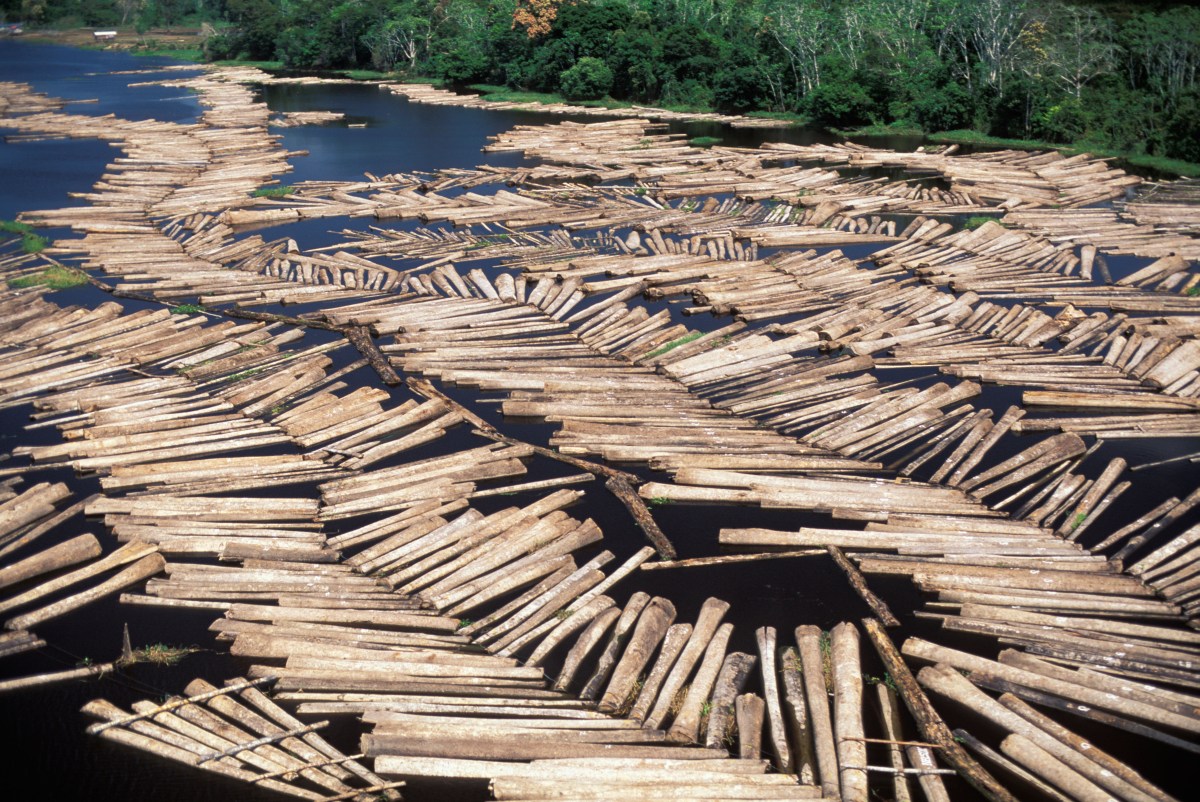
Featured image: Moving tree trunks from forest to sawmill downstream using the current of the river, logging, Amazon rainforest, Brazil. Credit: Ricardo Beliel / BrazilPhotos / Alamy


