
Monica Piccinini
18 September 2026
The world has discovered a new way to make money from a living Amazon. But unless power moves with money, Indigenous peoples and traditional communities could find themselves serving another economy built around their forest, rather than shaping one of their own.
Something rather strange has happened to the way we talk about the people of the Amazon.
Knowledge once seen as primitive, backward, even an obstacle to progress even, is now being considered a bioeconomy asset and part of the solution to the climate and biodiversity crises. They’re now being told that their knowledge may hold the key to the future.
Indigenous and traditional communities know what grows where, when fruit is safe, ripe and ready to be consumed, how a plant can be used and what happens when a river is disturbed upstream. Much of that knowledge has travelled through families and communities for many generations.
Now it has another name: innovation. And there’s plenty of money in it.
The Amazon bioeconomy is attracting many governments, banks, companies, environmental organisations, philanthropies and investors with a compelling proposition: economic development doesn’t have to come at the expense of the forest.
We really want that to be true. The Amazon desperately needs a future that doesn’t depend on its destruction.
Value
It gets quite interesting and less comfortable when you follow an Amazonian product from the forest to the consumer.
A community might possess generations of knowledge about a particular plant: where it grows, how it’s harvested without damaging future production and how it can be used. But once the plant enters a commercial chain, the balance changes completely.
Processing may happen elsewhere, along with research, product development, patenting, branding and distribution.
An ingredient bought for relatively little at its source can eventually sit inside an expensive cosmetic, food or pharmaceutical product sold in São Paulo, London, Paris, Berlin or New York.
Somewhere along that journey, value increases enormously. Those who provided the raw material and the knowledge that made the product possible may remain at the bottom of the chain.
This is why simply asking whether communities are making money from the bioeconomy tells us very little. They can earn much more and still have very little control over the business built around them.
A community may receive income from a project and still lose some autonomy over its territory, become dependent on a single buyer, or even alter its traditional practices to meet the demands of an external market.
And knowledge isn’t just another raw material.
How do you assign ownership to something developed collectively and passed between generations? What happens when knowledge and territory enter systems built around registration, intellectual property and commercial ownership?
The recognition of traditional knowledge should be celebrated, but it shouldn’t become an opportunity to appropriate it.
Invited in
There are plenty of photographs of Indigenous peoples at climate conferences these days. They appear in corporate sustainability reports, at international events and in presentations about forest conservation. They have also become politicians.
Visibility has improved significantly. But power is something completely different.
Many of the important decisions surrounding a project can be made years before a community is formally consulted.
Often, these communities appear in these projects as partners, beneficiaries, or guardians of the forest, while strategic decisions regarding funding, programme design, success criteria and resource distribution are made elsewhere.
Free, prior and informed consultation is meant to prevent precisely this. “Prior” cannot mean after the important decisions have already been made. “Informed” cannot mean handing communities documents they have had neither the time nor independent advice to properly assess.
There’s a huge imbalance when institutions spend years developing a project and communities are expected to reach decisions within weeks, or even days.
They need their own independent lawyers and advisers when necessary, and time to talk among themselves, including with elders and organisations they trust. They also need to know who stands to make money from a project, not simply what they themselves have been promised.
Above all, they need to be able to say no. Consent shouldn’t be a blank cheque signed at the start of a project.
Conditions may change; impacts may differ from those anticipated and new investors may come on board. The use of data or natural resources may also expand.
There should be formal review points throughout the project’s lifecycle, with clear mechanisms for renegotiation, complaints and reparation.
Money arrives with conditions
There’s no question that the Amazon needs investment. Anyone romanticising poverty in the name of forest protection is doing the people who live there no favours. Small businesses and cooperatives struggle to obtain support.
Blended finance has emerged partly in response to these problems. Public and philanthropic money can take on some of the risk that private investors are unwilling to carry, making projects more attractive to commercial capital.
But if public money makes the risk acceptable, while much of the return is private, we should know how the benefits are being divided. More importantly, we should look at what sort of projects the system favours.
Investors like things that can be measured, reproduced and scaled with a quick return. The forest is rather less tidy.
A community may have an exceptional way of managing a particular ecosystem, developed around local conditions and culture, but it may never become a model capable of expansion across thousands of hectares. A larger, standardised project with familiar metrics may be far easier to finance.
Slowly, the question can change. Instead of asking what kind of finance works for the Amazon, we start asking what kind of Amazon works for finance.
What money cannot see
Markets are particularly bad at seeing things that do not produce revenue.
There’s no obvious commercial value or return on allowing an endangered species to continue existing, cleaning mercury from a river, protecting a remote watershed or preserving an ecological relationship that scientists barely understand. These things may be essential without producing anything that can be sold.
Nature doesn’t operate on an investment fund’s calendar. A damaged ecosystem might need decades to recover.
Carbon offered an answer to part of this problem by creating something measurable that could be traded.
Money has flowed into forest projects as a result, including money that might otherwise never have reached conservation.
But voluntary carbon markets have also exposed the awkwardness of trying to fit a living forest into an accounting system.
For many forestry projects, credits depend on a projection of what would supposedly have happened to that forest had the project not existed. The higher the projected deforestation in this hypothetical scenario, the greater the potential volume of credits generated.
This creates a serious conflict of incentives. If you exaggerate the future risk of deforestation, you can potentially generate more credits. And those credits have financial value.
Furthermore, there are other issues, such as “leakage”: you protect a specific area, but the deforestation simply shifts elsewhere.
There is also the question of permanence. A forest that generated carbon credits today could burn down, become degraded, or be cleared a few years from now. Yet, those credits might have already been sold and used by a company to offset its emissions.
This highlights just how difficult it is to turn something as complex and dynamic as a forest into a perfectly measurable financial unit.
Perhaps the most concerning issue is this: a company can buy a credit and claim to have offset its emissions without necessarily reducing pollution at the source.
This can create a sort of moral licence to keep emitting: I keep burning fossil fuels here while paying someone to preserve a forest on the other side of the world. But one does not necessarily cancel out the other.
That’s why it’s dangerous to believe that the market alone will solve the climate crisis.
There’s a world of difference between paying people to protect a forest and paying people to protect a forest so that somebody else can claim to have cancelled pollution.
Green credentials
The new economy has created some very unusual alliances.
Companies involved in oil and gas, mining and agribusiness now appear alongside governments and environmental organisations in conservation initiatives. Some are financing restoration and biodiversity programmes.
That money can achieve something useful. Rejecting a restored forest because of the identity of the funder would make little sense.
What makes less sense is looking at the restoration without looking at the company.
If a corporation spends millions on conservation, how does that compare with what it spends expanding the activities responsible for its environmental footprint? What are its emissions?
What damage is associated with its operations? What remains unresolved? What’s the ratio between what it allocates to conservation and what it continues to allocate to the activities responsible for the problem?
These are not arguments against corporate environmental finance. They are basic questions of proportion.
Sustainability has become valuable to companies too. It affects their reputation, investor relationships and the social licence to operate. A corporation can now be associated with an environmental problem and finance part of the proposed solution at the same time.
Is conservation financing transforming these companies’ business models, or is it helping them continue operating without a proportional transformation of their business models?
Old memories
There is reason to be sceptical of large economic promises in this part of Brazil.
The Amazon has been repeatedly reorganised around things outsiders decided were valuable. Rubber had its moment, so did timber, gold, minerals and land. Wealth was made, often very far from the communities left living with the consequences.
Today, the valuable things have different names: carbon, biodiversity, genetic information and traditional knowledge.
Can this value be generated while the forest remains standing? If so, value can still leave the Amazon even when the trees don’t.
A genetic resource can become intellectual property elsewhere. A forest can generate a financial asset traded far from the territory. Traditional knowledge can help create a lucrative product while the people who developed that knowledge remain suppliers rather than owners.
We should be careful not to mistake a change in what is extracted for a change in who holds power.
More than beneficiaries
Public investment can support things that matter, even when they will never generate an attractive commercial return.
Most importantly, Indigenous peoples and traditional communities can be treated as political and economic actors with authority over their territories, not as beneficiaries attached to somebody else’s project.
For generations, these communities have protected much of what the rest of the world has suddenly discovered is valuable. They did so long before carbon had a price and biodiversity appeared in investment presentations, often while facing violence, land invasions and policies intended to push them aside.
Now everybody wants something from them and from the living forest.
Before we celebrate the amount of money flowing into the Amazon, we must ask:
What kind of Amazon do we want to leave behind once all this money has passed through it?
Because investments come and go. Governments come and go. Companies come and go. Politicians come and go. But the forest must remain.
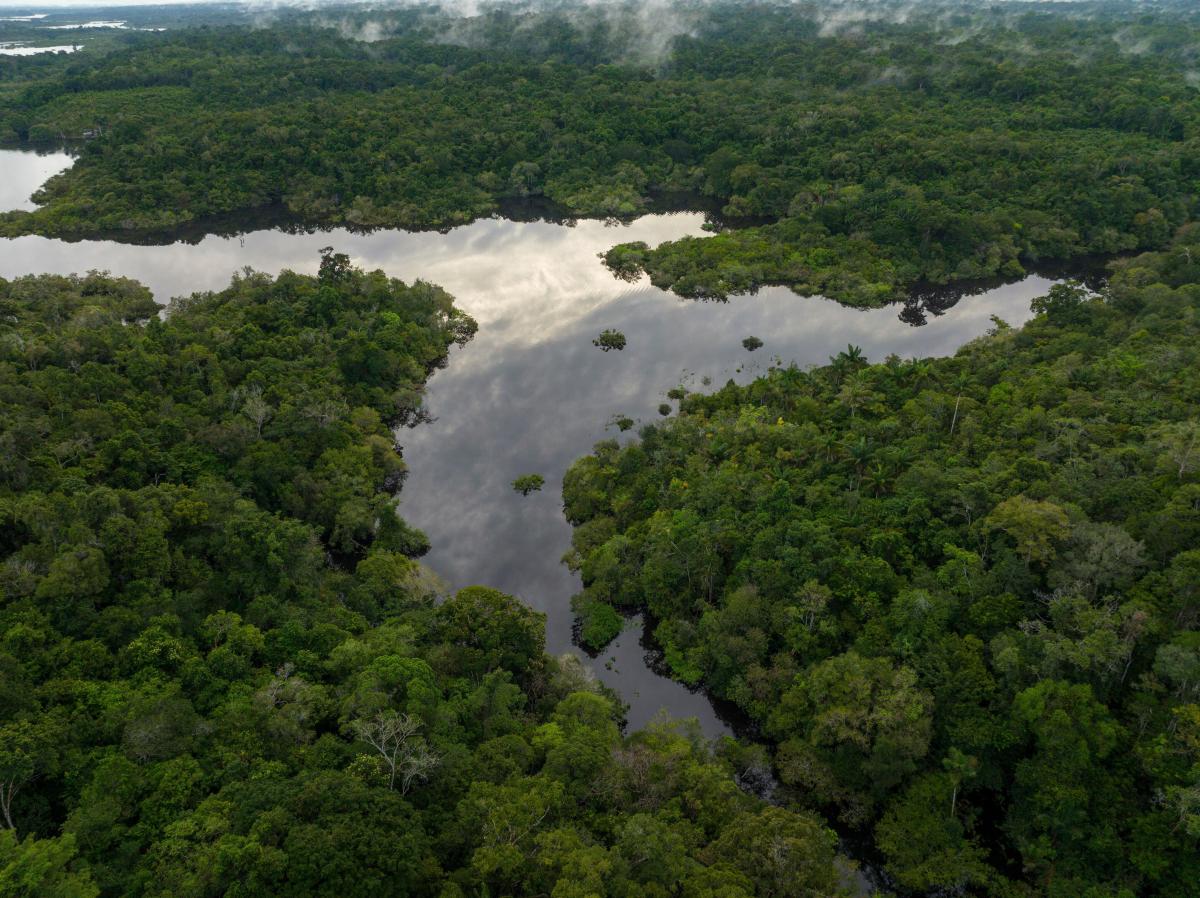
Featured image: Amazon rainforest, Amazon River, Brazil. Credit: Dennis Schmelz / Alamy

 YourVoiz