
Monica Piccinini
18 November 2026
Five centuries after Portuguese colonisation, Brazil’s economy remains closely tied to the extraction and export of natural resources. Efforts to tackle inequality and protect the environment continue to face resistance from powerful interests rooted in the country’s past.
Brazil is now one of the world’s major exporters of agricultural products, minerals and oil. It has developed industries, built large cities and become a very different country from the one ruled by Portugal. But control over land and natural resources still plays an important part in determining who has wealth and political influence.
When the Portuguese arrived in 1500, millions of Indigenous people were already living in what is now Brazil. The colonisers began changing the land into a source of wealth for European markets, starting with Brazilwood (Pau-Brasil) and followed by sugar plantations, gold, coffee and rubber.
There was plenty of money to be made, but much of it depended on enslaved labour, the taking of Indigenous territories and the concentration of land in relatively few hands.
Brazil has changed enormously since then. Industries developed, education and public services expanded, and millions of people have gained opportunities that earlier generations never had.
President Luiz Inácio Lula da Silva, recently re-elected, has promised to reduce inequality, strengthen environmental protection and defend Indigenous rights. But he governs a country whose economy still relies heavily on large-scale agriculture, cattle ranching, mining, oil and gas.
These industries bring jobs, investment and export earnings. They also create difficult choices when their expansion comes into conflict with environmental protection and the rights of people living on the land.
The Cerrado and the Amazon offer plenty of examples. Agricultural expansion, infrastructure and mining projects and the search for new oil reserves have raised questions about who controls Brazil’s natural wealth and who lives with the consequences.
These are not entirely new questions, as Brazil has been dealing with versions of them for centuries.
Land
Sugar made fortunes in northeastern Brazil during the sixteenth and seventeenth centuries. Large plantations depended on enslaved Africans, while forests were cleared and Indigenous communities lost their territories.
Towards the end of the seventeenth century, the discovery of gold in the state of Minas Gerais brought another opportunity to make money.
Portugal collected taxes, merchants prospered, and settlers and enslaved workers moved into the mining areas.
By the time Brazil declared independence in 1822, large landowners already held considerable economic and political power. Independence changed who governed the country, but it did rather less to change who owned the land.
Slavery continued for another 66 years. The Land of Law of 1850 made purchasing public land the main legal way to acquire it, although certain existing land claims could still be recognised.
For anyone without money or established property rights, acquiring land remained extremely difficult.
When slavery was abolished in 1888, formerly enslaved people received no general programme for land redistribution. They had gained their freedom, but very little support to build and independent livelihood.
Meanwhile, Brazil was encouraging immigration.
As Michael Reid explains in Brazil: The Troubled Rise of a Global Power, millions of immigrants arrived in Brazil between the late nineteenth and early twentieth centuries.
Many Europeans settled in São Paulo, where coffee production was expanding, while others established family farms or moved into towns and cities.
Immigrants from Japan and the Middle East also became part of Brazil’s changing society. But European immigration was encouraged for reasons that went beyond the need for workers.
Some members of Brazil’s ruling elite believed that bringing more Europeans into the country would make the population whiter. They regarded this as progress, drawing on racist theories presented as scientific knowledge at the time.
It’s an uncomfortable part of Brazil’s history, but an important one. The country was moving away from slavery while continuing to shape policies around ideas of racial superiority.
Brazil eventually became an industrial and increasingly urban country, and millions of people gained opportunities that had been denied to their ancestors. But the large estates remained, and owning land continued to bring wealth and political influence.
The colonial economy had changed, but some of those who benefited from its arrangements had managed to keep their advantages.
The Cerrado
Some of the consequences of this history can still be seen in the Cerrado, a vast region of savannah, grassland and woodland covering much of central Brazil. It’s one of the richest ecosystems in the world, although it receives far less international attention than the Amazon.
The Cerrado is sometimes described as land available for agricultural development, almost as though it were an empty space waiting to be used. But Indigenous peoples and traditional communities have lived there for generations, alongside an extraordinary variety of plants and animals.
Its deep-rooted vegetation also plays an important role in maintaining the soil and water systems that support several of Brazil’s major river basins.
More than half of its original vegetation has already disappeared, according to research published in Nature Ecology and Evolution, and the clearing continues.
Figures published by MapBiomas show that the Cerrado lost approximately 540,000 hectares of native vegetation in 2025. Although this was less in 2024, the region still accounted for about 55 per cent of all land deforested in Brazil that year.
Much of the pressure is concentrated in Matitoba, an agricultural region covering Tocantins, and parts of Maranhão, Piauí and Bahia.
Soya plantations and cattle ranches have expanded across large areas, along with environmental damage and disputes over land.
According to MapBiomas, Matitoba accounted for 70 per cent of the Cerrado’s deforestation in 2025. These figures should make us question what agricultural development means when it comes at such a cost. And this rapid expansion didn’t happen by accident.
The construction of Brasília in the late 1950s and early 1960s helped open Brazil’s interior to further development. During the military dictatorship, government policies encouraged road building, settlement and large-scale agriculture.
There’s also a connection with what people eat outside Brazil. Brazilian soya is exported to international markets, much of it to feed animals, meaning that a crop grown in the Cerrado can become part of a meat supply chain thousands of miles away.
The environmental consequences are not always visible in the final product.
Research by Trase, which examines the links between commodity trade and deforestation, shows that soya can contribute indirectly to the clearing of native vegetation.
A soya plantation may expand onto land previously used for cattle grazing. Ranching then moves into other areas, sometimes involving further clearance. The soya itself may be growing on land cleared years ago, with no obvious connection to recent deforestation.
But the cattle have gone somewhere else, and that movement can put pressure on native vegetation in other areas. This is why looking only at the land directly cleared for soya can give a misleading picture of its environmental impact.
A product may appear to come from an established agricultural area while the expansion of that area has helped put pressure on native vegetation elsewhere.
Rights
For Indigenous peoples and traditional communities, land isn’t just an economic asset. It’s where they live, grow food, maintain their cultures and pass knowledge from one generation to another. But the struggle to have their territories recognised continues.
One of the most controversial disputes concerns the marco temporal, an attempt to restrict Indigenous land claims by using 5 October 1988, the date Brazil’s Constitution came into force, as a cutoff.
There is an obvious problem with this. What happens to communities that were forced from their land before 1988?
Under such a rule, people could be denied recognition of their ancestral territories precisely because they had previously been expelled from them.
Brazil’s Supreme Federal Court rejected the 1988 cutoff in 2023. Congress nevertheless passed legislation seeking to establish it. In December 2025, the Court once again ruled that the legal provision imposing the cutoff was unconstitutional.
It was an important decision for Indigenous rights, although disputes over the recognition and protection of territories have continued.
These disputes show just how differently people see the same piece of land. For investors, a territory may represent an opportunity for agriculture, mining, oil or gas. For the people who live there, it may be the place where their families have lived for generations.
One group sees economic opportunity, while the other may be fighting to remain on its own land. And the people making the investment decisions are not necessarily the ones who will live with the consequences.
Power
It would be misleading to blame these problems on one president or one political party. Brazil’s economy has changed considerably, but the influence of those who control land and natural resources has developed over generations.
Agribusiness is a powerful political force, with strong representation in Congress.
Large scale agriculture, including cattle ranching, the bioeconomy, mining, energy companies, infrastructure businesses, financial institutions, international buyers and government authorities all have interests in maintaining commodity production.
These interests do not always agree with one another, but they can have huge influence over decisions about land use and environmental protection.
The debate over Brazil’s new environmental licensing law 15.190 in 2025 offered a good example. The legislation, known by critics as the ‘devastation bill’ introduced changes to the procedures used to assess and authorise projects that may affect the environment.
Supporters argued that the changes would reduce bureaucracy, provide greater legal certainty and encourage investment. Environmental organisations warned that some provisions could weaken scrutiny of damaging projects and reduce protections for affected communities.
There is a reasonable argument for making administrative procedures more efficient. Businesses need clear rules, and unnecessary delays can discourage investment. But environmental licensing is not simply a bureaucratic obstacle. It’s one of the ways governments examine what a project might do to the land, wildlife and people around it.
President Lula vetoed parts of the legislation, fully aware that Congress could overturn it. That’s exactly what happened in November 2025, when Congress overturned 52 vetoed items, restoring provisions involving exemptions and simplified licensing. This was a huge setback for Brazil.
A project may be approved more quickly, but that does not necessarily mean its consequences have become less serious.
Independence
Brazil is not the same country it was under Portuguese rule.
Slavery has been abolished, democratic rights have expanded and generations of Brazilians have fought for education, healthcare, land and political representation.
Indigenous organisations, environmental campaigners and rural workers have challenged powerful interests and achieved important victories. And those achievements should not be overlooked.
For centuries, Brazil produced wealth that was concentrated in the hands of a relatively small part of society.
The Portuguese Crown profited from land and labour, while enslaved Africans, Indigenous peoples and poor rural communities paid a huge price.
Today, Brazil controls its own political and economic decisions. But land remains concentrated in a few hands, powerful industries continue to influence national priorities, and communities are still fighting for recognition of their territories.
Political independence did not bring an end to every relationship established under colonial rule.
As long as a country respects the limits of nature and avoids harming the environment, there is nothing wrong with using its natural resources to improve people’s lives.
Brazil needs investment, employment and economic opportunities, particularly for those who have historically been excluded from them. But we should look carefully at what’s being promised and what may be lost along the way.
When a new plantation, mine or oil project is announced, an investment usually receives plenty of attention. These are figures for jobs, production and export earnings. But what about the people already living on the land?
What happens to the soil, rivers, forests and wildlife? Who will actually benefit in the long run, and who will be left to pick up the pieces and deal with the damage? What happens to them?
Brazil won its independence more than 200 years ago, but independence means more than having the freedom to sell the country’s natural wealth.
The Portuguese no longer decide who benefits from Brazil’s land. Brazil does, and the question now is whether the country will continue to allow wealth and power to remain concentrated in a few hands, while those who live on the land are left fighting for a voice in its future.
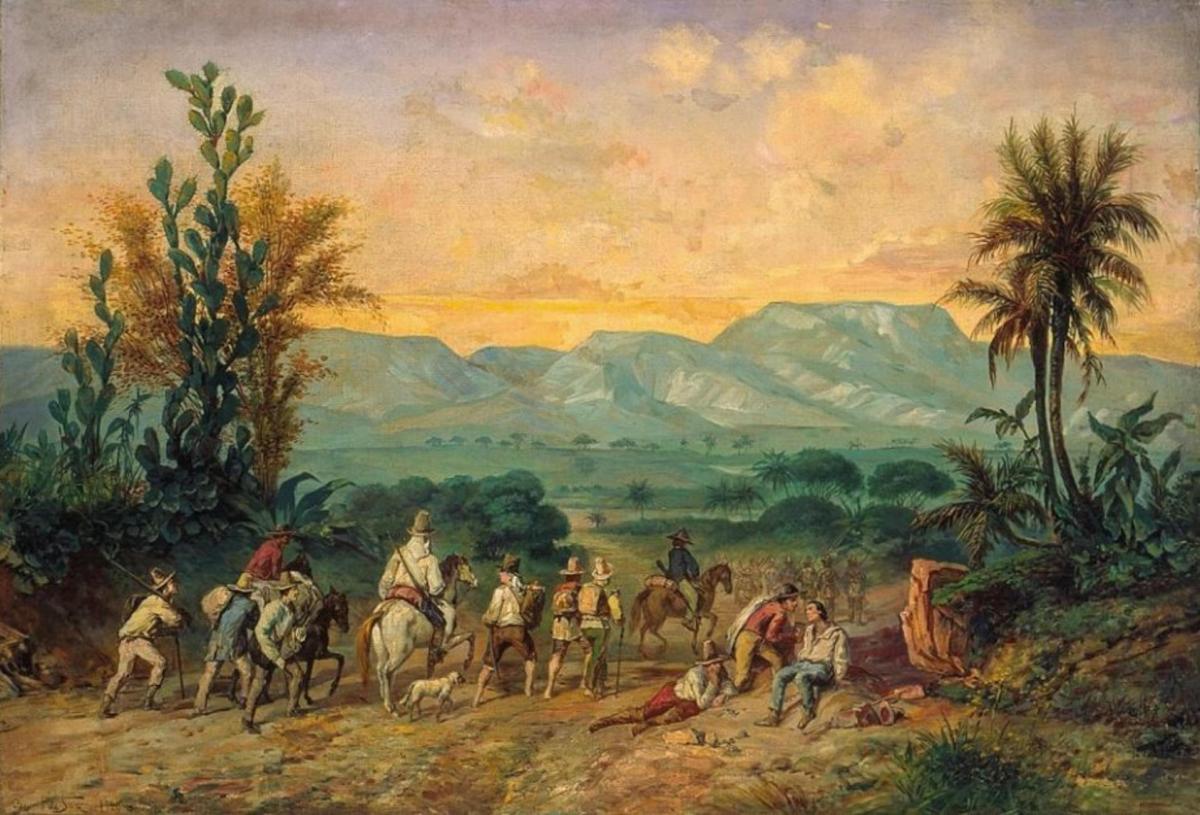
Featured image: This work by Oscar Pereira da Silva depicts the Bandeirantes, the Portuguese colonial explorers, on their journey to the mines in Brazil. It illustrates the historical context of 17th-century exploration and colonisation. Source: The History Collection/Alamy.


